

20/06/2025
Pluralism in peril: an urgent case for a democratic reboot of the EU
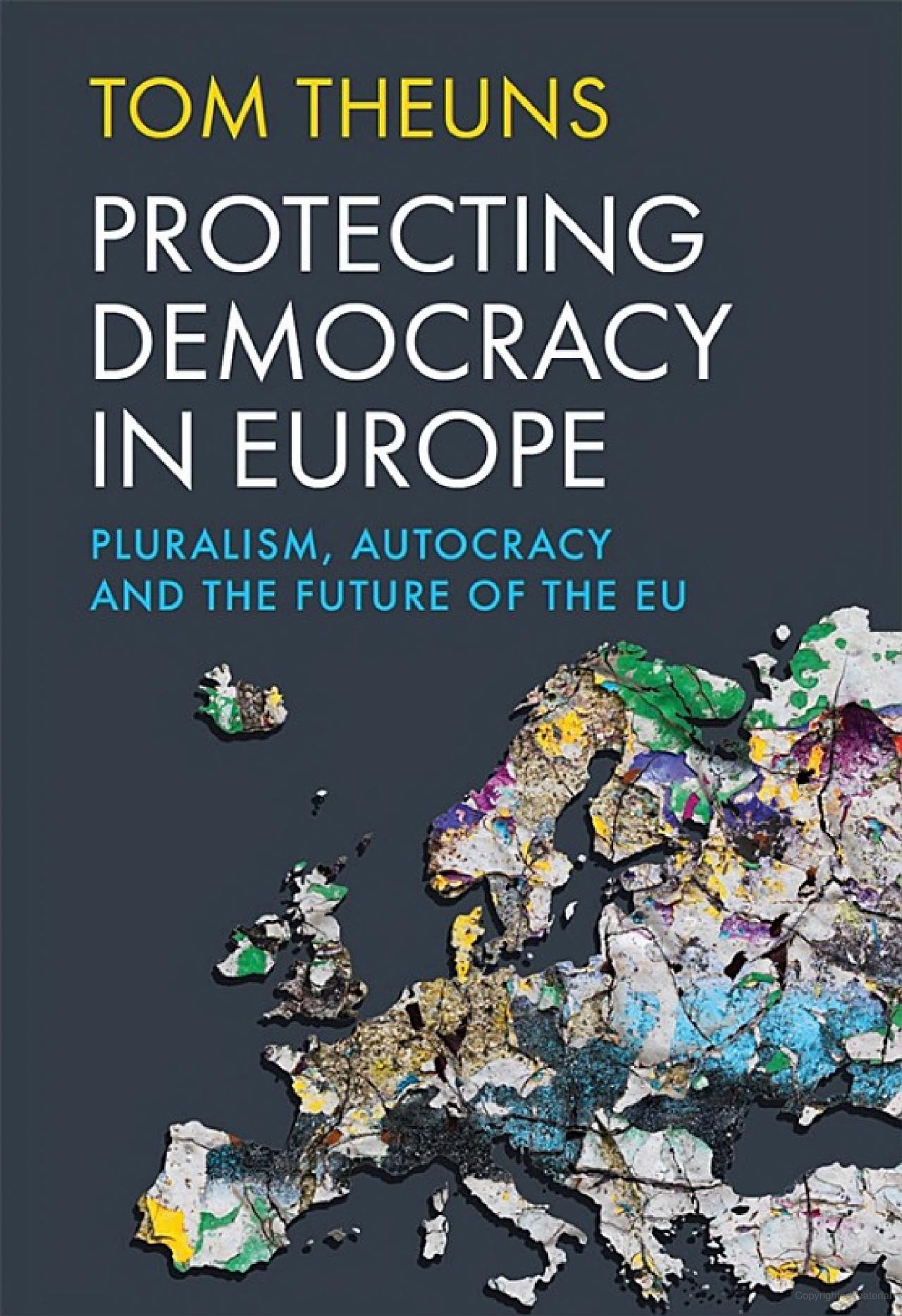
Protecting Democracy in Europe: Pluralism, Autocracy and the Future of the EU
by Tom Theuns
London: Hurst & Company, 2024
With Europe’s far-right emboldened by global illiberal trends, exemplified by Donald Trump’s second presidency, the urgency of safeguarding democracy in Europe has never been clearer. Tom Theuns’s book, Protecting Democracy in Europe: Pluralism, Autocracy and the Future of the EU, makes a timely and provocative contribution beyond typical discussions of the EU’s rule-of-law mechanisms. Although clearly academic, it is essential reading for those seeking practical solutions beyond passive acceptance of the status quo.
Central to Theuns’s analysis is the observation that EU membership alone no longer guarantees democratic progress, as shown by democratic regression in Hungary, Poland, Slovakia and rising illiberal pressures elsewhere. He identifies three key reasons why EU institutions must urgently address these threats:
- Autocratic consolidation and the risk of autocratic playbooks spreading from one country to another make democratic recovery increasingly challenging.
- Even a single autocratic member state can significantly compromise the Union’s overall democratic legitimacy.
- EU institutions themselves have inadvertently legitimised autocratic governments through economic support and funding. Rectifying this complicity must become an institutional responsibility.
Theuns’s pragmatic and practice-oriented approach offers feasible, real-world strategies to effectively counter democratic backsliding, making this book a valuable resource for policymakers aiming to defend and reinforce democracy across Europe.
The first part of the book (Chapters 2-4) offers a critical exploration of why the EU has consistently struggled to respond effectively to democratic backsliding. It argues compellingly that fatalism and depoliticisation within EU institutions have hindered decisive action. Theuns introduces the concept of ‘membership fatalism’ – the entrenched assumption that member states retain absolute sovereignty over their EU membership, despite clear and systematic breaches of democratic standards.
Further, Theuns examines the roots of depoliticisation, whereby the EU has increasingly deferred responsibility for addressing democratic erosion to legal procedures. The book identifies the EU’s weak response to Austria’s far-right FPÖ entering government at a critical juncture in 2000, and it vividly illustrates how initial symbolic outrage and sanctions rapidly faded due to fragmented coordination and reliance on bilateral actions rather than a unified European response. This failure, Theuns argues, has haunted EU policymakers, deterring stronger political measures in subsequent crises. Consequently, current EU actions towards Hungary and Poland remained fragmented, treating violations in isolation rather than confronting systemic threats to democracy head-on. The value of this genealogy lies in revealing how existing paradigms for addressing democracy in member states have emerged – a crucial step toward rethinking and improving these approaches.
Analysing 155 EU Commissioner speeches on democracy, Theuns further unpacks the European Commission’s narrow, legalistic and depoliticised conceptualisation of democracy – a deliberate choice rather than one mandated by EU treaties (Chapter 3). He aptly characterises the Commission as acting more like an “ombudsman of the EU rather than its main political executive actor”, reflecting an overwhelming emphasis on the rule of law. Although vital, this narrow focus neglects the pluralistic dimensions essential to a healthy democracy. Theuns also criticises the EU’s prominent but superficial emphasis on fact-checking and disinformation. While fact-checking is important, he highlights the absence of deeper considerations – like determining which facts matter politically and how to respond meaningfully. One might add to Theuns’s analysis that this gap remains evident today, as EU policy continues to overlook the domestic political and cultural drivers of disinformation – often fuelled by far-right actors in Europe that are also central to democratic backsliding – while placing important, but disproportionate emphasis on foreign interference.
Transitioning to actual protective measures, the book scrutinises the coherence of existing EU tools against democratic backsliding (Chapter 4). Theuns argues that Article 7.3 TEU is normatively flawed: suspending a member state’s voting rights in the Council paradoxically violates the very fundamental democratic and equality principles set out in Article 2 TEU, by subjecting that state to laws it can no longer help co-shape. While some advocate this approach under the banner of militant democracy – using undemocratic means to defend democracy against the background of a grave threat to democracy, and seeing no other alternatives to react – Theuns firmly rejects this for the case of the European Union. He underscores that such incoherence is not merely philosophical; it directly compromises policy effectiveness, as two competing EU policies can never reach their objective simultaneously. Importantly, he also demonstrates that more coherent and practical alternatives exist.
A better way forward: protecting the EU from democratic backsliding
Part Two presents alternative responses to democratic erosion, offering original – and at times radical – proposals that move the debate beyond the largely ineffective and incoherent Article 7. This shift is welcome: alongside Theuns’ critique of the internal contradictions of Article 7, the debate addresses the procedure’s sluggishness and the growing sense that Article 7 is simply unfit to contain democratic backsliding within the EU meaningfully. Before outlining his proposals, Theuns turns to a crucial and often overlooked issue: the complicity in the democratic backsliding of EU institutions over the past 15 years (Chapter 5). He highlights deliberate inaction and counterproductive responses – from the EPP’s long-standing protection of Hungary’s Prime Minister Viktor Orbán, to the Commission’s hesitation on infringement procedures, delayed Article 7 actions, and the Council’s watering down of conditionality tools. While autocratising member states remain the main culprits, Theuns makes a compelling case that EU institutions share responsibility – and therefore have a duty to act. Drawing on existing ideas, he proposes strengthening infringement procedures by bundling multiple violations of the fundamental rights set out in Article 2 TEU to withhold EU funds more effectively. This would increase pressure on governments to implement real reforms and help end the cat-and-mouse dynamic of repealing one problematic policy while autocratising member states are introducing two new ones.
Maintaining a pragmatic stance and explicitly rejecting utopian solutions like ambitious treaty reforms, Chapter 6 proposes realistic strategies for politically isolating autocratic influence beyond existing economic sanctions. Theuns advocates ‘hard legal containment’, such as preventing autocratic states from holding EU Council presidencies – measures he argues face fewer legal constraints and normative contradictions than Article 7 procedures. Theuns also recommends consistent ‘soft political containment’, such as denying legitimacy and prestige to autocratic leaders by withholding symbolic gestures like congratulatory messages or official photo opportunities – advice not consistently applied by EU leaders, for example in relation to Hungary, in recent years.
Finally, the book pragmatically suggests exploiting divisions among autocratic or backsliding states – as effectively demonstrated by Poland and Hungary’s differing stances on supporting Ukraine against Russia’s aggression – to strategically weaken their collective influence.
In Chapter 7, Theuns calls for a shift from the EU’s narrow view of democracy towards a more pluralistic approach. He highlights the essential role of free media, civil society and political opposition in sustaining democratic pluralism. Drawing on Chantal Mouffe’s agonistic theory, he argues that democratic conflict should be addressed openly in a vibrant public sphere – not endlessly deferred through compromise, as is typical in particular for addressing democratic backsliding by EU institutions. Consequently, he recommends stronger, proportionate partisan engagement by EU institutions in explicitly supporting civil society, independent media and democratic opposition within backsliding member states. He stresses that neutrality in defending democracy can dangerously weaken it. Additionally, Theuns points out the limitations of blunt sanctions – such as withholding substantial EU funds – which often harm ordinary citizens and pro-democratic actors more than autocratic governments, and he advocates indirect support mechanisms empowering democratic forces.
Theuns concludes with a radical proposal: if all else fails, democratic EU member states should collectively withdraw from the Union to reconstitute it without autocratic regimes. Given the absence of formal expulsion mechanisms (apart from voluntary exit under Article 50 TEU), and the low chances of being able to change the treaties to include such mechanisms, this strategy would create a credible, ultimate deterrent. Although mindful of the serious repercussions, particularly for citizens of the states left behind, Theuns maintains that this drastic measure may ultimately be necessary to preserve democracy within the EU framework. The measure presents an alternative to the above-discussed militant democratic proposals of using undemocratic means in kicking out member states by staying within the bounds of the rules of law. Whereas this may seem a far-fetched strategy, the lack of real progress on stopping backsliding, the credible threat it presents to the European Union and the absence of other viable proposals make this interesting food for thought.
Overall, this book is a highly valuable and insightful contribution to debates on European democracy, offering original and provocative arguments supported by thorough analysis. Yet one minor critique relates to its stylistic tendency – particularly in the first part – to repeatedly summarise and reinforce key points. While understandable for emphasising important and original ideas, less repetition might have enhanced readability. Additionally, readers might wonder why the author did not engage even more extensively with international relations literature on sanctions, particularly regarding their effectiveness, risks, and unintended consequences. Although some insights – like the risks of rally-around-the-flag effects and the benefits of directly supporting non-state actors – are addressed, a deeper exploration of these aspects could have further enriched the analysis of the complex interactions between the EU and its increasingly autocratic member states. But overall, the book captures many thought-provoking and well-argued ideas within its 200 pages, and one cannot expect to cover everything in such a short book.
Find all related Progressive Post
Progressive Post