


26/03/2026
From law to code
The silent erosion of democracy and accountability
Nathalie A. Smuha
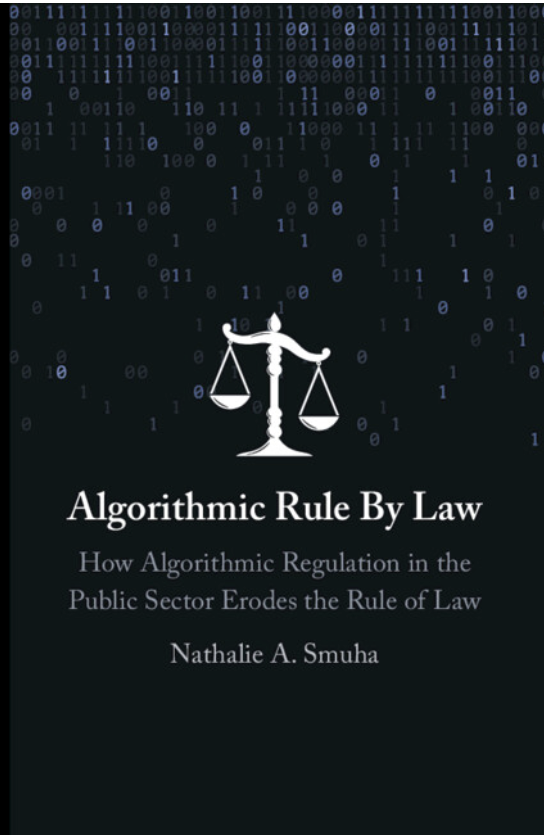
Algorithmic Rule by Law. How Algorithmic Regulation in the Public Sector Erodes the Rule of Law
Cambridge University Press, 2024
Imagine the following situation: you are watching the evening news, and the minister in charge of social affairs proudly announces a massive investment in digitalising the various public bodies responsible for providing government aid to citizens – for example, unemployment benefits or support for families with young children. The minister promises an end to mountains of paperwork, weeks- and months-long waits for mandatory in-person appointments, and long processing times. Instead, modern digital systems using AI and algorithms, deployed alongside civil servants, will enable citizens to access public and user-friendly services online efficiently. A win-win for all, it seems to you, and your thoughts drift to the last time you had to wait weeks to get a response from your local government office. In the meantime, the news anchor has already moved to the next item.
What the minister’s announcement glosses over, however, is a more troubling dimension of this shift. When public authorities delegate the implementation of legal rules – such as those that stipulate who is or is not entitled to certain benefits – to algorithmic systems, they inevitably outsource a range of consequential choices, about how the law is interpreted, how edge cases are handled and whose interests are prioritised, to the often private developers and vendors who build and maintain those systems. Decisions that were once made, however imperfectly, by accountable public officials operating within a legal framework are quietly transferred to actors who bear no equivalent democratic mandate or legal obligation. The efficiency gains are real and visible (at least initially), while the accountability losses are structural and largely invisible, buried in procurement contracts and technical specifications that few will ever scrutinise. It is precisely this silent redistribution of public responsibility that lies at the heart of the rule-of-law problem that Nathalie Smuha sets out to diagnose in her timely and ambitious work, Algorithmic Rule by Law – How Algorithmic Regulation in the Public Sector Erodes the Rule of Law.
Smuha advances a compelling and sobering thesis: that the growing reliance of public authorities on algorithmic systems to implement and enforce the law is actively eroding the very rule of law that those authorities are meant to uphold. She conceptualises this threat as ‘algorithmic rule by law’, a phenomenon whereby algorithms are deployed under a veneer of legality and efficiency, yet function in ways that hollow out the rule of law’s protective role. The threat, she argues, is characterised by five interconnected issues: the reduction of applying laws to an IT exercise; the centralisation of normative choices arising when translating law to code in the hands of an opaque class of software developers; the near-elimination of discretion at the level of street-level public officials; the erosion of accountability mechanisms and the introduction of a systemic vulnerability into the legal infrastructure itself. Crucially, Smuha insists that this threat need not stem from authoritarian intent. Rather, negligence and institutional carelessness are equally capable of producing the same corrosive effects.
The book – for the understanding of which no prior knowledge of digitalisation and algorithms is needed – spans six chapters, moving from a framing of the central hypothesis within the EU’s rule of law crisis, through a technical and normative analysis of algorithmic systems, to a comprehensive assessment of how such systems can undermine core rule of law principles. It then evaluates the adequacy of existing EU legal safeguards before closing with policy recommendations and a reflection on the normative tensions inherent to law and democracy. By virtue of its focus on the public sector, Smuha’s book is highly relevant for Socialists and Social Democrats, those who believe in and fight for expansive, competent and well-resourced public institutions with strong executive capacity in the service of ensuring the well-being of citizens — a goal for the achievement of which digitalisation and the use of algorithms are increasingly presented as not just a solution but a necessity.
More broadly, the book’s message should be particularly worrying for all who care about the integrity of our democracies. Whilst overt attacks on the rule of law like those we have witnessed in Hungary over the past decade are well documented and have at least to a degree drawn a response from the European Commission and other competent authorities, less extreme but still noticeable forms of the decay of rule of law, such as corruption or restrictions on the independence of the judiciary seen across several European states, have garnered attention and resulted in the mobilisation of civil society and other pro-democracy forces. However, the type of erosion described by Smuha – systemic, incremental, hidden in code and mediated through the digital backbone of society – not only flies under the radar but can even occur in countries that score highest on democratic benchmarks, such as the Netherlands or the Nordic countries.
Ultimately, the book challenges us to expand how we view the rule of law and the ways it can be chipped away, and to apply this to the digital world. Using a myriad of examples, Smuha demonstrates how seemingly harmless technical decisions delegated to IT staff can have serious consequences for the rule of law and, consequently, for the everyday lives of citizens and the legitimacy of the state. She urges us to demand transparency and democratic accountability in the deployment of public-sector algorithmic systems, and to treat the rule of law not as a technical checklist but as a living normative commitment requiring constant, collective tending.
Find all related Progressive Post
Progressive Post