
09/12/2025
A leader who has become a legend
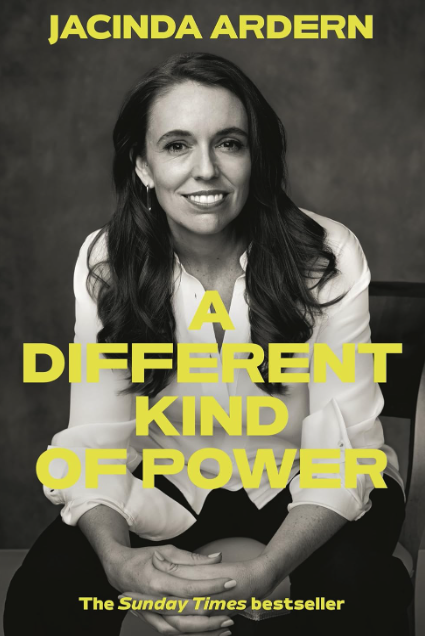
A Different Kind of Power
by Jacinda Ardern
Pan Macmillan, 2025
One of the most iconic scenes in The Lord of the Rings trilogy is when Eowyn, Eomund’s daughter and courageous shieldmaiden of Rohan, shouts at one of the story’s dark characters, “But no living man I am. You look upon a woman”. And within seconds, she defeats this dark character with a mighty stroke, demonstrating how narrow-minded he was to believe himself invincible just because prophecy had foretold that no man could ever overthrow him. There is much to unpack from this short scene. One of the key takeaways is never to underestimate the transformative power of female leadership when it is grounded in the genuine belief that the world can be a fairer place. Another is that a better future is totally worth striving for. Indeed, this remains an ageless message – and a modern version of it can be found in the captivating book A Different Kind of Power by Jacinda Ardern, which is both thrilling and inspiring.
The story Ardern shares in her book is incredibly personal yet at the same time universal and instructive. The introduction finds her in her friends’ bathroom, where she is captured in a state of suspense, waiting for the conclusion of some governmental negotiations, as well as for the results of a pregnancy test. Many will remember the scene from The AM Show on television when Ardern was asked if she planned to start a family, while she was at that time trying to resurrect the Labour Party from its feeble position in the opinion polls and, by default, lead it with herself as a candidate for Prime Minister. Her answer was that while she had openly stated in the past that she wanted to be a mother, asking her about that when she was running for a job (of leading a country) was unacceptable (see Chapter 17). And with that, she set her ethical boundaries. Ardern insisted that she had the right to pursue her own ambitions and define how to handle diverse life opportunities, as well as make her own choices. The recording then went viral after it was picked up by various international broadcasters. It became an encouragement for young women worldwide, as well as a striking phenomenon. In times when it seemed that all must be exposed to the public eye, here was Ardern insisting that some issues are private. She thus possibly became easier to relate to than any politician who had tried the opposite approach.
It is in this spirit that Ardern’s narrative allows the reader to feel a personal connection with the story she chooses to share about herself. It all starts in a small town, Marupara, where her family moved when she was four, and where her father took a post at the local police station. It continues, through the prism of various memories from her school years, including friendships and family reunions, as well as her experiences as an active member of the Mormon Church. Ardern discloses how much her faith has shaped her. She also explains the difficult process of later having to choose to leave her Mormon faith behind – but not all of its teachings, like the obligation to share, to help one another, to respect possessions, which led her, even during her parliamentary service, to have a very limited wardrobe, composed mostly of hand-me-down items. Readers learn about the struggles the people close to her were going through, including the suicide of her closest schoolfriend’s brother, and the hardship of a queer boy growing up in a traditional small city. The storyline follows Ardern to school (where she loved history), to her first job at a fish-and-chip shop, to her debating clubs, to her door-knocking Church evangelism, to her first engagements in politics, to university, to her youth activism (including as president of the International Union of Socialist Youth, p. 124), to her time abroad with experiences like volunteering in soup kitchens in the US and mobilising Kiwi voters in the UK. At every step, Ardern appears curious, open-minded, empathetic, and ready to engage and challenge herself, with each experience contributing to the consolidation of her own integrity and shaping her into the leader she was becoming. Although political scientists reading this book might find it too down-to-earth, they should perhaps consider whether the leadership style that Ardern forged for herself and describes in simple terms is not just something that successfully breaks out from the overly restrictive criteria of leadership theories. For Ardern, it is clear that politics – despite all that has happened to it in many different party systems – is not a profession. She does not take shortcuts; she does not outsource. Instead, for her, politics is a mission that one gets the honour to carry out.
Throughout the book, we learn a great deal about the reality and society of New Zealand, which also serves to highlight why Ardern’s prime ministership was so memorable. She frequently alludes to the fact that her country is small and may be seen as one of the world’s peripheries, thereby making it particularly vulnerable. It is for this reason that one of the important aspects of her work was to elevate her country to the world stage and place it on the map as a relevant stakeholder, setting the tone for New Zealand’s role in international relations. This also contributed to her priority of negotiating trade deals within the Asia-Pacific region, as well as continuing to advocate for policies against climate change, which are key for her country and crucial for the entire globe to pursue to prevent further environmental deterioration and global warming. In this sense, Ardern can be highlighted as a leader who understands the responsibility of both governing and demonstrating patriotism in a progressive sense. Ardern has stood proudly for her country, representing it in all its aspects – the past and the future, uniting diverse communities and advocating for reconciliation and moving forward. This was exemplified when she spoke Maori at the UN. The mutual responsibility and sense of togetherness that she insisted on is what helped New Zealanders persevere through Covid-19, as well as through times of natural disasters and the tragedy of the Christchurch shootings. These were moments of extreme stress, through which Ardern led her country with a sense of compassion and humanity. Furthermore, they are recorded in some of the iconic snapshots that she shares in the book – like those taken in Christchurch through a stained glass window, or like the one featuring her in a traditional Maori cloak at Buckingham Palace during the Commonwealth heads of government meeting in London.
In all the defining moments, Jacinda Ardern stood tall, and she stood out, leading by example. Many claim that this was because she was not like other leaders of her contemporary era. In fact, she was not even the first choice of Labour, nor was she a member of the dominant party’s faction. She had only stepped in after former party leader Andrew Little’s unexpected resignation amid scandals and the party’s plummeting numbers. She recalls how tough it was, how it was initially about damage-control and somehow safeguarding the bare minimum — already ambitious goals when she took charge just two months before the 2017 general elections. However, while commentators have suggested that it was her leadership style — which stood in stark contrast to the cynical style of contemporaries like Donald Trump – that made her unique, she believes that this explanation is belittling. In her mind, it is insufficient not to be someone else. To lead, do it well and in the service of others, one first and foremost has to be oneself. That is what she was, and this authenticity and integrity are what shone out, and what will continue to shine out as Ardern now engages in social and political activities by investing effort in shaping women leaders for the new generations to come.
Find all related Progressive Post
Progressive Post