
Search
Skip to content
progressive-post home
  • About
  • The magazine
  • Progressive Pages
  • Dossiers and debates
  • Election Observatory
  • Reads & Views
The Progressive Post

The Dutch 2021 elections: education as the new divide?

EducationElectionsSocial Democracy
Authors
Network
André KROUWEL
Search author
Share:
Tweet this Share on Facebook Share on Linkedin Print

André KROUWEL

Associate Professor of Comparative Politics and Communication Vrije Universiteit Amsterdam Founder of Election Compass online Vote Advice Applications
23/03/2021

On March 17, the Dutch went to the polls in the middle of the Covid pandemic and a faltering roll-out of the vaccination programme. In addition, the government had resigned shortly before the elections over a scandal of racial profiling of families claiming child support. Neither the scandal nor the botched vaccination scheme seemed to hurt Prime Minister Rutte’s liberal VVD. He was riding high in the polls, resulting in a frequent media portrayal of Rutte as ‘the winner’ in this campaign.

Meanwhile, the ethnic-profiling scandal had resulted in the resignation of Lodewijk Asscher as leader of the Labour Party (PvdA), as he was considered responsible in the previous government for this policy. Thus, having lost already one of the main contenders on the left in the 2021 race, Rutte was also lucky enough that the minister of Health, responsible for the vaccinations, stepped down as leader of the Christian Democrats (CDA). Both PvdA and CDA had to find a new leader shortly before the elections, which is always an uphill battle for voters to get to know and trust the candidate. 

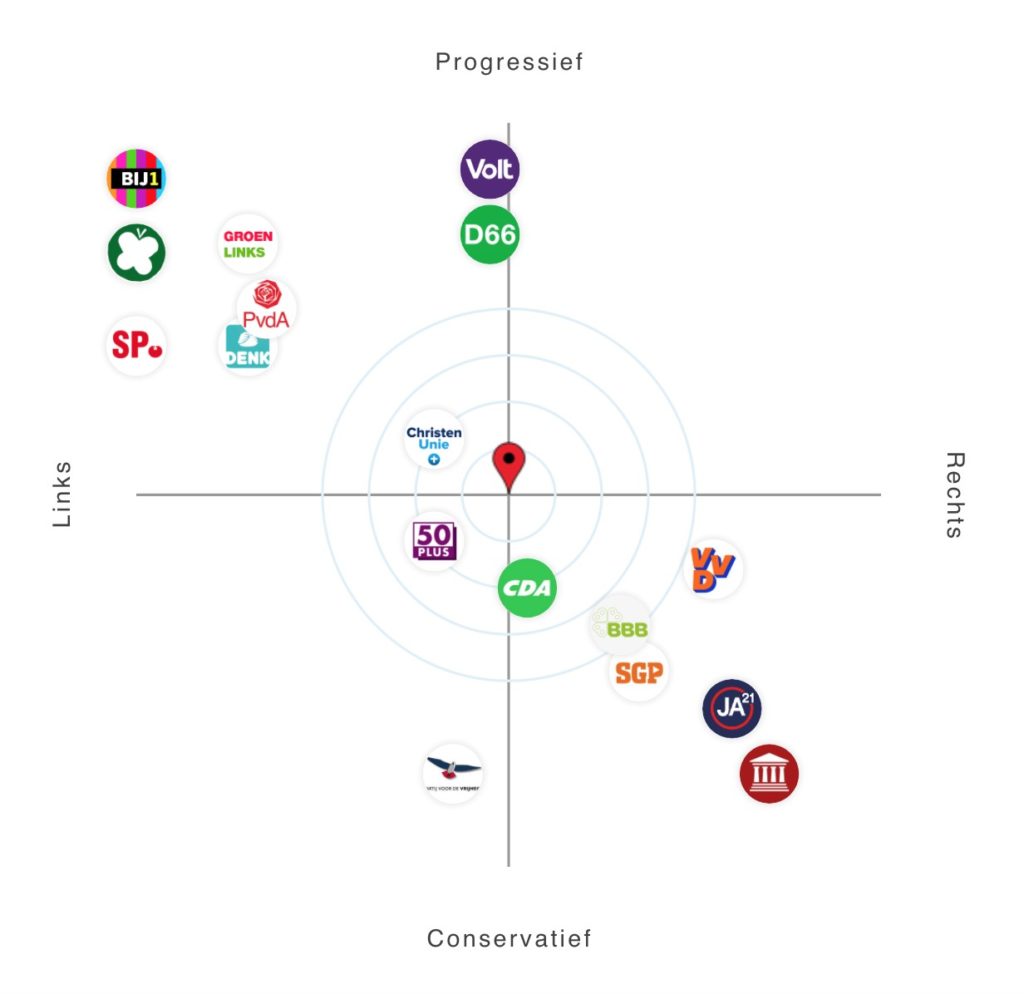
On the left, many voters were seriously doubting which party would be able to make the next government tilt to the left. In the 2017 elections, the combined left had lost a net of 20 seats, with Jesse Klaver’s GreenLeft (GroenLinks) emerging as the largest left-wing party. However, he was unable or unwilling to enter government and after a complex coalition formation, Klaver ended up in the opposition benches. The more pragmatic left-wing voters were hesitant to again support GroenLinks, yet also the Socialist Party (SP) with their relatively new leader Lilian Marijnissen (daughter of a previous leader, Jan Marijnissen) did not look like gaining any steam to threaten the dominance of Rutte. As neither SP, nor PvdA nor GroenLinks seemed a viable alternative to Rutte, D66 leader Kaag openly challenged Rutte for the position of Prime Minister. D66 – a centre-right, progressive party – was part of the incumbent coalition consisting also of Rutte’s own VVD, CDA and the Orthodox Protestant Christian Union (CU). For many voters on the left, the only viable option to tilt the next coalition to the left was to vote D66, a centre-right, pro-market party (see the political landscape figure).

The campaign thus became dominated by the theme of ‘leadership’, as Rutte emphasised he needed another term to ‘get us all through the pandemic’ and Kaag suggested that she would provide a ‘new leadership’. Despite all the hardship caused by the lockdown, with many losing their income, job, or company, economic issues were pushed to the background.
The issue of leadership, particularly with regard to the handling of the pandemic, was exacerbated by the fact that the populist parties attacked Rutte and his ministers for being too heavy-handed, particularly as the government introduced a curfew. The curfew led to violent protests in 11 Dutch cities and put the pandemic even more centre-stage. On the populist wing of the political spectrum, Geert Wilders’ PVV still dominated in the polls, but only because the populist party under the leadership of Baudet, Forum for Democracy (FvD), had collapsed and split over a group of activists that had shared Nazi propaganda, anti-Semitic tropes, and homophobic discourse. The split-off, named The Right Answer 21 (JA21), completed the fragmentation of the populist pole of Dutch politics.

In the regional elections in 2019, Baudet’s Forum party had actually emerged as the largest party in the country, in the same year that the Labour Party had become the largest party in the European elections. This shows that both turnout and volatility among Dutch voters makes significant power shifts possible.

The outcome of the election was a further defeat of the left, losing another net 12 seats, rendering the political left a marginal force at least until the next elections. Many traditional left-wing voters supported D66, which won four seats to become the second-largest party after Rutte’s VVD. The biggest winner, however, was the populist block that gained a net of six seats.

Immediately after the election, Kaag claimed that ‘political moderation’ had won in this election. From two corners of the political spectrum, this analysis will not be shared. People who support populist parties see D66 as an extremist party on issues like climate change, European integration, and multiculturalism. For them, Kaag portraying herself as moderate will sound insane. From the radical left, Rutte’s policies are pro-market and pro-big-business, so that they will also question that moderation has won. At the same time, across the progressive side of the political spectrum from SP, GreenLeft, PvdA to D66, people are really concerned about the ever more openly racist, xenophobic, and conspiratorial rhetoric coming from the populist side and their supporters.

What seems to be occurring more and more is the sorting of voter groups by education. Increasingly the parties on the progressive side attract voters with higher education from more urban communities – or at least the more well-to-do areas in larger cities – while the conservative-nativist pole of the political spectrum represents more people with mid-level and practical or vocational training from suburban and smaller communities. In the figure below we see that in particular D66, PvdA and GreenLeft are the parties of the higher educated with only a marginal segment of voters with lower educational attainment. Note that the left-wing populist SP attracts more voters with practical education and work experience and distinguishes itself from the rest of the left. We see that particularly the PVV attracts more voters with lower educational attainment. Even when we control for age – as older generations did not enjoy the same educational opportunities – this educational divide remains visible. It seems that David Goodhart’s grim tale of the ‘Anywheres’ being politically pitted against the ‘Somewheres’ is becoming a reality in the Netherlands. 
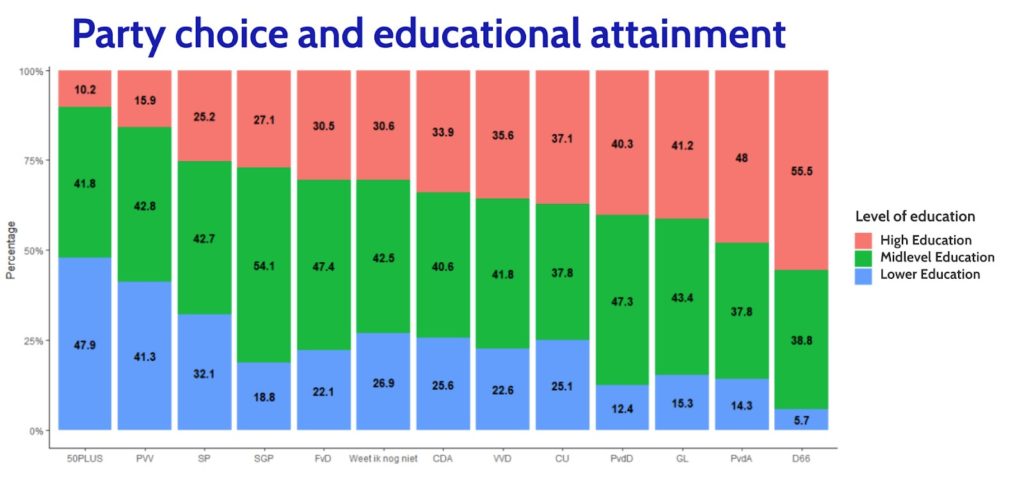
Photo Credits: Shutterstock.com/MarcelRommens


Related articles:

Dutch elections 2021: no recovery of Social Democracy!, by Hans Keman.

Last call for the Dutch Left?, by Klara Boonstra.

Find all related Progressive Post
Progressive Post
03/10/2024
Andreas SCHIEDER

A bigger bang

03/10/2024
Eva ZEGLOVITSMartin OPPENAUER

A far-right triumph: Austria’s 2024 election and the FPÖ’s historic win

03/10/2024
Felix BUTZLAFF

The revenge of the countryside

Post navigation

Previous: A summit of the future in New York
Next: A far-right triumph: Austria’s 2024 election and the FPÖ’s historic win
Sitemap
  • Newsletter
  • Themes
  • FEPS Logo
  • Search
  • About
  • Member Area
Logo feps
Contact

Foundation for European Progressive Studies
Avenue des Arts - 46, 1000 Bruxelles
+32 223 46 900 - info@feps-europe.eu
communication@feps-europe.eu

  • Legal
  • Disclaimer
  • Privacy Policy
© 2024 FEPS-EUROPE. All Rights Reserved.
REG 490049891801-93
Amofordesign
XThis website uses cookies. Some cookies are necessary for the proper functioning of the website and cannot be refused if you wish to visit the website.
Other cookies are used for Advertisement and Analytics (Sharing on social networks, video playing, analysis and statistics, personalized advertising ...) You can refuse them if you want to.
REJECTACCEPTCookie settings
Manage consent

Privacy Overview

This website uses cookies to improve your experience while you navigate through the website. Out of these cookies, the cookies that are categorized as necessary are stored on your browser as they are essential for the working of basic functionalities of the website. We also use third-party cookies that help us analyze and understand how you use this website. These cookies will be stored in your browser only with your consent. You also have the option to opt-out of these cookies. But opting out of some of these cookies may have an effect on your browsing experience.
Necessary
Always Enabled
Necessary cookies are absolutely essential for the website to function properly. These cookies ensure basic functionalities and security features of the website, anonymously.
CookieDurationDescription
cookielawinfo-checkbox-advertisement1 yearSet by the GDPR Cookie Consent plugin, this cookie is used to record the user consent for the cookies in the "Advertisement" category .
cookielawinfo-checkbox-analytics11 monthsThis cookie is set by GDPR Cookie Consent plugin. The cookie is used to store the user consent for the cookies in the category "Analytics".
cookielawinfo-checkbox-functional11 monthsThe cookie is set by GDPR cookie consent to record the user consent for the cookies in the category "Functional".
cookielawinfo-checkbox-necessary11 monthsThis cookie is set by GDPR Cookie Consent plugin. The cookies is used to store the user consent for the cookies in the category "Necessary".
cookielawinfo-checkbox-others11 monthsThis cookie is set by GDPR Cookie Consent plugin. The cookie is used to store the user consent for the cookies in the category "Other.
cookielawinfo-checkbox-performance11 monthsThis cookie is set by GDPR Cookie Consent plugin. The cookie is used to store the user consent for the cookies in the category "Performance".
csrftokenpastThis cookie is associated with Django web development platform for python. Used to help protect the website against Cross-Site Request Forgery attacks
JSESSIONIDsessionThe JSESSIONID cookie is used by New Relic to store a session identifier so that New Relic can monitor session counts for an application.
viewed_cookie_policy11 monthsThe cookie is set by the GDPR Cookie Consent plugin and is used to store whether or not user has consented to the use of cookies. It does not store any personal data.
Functional
Functional cookies help to perform certain functionalities like sharing the content of the website on social media platforms, collect feedbacks, and other third-party features.
CookieDurationDescription
__cf_bm30 minutesThis cookie, set by Cloudflare, is used to support Cloudflare Bot Management.
S1 hourUsed by Yahoo to provide ads, content or analytics.
sp_landing1 dayThe sp_landing is set by Spotify to implement audio content from Spotify on the website and also registers information on user interaction related to the audio content.
sp_t1 yearThe sp_t cookie is set by Spotify to implement audio content from Spotify on the website and also registers information on user interaction related to the audio content.
Performance
Performance cookies are used to understand and analyze the key performance indexes of the website which helps in delivering a better user experience for the visitors.
Analytics
Analytical cookies are used to understand how visitors interact with the website. These cookies help provide information on metrics the number of visitors, bounce rate, traffic source, etc.
CookieDurationDescription
CONSENT2 yearsYouTube sets this cookie via embedded youtube-videos and registers anonymous statistical data.
iutksessionThis cookie is used by Issuu analytic system to gather information regarding visitor activity on Issuu products.
s_vi2 yearsAn Adobe Analytics cookie that uses a unique visitor ID time/date stamp to identify a unique vistor to the website.
Advertisement
Advertisement cookies are used to provide visitors with relevant ads and marketing campaigns. These cookies track visitors across websites and collect information to provide customized ads.
CookieDurationDescription
NID6 monthsNID cookie, set by Google, is used for advertising purposes; to limit the number of times the user sees an ad, to mute unwanted ads, and to measure the effectiveness of ads.
VISITOR_INFO1_LIVE5 months 27 daysA cookie set by YouTube to measure bandwidth that determines whether the user gets the new or old player interface.
YSCsessionYSC cookie is set by Youtube and is used to track the views of embedded videos on Youtube pages.
yt-remote-connected-devicesneverYouTube sets this cookie to store the video preferences of the user using embedded YouTube video.
yt-remote-device-idneverYouTube sets this cookie to store the video preferences of the user using embedded YouTube video.
yt.innertube::nextIdneverThis cookie, set by YouTube, registers a unique ID to store data on what videos from YouTube the user has seen.
yt.innertube::requestsneverThis cookie, set by YouTube, registers a unique ID to store data on what videos from YouTube the user has seen.
Others
Other uncategorized cookies are those that are being analyzed and have not been classified into a category as yet.
CookieDurationDescription
COMPASS1 hourNo description
ed3e2e5e5460c5b72cba896c22a5ff98sessionNo description available.
loglevelneverNo description available.
Save & Accept