

Marcus Schneider, Director, Competence Centre for Peace and Security in the Middle East/North Africa Region
28/10/2026
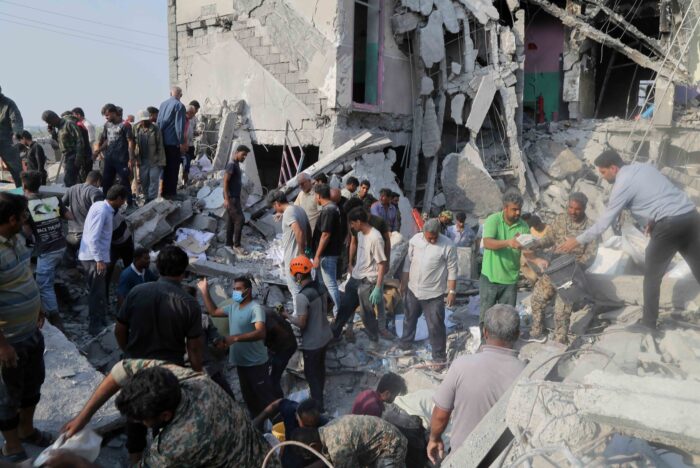
It came as little surprise that Lebanon once again became a battleground in the regional war between Israel and Iran. Even without Hezbollah’s half-hearted rocket fire, Israel would have invaded the South again. No one knows the business of preventive war better than Tel Aviv. While Iran, under attack, has fared far better in the Gulf than initially expected, Israel has largely succeeded in imposing its agenda in Lebanon. Yet this is unlikely to bring Lebanon any peace. Instead, the country risks jumping out of the frying pan and into the fire: Iranian hegemony is simply being replaced by Israeli hegemony.
Lebanon’s reformist government, of course, frames things differently. Sovereignty is its watchword. The fact that Lebanon is negotiating directly with the Israeli state under US auspices is presented as an expression of that sovereignty. This, however, is an excessively optimistic assumption – one that misreads both Israel’s new security doctrine and the region’s emerging alignments. These separate negotiations will not bring stability. Instead, they will ensure that Lebanon remains divided, weak and occupied.
Since 7 October 2023, Israel has pursued a security doctrine rooted in zero-sum thinking. In this worldview, security for the Jewish state means permanent insecurity for everyone else. What matters is capabilities, not intentions. From Israel’s perspective, states such as Lebanon and Syria are inherently weak and must be kept that way. In this logic, Israeli security is best served by keeping both countries weak and perpetually on the brink of civil war. Anyone familiar with the settler movement, which has long since become a hegemonic force, knows that the occupied and ethnically cleansed territories in Syria and South Lebanon will ultimately be opened to settlement. Israel is not only the preeminent military power in the Middle East; it also has a rapidly growing population. Excluding the Negev desert, its population density approaches that of Bangladesh. Expansion is in its nature; the West Bank alone will not suffice indefinitely. A state seeking peace would hardly raze entire villages and towns. Their systematic destruction is no accident.
The prospect of Lebanon joining the Abraham Accords may appeal to some – especially higher up in the mountains. But Lebanon is not one of those Arab dictatorships in which ruling families alone define the national interest. Peace with Israel requires a national consensus in Lebanon. It cannot be imposed through confrontation alone with Hezbollah, which remains, whether one likes it or not, the strongest party within the country’s largest confessional community. If anything, the occupation and ethnic cleansing of the South strengthen the party, providing it with a political lifeline. Under these conditions, it will never surrender its weapons unless forced to do so. But who is to use that force? The Lebanese Armed Forces, whose rank and file are half Shia? That would be a recipe for another civil war. Lebanon’s more clear-eyed observers know this. By accepting a framework that makes Israeli withdrawal conditional on Hezbollah’s disarmament, the government has handed Israel a rationale for prolonging the occupation indefinitely.
The problem lies in the setup of these so-called negotiations. Small, weak and internally divided, Lebanon finds itself alone in a room with Israel’s formidable military machine and the US superpower that sustains it. The imbalance could hardly be greater. The notion that Lebanon carries any weight in Washington is an illusion – albeit one cultivated by a lobby financed predominantly by pro-Israeli money.
In such a setting, Lebanon can only lose, even with the finest negotiators in the world. It is like a lamb sitting down to dinner with a pack of wolves. Lebanon’s sovereignty is not served simply by making decisions alone. A realistic assessment of the balance of power requires Beirut to bring in friends who will support its interests vis-à-vis Washington and Tel Aviv. Such friends exist. France is one. Germany’s role is far more ambivalent: Beirut can hardly count on Berlin to defend Lebanese interests when they clash with Israel’s. There is good reason why both Israelis and Americans seek to roll back French influence: Paris stands in the way of their hegemonic ambitions.
Lebanon’s friends also include the emerging alliance of moderate regional powers: Saudi Arabia, Turkey, Pakistan and Egypt. The Mecca Alliance, linking the first three, gives this broader alignment a more concrete institutional form. It seeks to counter both Israel’s and Iran’s malign ambitions for regional hegemony. These powers want to strengthen Arab statehood and seek a just and lasting settlement of the Israeli-Palestinian conflict instead of perpetual war. If Lebanon wants to become sovereign, it must align itself with these powers.
A separate peace with Israel that runs counter to this alliance’s vision would come at the price of total submission. But then Lebanon would cease to exist as Lebanon. The very idea of the country – a state built on coexistence and equality among 18 officially recognised religious communities – is the antithesis of everything the dominant Zionist right stands for. Lasting peace requires an easing of regional tensions and an end to the stoking of sectarian divisions – a practice Israel pursues no less actively than Iran. The implication is clear: the road to peace runs through Ramallah and East Jerusalem. There is no route around them.
The attacks of 7 October and the regional war that followed exposed the limits of pursuing normalisation while leaving Palestinians under occupation and without a state. The Abraham Accords have failed to deliver the regional peace their advocates promised.
The contours of a just peace, as demanded by the entire world, have long been set out in the two-state solution. Of the UN’s 193 member states, only two oppose it: Iran and Israel. Yet these two keep the world on edge and plunge the entire region into chaos. Both want a weak Lebanon, defined by sectarian hatred rather than national unity.
Only an agreement between Israelis and Palestinians can bring lasting peace to Lebanon. Once Palestinians have a state of their own and their national aspirations are fulfilled, Iran will lose its justification for intervention, just as Hezbollah will lose its justification for holding on to its weapons. The separate peace that some envisage, at the expense of the people of South Lebanon, is an illusion. As long as Palestinians remain oppressed – and inevitably resist that oppression – Israel will remain fundamentally aggressive. Under cover of war, territorial expansion can continue.
The road to peace runs through Ramallah. And it will be Riyadh, Ankara and Cairo – not Beirut alone – that lead the way. The sooner Lebanon recognises that it must align its quest for sovereignty with the ambitions of the moderate regional powers, the sooner the South can be reclaimed.
Find all related Progressive Post
Progressive Post