

Associate Professor in International Relations, Universitat Autònoma de Barcelona (UAB) and Institut Barcelona d'Estudis Internacionals (IBEI)
28/05/2026
Great power competition and assertive regional powers – from Turkey to the Gulf states – have transformed the Mediterranean beyond recognition. The EU is no longer the dominant framer, but this need not be a defeat. Approached with humility, its relative loss of power could become the basis for the more equal partnership it has long promised but never delivered.
The EU once saw itself as the benign anchor of Mediterranean affairs, the actor that set the terms for dialogue and cooperation, channelled and funded through Brussels-based institutions. This was the spirit of the 1990s: the Cold War was over, the international liberal order seemed uncontested, the Oslo Agreements kindled hopes of peace, and the Barcelona Process promised shared prosperity, political dialogue and people-to-people exchanges. That world is gone.
Today, the Mediterranean is a multipolar space, shaped by forces largely beyond European control. Great power rivalry is back, with the US and China competing for influence and Russia playing a destabilising role. The constitutive norms of the post-war order are under assault. In the region, Israel has set a record of impunity in its violations of international law. Donald Trump’s second presidency has accelerated the dismantling of multilateral frameworks, with the Middle East as one of his primary laboratories – from the ‘Board of Peace’ fantasy for Gaza to the illegal war against Iran.
But the most consequential shift is the rise of regional powers. The Mediterranean and broader Middle East have always been a crowded geopolitical field, with at least five major players – Egypt, Saudi Arabia, Iran, Israel and Turkey – plus Morocco and Algeria as sub-regional powers in the Maghreb. What has changed is their assertiveness. Israel is attempting to become an uncontested force while simultaneously building the so-called ‘Abrahamic axis’, based on the Abraham accords, which US President Donald Trump pushes for. Turkey has abandoned its traditional posture for an activism that stretches from Syria to the Red Sea, while positioning itself as indispensable to European defence. Saudi Arabia, under Crown Prince Mohammed bin Salman, has projected unprecedented ambition across diplomacy, economy and security.
And the field has become even more crowded. Two relatively small but extraordinarily active players – the UAE and Qatar – have carved out outsized roles through investment, mass media, mediation, arms procurement and alliance-building. The centre of gravity of the region, traditionally anchored in the Levant, has shifted gradually toward the Gulf. The 2026 Iran war has made this definitive: Gulf states are no longer distant partners of Mediterranean affairs but a frontline. Moreover, the emerging Saudi-UAE rivalry is becoming a new structuring dynamic whose effects transcend the Gulf – from Sudan to southern Yemen and beyond.
Neighbouring regions, too, are more embedded with the Mediterranean than ever. Africa’s weight is growing, and the Mediterranean can increasingly be thought of as a Euro-African lake; the security dynamics in the Sahel and the Horn of Africa demand a comprehensive view. To the east, South Asia has entered the equation: Pakistan’s mediation between the US and Iran, the Saudi-Pakistani defence agreement, India’s deepening connections with the Gulf through projects like the India-Middle East-Europe Economic Corridor – all point to a region whose boundaries have expanded well beyond either shore of the sea.
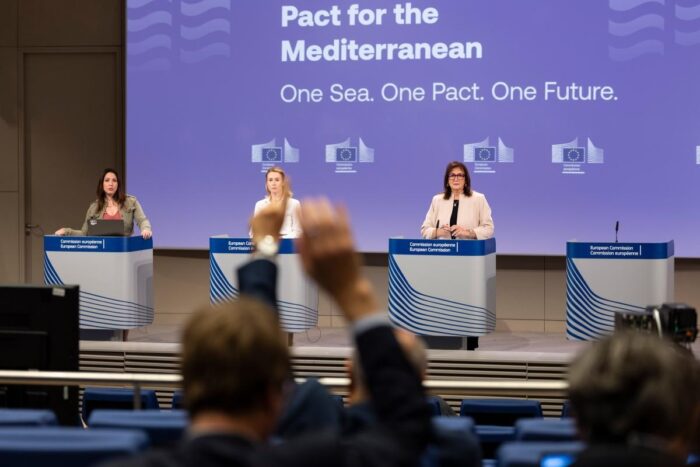
Where does this leave the EU? Weakened by its own polycrisis – migration, Brexit, Covid-19, the war in Ukraine and now the economic fallout of the Hormuz-Strait disruptions – the EU is more inward-looking, less ambitious and more divided than in the 1990s. Its ‘Pact for the Mediterranean’, launched with genuine effort in late 2025, arrived in a region that had already moved on. The reputational damage from the EU’s inability to act on Gaza, where it proved relevant but impotent, divided and unable to pressure Israel, will take years to repair.
Yet defeatism would be the worst response. A multipolar Mediterranean, for all its risks, could open the door to a more equal, less paternalistic relationship with the region’s actors. The EU is no longer the only game in town; it must earn its place rather than assume it. And it has genuine assets: geographic permanence, dense people-to-people connections, a stake in its neighbours’ progress, reliability and a commitment to rules and multilateral cooperation that most regional actors – however frustrated with European double standards – still value.
The key lies in coalitional thinking. Rather than waiting for twenty-seven member states and all its Mediterranean and Middle Eastern partners to agree on everything, the EU should embrace flexible partnerships: coalitions bringing together willing member states, EU institutions and regional powers around concrete projects. This will require careful choices, transparency and consistency. Some initiatives will not include all actors, and the EU must be prudent about those that could be perceived as adversarial. But the alternative – paralysis or a residual policy that satisfies no one – is far worse. Those instruments that do remain consensual, starting with the Union for the Mediterranean, should nevertheless be preserved with care: it is always easier to destroy than to build.
Above all, Europeans must understand that this is not ‘just’ about the Mediterranean, a dossier that perhaps only southern European states care deeply about. It is about the world order. Ukraine, Gaza, Sudan and Hormuz are connected chapters of the same story: the erosion of the rules-based international system. The Mediterranean and the MENA region at large is a laboratory, a testing ground. What the EU builds or fails to build here will define its global credibility. If it cannot defend international law, foster cooperation and offer a credible alternative in its own neighbourhood, it will not be taken seriously anywhere else.
Photo credits: EC – Newsroom/European Union, 2025
Find all related Progressive Post
Progressive Post