

Search
Skip to content
progressive-post home
  • About
  • The magazine
  • Progressive Pages
  • Dossiers and debates
  • Election Observatory
  • Reads & Views
The Progressive Post

🇩🇰 Europe goes right, Denmark turns left

DENMARK
ElectionsSocial Democracy
Authors
Progressive Post
Asbjørn SONNE NØRGAARD
Progressive Post
Asger Kent REFSING
Search author
Share:
Tweet this Share on Facebook Share on Linkedin Print

Asbjørn SONNE NØRGAARD

Ph.D, Director at Thinktank Cevea

Asger Kent REFSING

Intern, Thinktank Cevea
13/06/2024

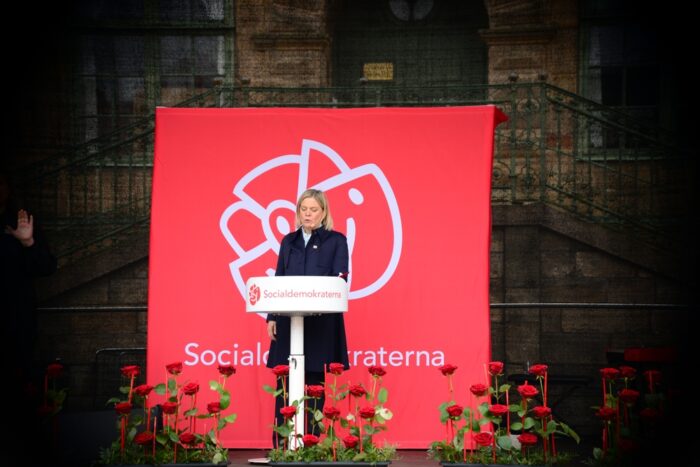
Compared to 2019, the Social Democratic Party lost one out of four voters in the Danish EP election. But contrary to other countries in Europe, Danish SDP voters took a left turn. The vote for the populist right only increased marginally, and the combined vote of pro-EU parties increased.

The Social Democratic post-election party at Christiansborg, the Danish Parliament, ended before it really began. True, the Danish SDP managed to keep its three seats in the European Parliament, but at the same time it lost one out of four voters. Only 15.6 per cent of voters opted for an SDP candidate, the lowest electoral support for the SDP ever recorded for an EP election. If SDP activists and guests really were looking for a party, they had to take the stairs one floor up at Christiansborg to the Socialist People’s Party (SPP) that is part of the Green group in the European Parliament. By and large, the SPP electoral gains equalled the Social Democrat’s losses. With 17.4 per cent of the vote, the SPP became the largest party. For the first time ever.

Combined, the progressive parties of the Left, mustered around 43 per cent of the vote – the same as five years ago – and they even managed to secure one MEP more than they did in the 2019 election. So even if the SDP was bleeding votes, these flowed toward the progressive left rather than the populist right.

Undoubtedly, part of the reason why the SDP lost so many voters compared to 2019 is the unpopularity of the current Danish government, and troubles on the domestic front once again spilt over on the European one. The SDP also lost ground because it lacked an edge in the debates on the big issues. Most of the parties running for election agreed on high climate ambitions, a stern immigration policy, and a strong pro-Ukraine security policy – the three issues most salient to voters. When so-called valence issues dominate the debates and candidates largely agree on goals and ambitions, voters often become less engaged. The low turnout – 58 per cent in 2024 compared to 66 per cent in 2019 – is an indication of this. In this context, the top SDP candidates failed in mobilising voters and fostering enthusiasm for the SDP.

A mid-term election for an unpopular government

Since December 2022, the Danish SDP has been leading a majority coalition government that includes the new centre party Moderaterne and the old liberal party Venstre. Historically, Venstre has been fighting any SDP-led government and has taken the leadership in centre-right governments. Most observers, as well as voters, see the government as a coalition of somewhat strange bedfellows. At the EP election, the three governing parties got 38 per cent of the vote, just a bit more than the 34 per cent they would muster in the Folketing if there was an election tomorrow, according to recent polls.

The populist Right did not get it right

Contrary to what we have seen in most European countries, enthusiasm for populist right parties was limited at the Danish EP election. The two harshest anti-immigration parties, the Danish Peoples Party and the new Denmark Democrats, got 13.8 per cent of the vote and one additional seat in the EP. This is three per cent more than in 2019, but 13 per cent less than in 2014. Besides, support for outright anti-EU parties actually declined.

There was no big turn to the populist right at the Danish EP election, partially because all parties now seem to agree on a stern immigration policy that strengthens the control of EU borders and does not allow more refugees into Denmark. In fact, no parties argued strongly against this position. Therefore, the populist right failed to mobilise Social Democratic voters on the immigration issue. 

Photo Credits: Shutterstock.com/oleschwander

Find all related Progressive Post
Progressive Post

03/10/2024
Andreas SCHIEDER

A bigger bang

03/10/2024
Eva ZEGLOVITSMartin OPPENAUER

A far-right triumph: Austria’s 2024 election and the FPÖ’s historic win

03/10/2024
Felix BUTZLAFF

The revenge of the countryside

Post navigation

Previous: A summit of the future in New York
Next: A far-right triumph: Austria’s 2024 election and the FPÖ’s historic win
Sitemap
  • Newsletter
  • Themes
  • FEPS Logo
  • Search
  • About
  • Member Area
Logo feps
Contact

Foundation for European Progressive Studies
Avenue des Arts - 46, 1000 Bruxelles
+32 223 46 900 - info@feps-europe.eu
communication@feps-europe.eu

  • Legal
  • Disclaimer
  • Privacy Policy
© 2024 FEPS-EUROPE. All Rights Reserved.
REG 490049891801-93
Amofordesign
XThis website uses cookies. Some cookies are necessary for the proper functioning of the website and cannot be refused if you wish to visit the website.
Other cookies are used for Advertisement and Analytics (Sharing on social networks, video playing, analysis and statistics, personalized advertising ...) You can refuse them if you want to.
REJECTACCEPTCookie settings
Manage consent

Privacy Overview

This website uses cookies to improve your experience while you navigate through the website. Out of these cookies, the cookies that are categorized as necessary are stored on your browser as they are essential for the working of basic functionalities of the website. We also use third-party cookies that help us analyze and understand how you use this website. These cookies will be stored in your browser only with your consent. You also have the option to opt-out of these cookies. But opting out of some of these cookies may have an effect on your browsing experience.
Necessary
Always Enabled
Necessary cookies are absolutely essential for the website to function properly. These cookies ensure basic functionalities and security features of the website, anonymously.
CookieDurationDescription
cookielawinfo-checkbox-advertisement1 yearSet by the GDPR Cookie Consent plugin, this cookie is used to record the user consent for the cookies in the "Advertisement" category .
cookielawinfo-checkbox-analytics11 monthsThis cookie is set by GDPR Cookie Consent plugin. The cookie is used to store the user consent for the cookies in the category "Analytics".
cookielawinfo-checkbox-functional11 monthsThe cookie is set by GDPR cookie consent to record the user consent for the cookies in the category "Functional".
cookielawinfo-checkbox-necessary11 monthsThis cookie is set by GDPR Cookie Consent plugin. The cookies is used to store the user consent for the cookies in the category "Necessary".
cookielawinfo-checkbox-others11 monthsThis cookie is set by GDPR Cookie Consent plugin. The cookie is used to store the user consent for the cookies in the category "Other.
cookielawinfo-checkbox-performance11 monthsThis cookie is set by GDPR Cookie Consent plugin. The cookie is used to store the user consent for the cookies in the category "Performance".
csrftokenpastThis cookie is associated with Django web development platform for python. Used to help protect the website against Cross-Site Request Forgery attacks
JSESSIONIDsessionThe JSESSIONID cookie is used by New Relic to store a session identifier so that New Relic can monitor session counts for an application.
viewed_cookie_policy11 monthsThe cookie is set by the GDPR Cookie Consent plugin and is used to store whether or not user has consented to the use of cookies. It does not store any personal data.
Functional
Functional cookies help to perform certain functionalities like sharing the content of the website on social media platforms, collect feedbacks, and other third-party features.
CookieDurationDescription
__cf_bm30 minutesThis cookie, set by Cloudflare, is used to support Cloudflare Bot Management.
S1 hourUsed by Yahoo to provide ads, content or analytics.
sp_landing1 dayThe sp_landing is set by Spotify to implement audio content from Spotify on the website and also registers information on user interaction related to the audio content.
sp_t1 yearThe sp_t cookie is set by Spotify to implement audio content from Spotify on the website and also registers information on user interaction related to the audio content.
Performance
Performance cookies are used to understand and analyze the key performance indexes of the website which helps in delivering a better user experience for the visitors.
Analytics
Analytical cookies are used to understand how visitors interact with the website. These cookies help provide information on metrics the number of visitors, bounce rate, traffic source, etc.
CookieDurationDescription
CONSENT2 yearsYouTube sets this cookie via embedded youtube-videos and registers anonymous statistical data.
iutksessionThis cookie is used by Issuu analytic system to gather information regarding visitor activity on Issuu products.
s_vi2 yearsAn Adobe Analytics cookie that uses a unique visitor ID time/date stamp to identify a unique vistor to the website.
Advertisement
Advertisement cookies are used to provide visitors with relevant ads and marketing campaigns. These cookies track visitors across websites and collect information to provide customized ads.
CookieDurationDescription
NID6 monthsNID cookie, set by Google, is used for advertising purposes; to limit the number of times the user sees an ad, to mute unwanted ads, and to measure the effectiveness of ads.
VISITOR_INFO1_LIVE5 months 27 daysA cookie set by YouTube to measure bandwidth that determines whether the user gets the new or old player interface.
YSCsessionYSC cookie is set by Youtube and is used to track the views of embedded videos on Youtube pages.
yt-remote-connected-devicesneverYouTube sets this cookie to store the video preferences of the user using embedded YouTube video.
yt-remote-device-idneverYouTube sets this cookie to store the video preferences of the user using embedded YouTube video.
yt.innertube::nextIdneverThis cookie, set by YouTube, registers a unique ID to store data on what videos from YouTube the user has seen.
yt.innertube::requestsneverThis cookie, set by YouTube, registers a unique ID to store data on what videos from YouTube the user has seen.
Others
Other uncategorized cookies are those that are being analyzed and have not been classified into a category as yet.
CookieDurationDescription
COMPASS1 hourNo description
ed3e2e5e5460c5b72cba896c22a5ff98sessionNo description available.
loglevelneverNo description available.
Save & Accept