


18/07/2025
In the beginning, there was the word
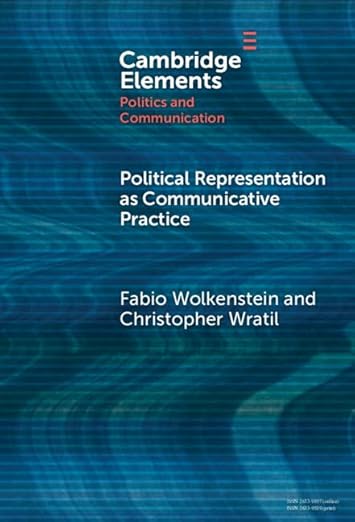
Political Representation as Communicative Practice
by Fabio Wolkenstein and Christopher Wratil
Cambridge University Press, 2025
Almost 15 years ago, one of the iconic political scientists of this century, Pippa Norris, published a book with the gloomy title Democratic Deficit (Cambridge University Press, 2011). It begins with the statement that an infinite number of pages have already been written about the crisis of representative democracy. Nevertheless, she argues, there are still things to add – and she challenges her readership to think about the gap between the performance of democracy and the aspirations of citizens. Norris points to the fact that there is a growing dissatisfaction among the people with the failure of public institutions to deliver, leading to an erosion of trust. The process is further fuelled by what she calls ‘negative news’. Remembering her groundbreaking work today, while watching the tectonic shifts that are taking place across the political landscape in Europe, prompts a question: is the issue of delivering on political promises still relevant, or has the main question become one of perception? This is one of several key considerations pondered in a book by the same publisher, but written by two political scientists of a new generation: Fabio Wolkenstein and Christopher Wratil (both scholars at the University of Vienna).
In Political Representation as Communicative Practice, they reflect an ambition to broaden Norris’s approach, or even to be pioneers in a new field of research – a task they accomplish in just 92 pages. Wolkenstein and Wratil go beyond the traditional schemes used to describe the crisis of political representation through the lenses of opinion polls and electoral figures. They challenge these schemes by claiming that on the one hand, there is no linear development when it comes to levels of trust in institutions and stakeholders across the EU, and that on the other hand, the discourse focused only on electoral aspects misses an entire dimension of political life. Instead, the authors argue that the degree to which democracies are representative should be determined from the perspective of democracy as a communication process.
This is a critical reflection in a context where so much is influenced by media and social media bubbles, and where so much content is controlled by global media oligarchs or pushed through by so-called ‘influencers’. Wolkenstein and Wratil’s way of considering the degree to which a democracy is representative is an invitation to think differently about politics and, hence, the role of communication processes. Potentially, it liberates political analysts from focusing exclusively on the decline of traditional electorates and stakeholders – and it shows that categories of ‘traditional voters or parties’ and their performance are not sufficient for grasping the nature of political changes, the shifts in opinions and attitudes and the transfer of voters.
Wolkenstein and Wratil’s book departs from the often-repeated question ‘how can the historical political parties reconnect with disenchanted citizens?’ Instead, it asks a new question: ‘how can the historical political parties become the political agents seen as speaking on behalf of diverse citizens?’. Wolkenstein and Wratil argue that it is impossible to continue thinking that only elected politicians can speak on others’ behalf, and they mention social mobilisation, as well as public figures such as Bono from U2 (p. 29/ who claimed to “speak for those who have no voice”). The authors suggest that in the current era, the constituencies that vote for certain parties or politicians (and not for the others) are no longer to be framed as a parenthesis of the traditional ‘core electorates’ or as their spin-off. Instead, these constituencies must be understood as creations resulting from communicative acts. It is about how an issue is articulated that forms a collective, which eventually supports one political force or another. This makes the electorate much more volatile and leads to a situation the authors call “political surrogacy”. Citizens can feel represented by politicians they had not voted for – a situation frequent in multipartisan systems, where voters swinging between the parties is common. Interestingly, the authors state that the readiness to relate to political surrogates is greater among more educated cohorts. These innovative ideas shed new light on how populism can be attractive to those whom the authors describe as more sophisticated consumers of communication acts – a group only a relatively small body of literature has focused on so far (p.51).
Evidently, the authors do not suggest that every communication act (verbal or non-verbal) can trigger an electoral shift. They neither claim that citizens have no filter when digesting information about the different aspects of the representation of a communication act. On the contrary, in their interactive-constructivist perspective (inspired also by the work of others such as Jürgen Habermas), they believe there is a two-way street. Voters are driven by values, partisanship, group-based identities, cognitive abilities and political sophistication (p.40). At the same time, the communication act has at least six dimensions (substantive, descriptive, the above-mentioned surrogacy, justification, personalisation and responsiveness). All of these are duly explained and exemplified, using case studies that focus, for example, on how Joe Biden aspired to be the president of all Americans (and not only those who elected him); how Jacinda Ardern acted in a way that made others connect with her after the Christchurch city council attack; how the FPÖ shifted from representing just one group to sounding as if their policies would benefit all. Based on these case studies, the authors prove that electoral support is no longer dependent on voters finding the best match between their beliefs and the candidates/parties, but that it is more a result of a communication act which, the authors insist, is a two-way street. It is not only about the communication package or content, but even more about how content and communication are perceived.
All these examples are fairly recent, making the book’s findings appear easily applicable. However, there are several caveats. The authors show that women are more successful than men in coining more pluralist, and therefore more inclusive, messages. Female politicians appear to be quite communitarian, inclusive and consistent in representing their respective parties’ lines. The problem is that today, the personalisation aspect of politics and the readiness to rebel are perceived as more genuine and hence earn more trust among voters. And these non-conformist approaches are more attributed to men (as shown by the example of the Brexit debates in the UK’s House of Commons). This provides an insight into the cultural war which affects many spheres, including politics, and into the fact that women may have to face even harder fights in the future.
Voters seem to reject politicians who try to justify themselves and who explain their actions by enlisting the promises they have fulfilled, and, hence, ask to be re-elected on this basis. This observation is unsettling, but for traditional parties, it should be a hint that neither the social contract nor a mandate is given as an omnibus package by default. Every election is, therefore, more of a new chapter than a sequel.
Political Representation as Communicative Practice should be read by all those keen on understanding what drives contemporary politics. There is a great wealth of material gathered in the book, as well as an original proposal on understanding the function of political communication in the context of representation, support and mandate. Where Wolkenstein and Wratil’s book has perhaps not fulfilled expectations is in its take on how politicians can avoid being deceived by the perceptual illusion generated by opinion polls. And concerning this, the book focuses on connections through communicative acts rather than how communication could help educate the public, raise aspirations and change opinions. But then again, the authors’ choice to narrow the focus is legitimate. Assuming others will perceive it as innovative, it is quite likely that the debate will be continued and that reference will be made to their arguments in the future.
Find all related Progressive Post
Progressive Post