
26/03/2026
Gramscianism of the right
Rita Abrahamsen, Jean-François Drolet, Michael C. Williams, Srdjan Vucetic, Karin Narita and Alexandra Gheciu
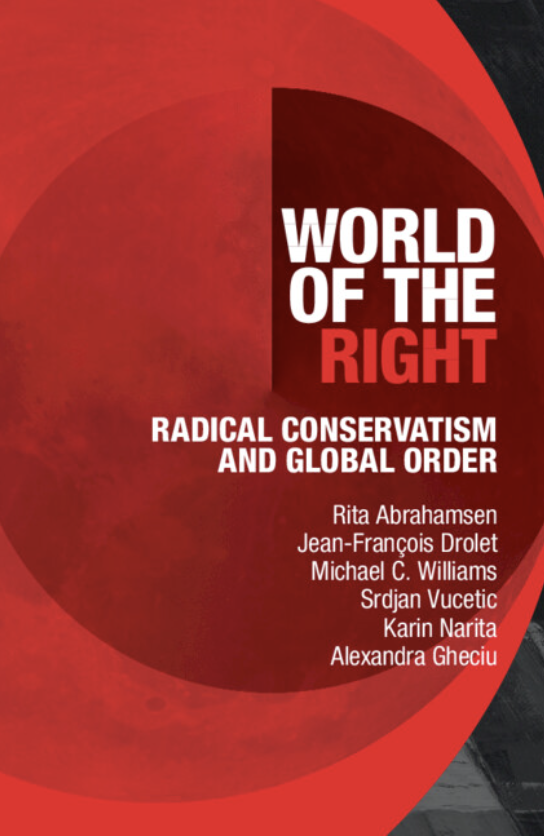
World of the Right. Radical Conservatism and Global Order
Cambridge University Press, 2024
‘Project 2025’ was a topic of the highest interest to political observers before, and even more so after, Donald Trump’s re-election as US president in November 2024. Led by the Heritage Foundation and backed by a coalition of over 100 conservative organisations, Project 2025 is a playbook for transforming the US government. Furthermore, it aims to reshape the American public. Applying the terminology of the Italian Marxist philosopher Antonio Gramsci, Project 2025 is part of a counter-hegemonic strategy to progressive and liberal understandings and worldviews in public spheres. Crucially, gaining cultural hegemony for conservative ideas is not only an American project of the Heritage Foundation. It is a phenomenon linking radical right forces globally.
But what exactly is the radical right’s cultural counter-hegemonic strategy? What is driving the radical right to build transitional alliances? And what exactly do they want to achieve? World of the Right. Radical Conservatism and Global Order, co-authored by six international affairs academics from the University of Ottawa, Queen Mary University of London, and the University of Sheffield, provides profound answers to these questions. It maps the global right’s transnational initiatives, traces key elements of their intellectual strategies and ideological content, and assesses possible implications for the current global order. Moreover, it explains how, despite differing national contexts and policies, the radical right can form a global movement at all.
There is a certain irony that concepts developed by the left-wing thinker Gramsci provide the radical right with intellectual and political inspiration for how their movement might successfully challenge the existing liberal order and power. In a nutshell, a counter-hegemonic strategy requires various cultural actors and intellectuals to undertake a systematic critique of the existing order and replace it with a dominant power structure, along with dominant ideologies and cultural norms. Assuming that culture underpins and supports social orders, these cultural actors and intellectuals engage in a long-term war of position, aiming to transform societal common sense to favour political change toward a new order. In fact, this is exactly what the global radical right has been doing for some time now.
As the book demonstrates, attempts to develop a Gramscianism of the right go back to the late 1960s, when militant right-wing intellectuals of the French Nouvelle Droite tried to make use of Gramsci’s core ideas for a counter-hegemonic project. Most prominent among these intellectuals was probably Alain de Benoist, a highly influential thinker of the radical right, well beyond France, and a strong critic of the liberal international order. Today, extreme-right thinkers from all parts of the world are engaged in this war of position. To name just a few, they include the Russian radical-right ideologue Alexander Dugin; the Pan-African writer and activist Kemi Seba, who advocates a radical racial ‘ethno-differentialism’, parallel to the European radical right’s identitarian, anti-immigration discourse; and the American neo reactionary and openly racist internet philosopher Curtis Yarvin.
In practical terms, the radical right’s counter-hegemonic strategy comprises various elements. Of course, there is their often-discussed offensive use of digital communication and social media that has helped them rise and gain visibility. However, the authors of the book point out that there are other important fronts in the war of position where the radical right has invested heavily. First, there is the publishing industry, with a sharp rise in the number of publishing houses, journals, podcasts, and online magazines making radical-right content available. A prime example is the publishing house Arktos, which has a strong anti-globalism agenda. Second, there are right-wing educational institutions dedicated to educating a new elite that is equipped with the skills to fight the war of position. In the US, one of the most established and influential educational institutions with a radical-right agenda is Hillsdale College in Michigan, which has a reputation as a feeder school for the Trump administration. In Europe, the Hungarian Ludovika University of Public Services is noteworthy for having 5,000 students enrolled annually across four faculties and for maintaining close relations with Viktor Orbán’s government and the Fidesz party. Moreover, new research shows that numerous radical-right think tanks have been established in various parts of the world in recent years, and that they work closely together via transnational networks to share ideas, concepts and strategies (see, for example, Thomas Greven, The Global Radical Right. Transatlantic Networks, published by Friedrich-Ebert Stiftung, 2025).
World of the Right‘s most interesting and strongest parts are those on the global radical right’s common driving forces. First and foremost, despite differing national agendas and positions, radical-right forces worldwide constitute a global right due to their opposition to globalism and similar visions of the global order. Central to their conception of the world is the so-called managerial class. This is a global elite of corporate executives, academics, journalists, government bureaucrats and staff in supranational institutions like the European Union and United Nations, benefiting from the international liberal order and targeting traditional social orders that oppose its expansion. The framing of a new class provides a shared line of discourse and a powerful rhetoric of a common enemy. Clearly, this concept of class is no longer defined by the left’s anti-capitalism but by its opposition to the new class of a global liberal managerial elite. Furthermore, it explains why the radical right can bring together actors from multiple locations around the world.
Attacking the managerial class and the international liberal order, which operates on multilateralism as its primary principle, the radical right’s vision for a new global order is embedded in multipolarity and civilisationalism. In short, only a strong civilisation with compatible national states will prosper in a multipolar world. Driven by a feeling of not being recognised by the Western powers that dominate the multilateral system, illiberal states such as China and Russia, as well as states and people in the Global South, are equally lured by this multipolar global vision, resonating anti-Westernism and anti-colonialism. Furthermore, the radical right’s civilisational understanding of multipolarity has implications for the EU. There are basically two narratives. While the first aims to install an ethno-pluralist order and to reject the EU completely, the second favours a patriotic Europe that defends the sovereignty of EU member states and challenges the EU’s liberal norms. A development in either of these directions would jeopardise the EU’s system, which provides freedom and prosperity to European citizens.
By covering all of the above topics, the World of the Right comprehensively delivers on its own objective of helping understand the global radical right and of finding ways to counter it. Progressives worldwide therefore need to mobilise and strengthen their cooperation, sharpen and reclaim their narratives, expand their funding for activities, and build a diverse leadership.
Find all related Progressive Post
Progressive Post