

15/04/2026
Among European heads of state and government, Spain’s Prime Minister Pedro Sánchez alone went out with a categorical critique and rejection of the US-Israeli aggression against Iran, which was launched on the last day of February. No sympathy for the theocratic regime of Iran was behind this, along with a good understanding of the consequences of the systematic violation of international law by the US and Israel, and the risks of such a war for Europe, which needs neither another energy crisis nor another humanitarian crisis with hundreds of thousands of refugees involved.
This has not been the only action that has separated Spain’s Socialist government from the right-wing majority in Europe. A little earlier in February, the Spanish government had also announced social media restrictions for children under 16, six months after a similar measure was introduced by the Australian Labour government. The smart regulation is expected to diminish the risk of mental health problems among adolescents, and it can be implemented without throwing out the baby (all the positive services contemporary info-communication tools offer) with the bathwater.
Fifteen years ago, Spain suffered most from the EMU (economic and monetary union) crisis, along with Greece. The government of Mariano Rajoy followed the flawed recipes of internal devaluation and was even proud of it. Since Sánchez became PM, the minimum wage has increased by 66 per cent, demonstrating that real change is possible when Socialists govern for the public good, rather than for privileged interests. Moreover, the Spanish government published a blueprint earlier this year to transform corporate governance and boost economic democracy, including employee participation.
In economics, Spain has been a star performer in the last five years. Capitalising on the EU’s recovery funds after the Covid-19 recession, Spain has orchestrated a new path of sustainable and inclusive growth, with particular attention to gender equality. The country is now among the leaders in renewable energy and digitalisation. Sánchez bravely went ahead with the naturalisation of about half a million immigrants, a measure that triggered the ire of right-wing ministers, MEPs and ordinary commentators across Europe.
And the gentleman is not for turning. Thanks to the robust delivery at home and the principled approach to foreign policy, his support remains strong. This is in sharp contrast, regrettably, with countries where Social Democrats continue to experience erosion of electoral support, or even greater setbacks. One could have the impression that the political pendulum is broken in some countries: a swing to the right was not followed by a swing back to the left, but the replacement of the Social Democratic forces with some new populist tendency.
In the spring of 2025, it was a welcome development that in both Germany and Austria, the Social Democratic parties decided to join grand coalitions. This has delivered badly needed stability, which is the positive side. However, these positions in government have not yet resulted in improved popularity in either case. Not only more time, but also much more innovation will be needed to regain support and fend off the risk of relegation to second-order political forces. Meanwhile, a more acute crisis has developed in the United Kingdom, in the aftermath of the Mandelson-McSweeney imbroglio. The Labour Party had been on a rollercoaster even without these revelations, and the full consequences still need to play out. Even if one looks back to the 1976 IMF crisis or the split of the Social Democrats in 1981, it is hard to find a crisis in the history of UK Labour that would have been deeper and more troubling than the one unfolding before our eyes, given the oversized influence of Peter Mandelson over the development of the Labour Party ever since the late 1980s.
‘Third Way’ thinking was once an export product as well. It was loved in East Central Europe following the rise of Tony Blair and Gerhard Schröder some 25 years ago, and its modernist messages had a strong appeal in new EU member states after 2004. However, the consequence was that Socialists in this region began to lose focus on economic and social development, and they lost support in peripheral areas and then in every other area. They have experienced a decline following EU accession, primarily because EU membership did not lead to upward convergence in social conditions. First in Poland, and then in Czechia, there have been parliaments without any progressives. In Hungary, 2026 marks the culmination of a long period of exhaustion, division and agony.
The silver lining is that in Northern Europe, Social Democrats not only remain top players, but the centre-left parties entered 2026 with hope and confidence ahead of the parliamentary elections of the coming period. Northern Europe has always been a great attraction for progressives, with the caveat that, in reality, the region represents a relatively small population. And it was always wishful thinking that Sweden (or, more broadly, Scandinavia) could be copied and pasted onto the rest of the world. Nevertheless, even without the illusion of transplants, inspiration certainly comes oftentimes from the North.
And more recently, the presidential election in Portugal has also come as a pleasant surprise, with the victory of the former PS leader António José Seguro. In a way, his triumph can be compared to the French parliamentary election in June 2024, when the pop-up Popular Front managed to defeat the ferocious far-right bloc, to which Macron’s irresponsibility opened the door, following the European Parliament election debacle of the liberal centrists. From these two cases, it appears that Social Democracy can offer a unifying platform, when needed, against the far right, although rallying cries against fascists and other extremists alone will not deliver Socialists success and save democracy.
Altogether, Pedro Sánchez is not alone, and as a matter of fact, he is not alone even in the European Council. Denmark, Lithuania and Malta are also represented by Social Democrats, and they need the support of the entire political family, even if in some of their policies they may not represent the median opinion of the centre-left, and sometimes they find themselves in unusual domestic conflicts. And, very importantly, Antonio Costa, the President of the European Council, has indeed played the role of the ‘adult in the room’, for example, when he distanced himself from Ursula von der Leyen, who spoke so carelessly about abandoning international law and the rules-based international order.
It is too early to look for a historical comparison. But we shall not forget what Sánchez said to those who thought he was isolated. “You may have heard that Spain is alone. They’re the same people who said that when we recognised the State of Palestine, and then others followed”. And the conclusion: “We are not alone. We are the first. Those who will end up alone are the ones defending the indefensible”.
Photo credits: Pool Moncloa / Borja Puig de la Bellacasa
Find all related Progressive Post
Progressive Post

Find all related events
Events

Budapest, Hungary (Expert meeting)

Warsaw, Poland (Expert Meeting)
FEPS HQ, Brussels
Vienna, Austria (Training)
Load more...
Find all related publications
Publications
Find all related Audiovisual
Audiovisual
06/11/2026
06/11/2026
21/09/2026
27/06/2026
Find all related news
News
Find all related in the media
In the media
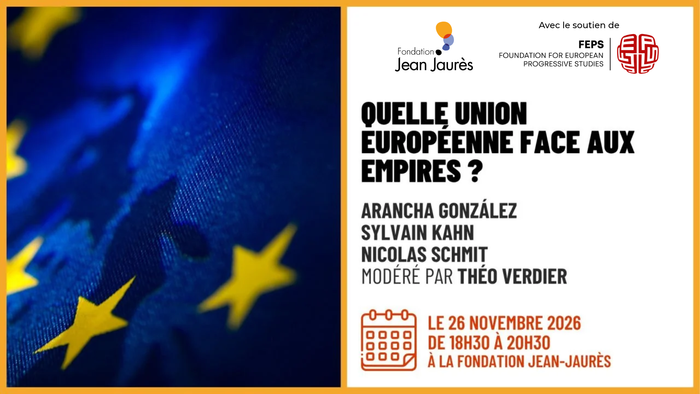
“A civic revolution, not yet a social revolution”
Interview with László Andor, FEPS Secretary General, published by Fondation Jean-Jaurès (FR), analysing the electoral defeat of Viktor Orbán, the emergence of a broad opposition movement in Hungary, and the prospects for democratic renewal, EU relations and social change following what he describes as a “civic revolution” that has yet to deliver a social transformation.
“Money is coming! Will Péter Magyar deliver on his promise?”
Video Interview published on KlikkTV (HU), featuring László Andor, FEPS Secretary General, discussing EU funds to Hungary, their political conditionality, and the importance of fair distribution, rule of law and social investment within the European Union.
‘Bruselas, ¿te Quiero?’ Tras un verano cruel, Von der Leyen pide a Europa que “luche”
by Euronews 16/09/2025
László Andor: «En Hongrie, malgré l’érosion de la popularité d’Orbán, la gauche peine à regagner en crédibilité»
by Le Figaro 25/08/2025