

24/03/2026
Billions in damage, thousands of deaths, increasingly vulnerable territories: climate adaptation is no longer optional for Europe. €70 billion per year is necessary until 2050, but current funds are insufficient. A new levy on the extra profits of fossil fuel companies could finance safety, health and economic stability.
Climate adaptation must become a strategic priority for Europe. No preambles or euphemisms are needed to highlight the ongoing urgency. The data speaks for itself. Climate change cost €54 billion in property and infrastructure damage in 2022 and €40 billion in 2024, according to the European Environment Agency. And there is an incalculable cost to public health: in the summer of 2024 alone, heatwaves were estimated to have caused approximately 62,775 deaths. In the tragic floods in Valencia, Spain, in the same year, 234 people lost their lives.
Phenomena previously considered once-in-a-lifetime catastrophes will become increasingly frequent by the middle of the century until they become the norm. Climate adaptation is, therefore, not a mere environmentalist’s pipe dream, but a matter of national and EU-wide security, economic stability, health and human well-being. Considering the significant setback in decarbonisation efforts due to the sudden decisions of US President Donald Trump and certain governments aligned with Washington on environmental and climate issues, the importance of making cities and infrastructure climate-proof has become a priority, especially in countries considered ‘climate hotspots’ – the highly vulnerable ones – such as the Mediterranean area of Spain, Italy, Greece and the rest of the southern Balkans. These are all places subject to increasingly long and intense heatwaves, long multi-year droughts and forest fires.
The concept of climate adaptation emerged in the 1970s, following the American economist William Nordhaus’s economic analysis of climate change, which defined adaptation as a rational response based on cost-benefit choices regarding climate impacts. The term gained political recognition in 1992 with the United Nations Framework Convention on Climate Change. Article 4 of this convention explicitly mentions adaptation, requiring parties to prepare for and facilitate it. It then became part of the official international political vocabulary.
Thirty-four years have passed, and technologies and adaptation know-how have expanded exponentially. Yet resources remain insufficient: current levels of funding actually committed to adaptation-related projects are estimated at €15-16 billion per year. This suggests that EU and member state resources are significantly below the estimated annual need for adaptation action. The goal is to attract at least €70 billion per year in Europe until 2050 to climate-proof the most vulnerable areas of the Union, following the EU Adaptation Strategy and implementing national climate adaptation plans, in addition to strengthening development cooperation in less developed countries, where climate disasters are a source of geopolitical, geo-economic and social instability.
So, how can additional resources for adaptation be found? Member states already have resources allocated in their budgets for adaptation and hydrogeological risk; municipalities are increasingly investing in projects to make cities climate-proof, and businesses, together with the insurance industry, are gaining awareness of climate risks and the impacts they can have on their operations, supply chains and proprietary assets through double materiality analysis. There is, however, one mechanism that can still be explored to amplify adaptation efforts: a contribution from those who have profited most from the commercialisation of climate-changing energy sources. A new tax instrument is needed to support a European Adaptation Fund (strengthening instruments such as the Cohesion Fund or LIFE), investments in resilient infrastructure (water networks, coastal protection and adaptive agriculture) and assistance for climate-vulnerable regions (Mediterranean and Alpine areas, coastal deltas).
There is already a precedent. In 2022, amid the energy crisis following Russia’s invasion of Ukraine, the EU adopted a regulation introducing a ‘temporary solidarity contribution’ on the extra profits of fossil fuel companies. Formally, it was not an EU tax but a coordinated commitment of all member states. A few liberals might say, ‘But we already have the emissions trading system (ETS)’. However, that remains a levy for mitigation, as necessary for citizens as it is for the companies that pay it, as they help invest in EU-wide energy independence and economic resilience. Moreover, it is under attack from the European sovereignist bloc.
A new ‘solidarity contribution for adaptation to climate change’ (or adaptation deal), sponsored by the EU Commission, parliament and civic society, could be attributed to the responsibilities of those fossil fuel companies that are at risk of being held liable for non-contractual climate damage in legal proceedings (see the case of Lliuya v. RWE AG). A principle can thus be defined under which supporting the adaptation deal absolves companies of medium- to long-term legal liability. A solidarity contribution until 2050 to support adaptation in Europe would constitute a voluntary remedy for companies that otherwise risk ending up bogged down in complex lawsuits over the next 15 years, from which they could emerge destroyed (and with serious economic consequences).
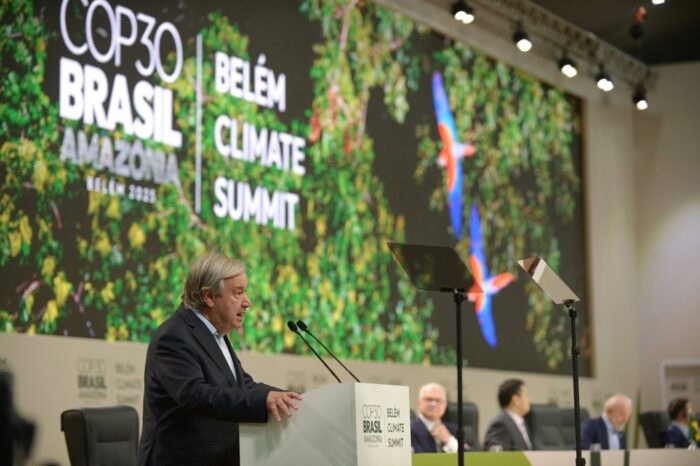
The adaptation deal is a complex proposal that requires careful technical validation and discussion with all parties. It nevertheless highlights the urgency and difficulty of mobilising sufficient resources to achieve minimum adaptation targets. On the other hand, at COP30 in Belém, one of the most significant outcomes of the negotiations was the agreement among countries to triple global climate adaptation funding by 2035. And at COP31 in Antalya, the focus will once again be on adaptation plans and a clear, strong political indication of the importance of mobilising more resources for the most vulnerable communities. However, new mechanisms and tools will be needed to generate the expected resources. Otherwise, adaptation plans will stay on paper, and people in Europe will continue to die from climate change.
Photo credits: Shutterstock/David Raw
Find all related Progressive Post
Progressive Post