
Search
Skip to content
progressive-post home
  • About
  • The magazine
  • Progressive Pages
  • Dossiers and debates
  • Election Observatory
  • Reads & Views
The Progressive Post

🇨🇿 The Czech Republic: the periphery strikes back?

CZECH REPUBLIC
ElectionsSocial Democracy
Authors
Progressive Post
Daniela OSTRA
Search author
Share:
Tweet this Share on Facebook Share on Linkedin Print

Daniela OSTRA

political scientist at the Department of Political Science and European Studies at Palacký University in Olomouc
13/06/2024

The elections to the European Parliament brought many surprises in the Czech Republic. While the historically high turnout may sound optimistic, the results themselves are a strong warning. Even our country at the heart of Europe has not escaped the phenomenon of growing support for anti-establishment populist political forces, black-and-white narratives with strong mobilisation appeals and emotions of fear and threat. 

European elections are traditionally accompanied by low interest among Czech voters. Although this year’s voter turnout exceeded 30 per cent of the vote for the first time in the country’s EU membership (36.45 per cent to be precise), this is a low figure especially compared to the turnout in the elections to the Chamber of Deputies or the presidential elections. This means that these elections are still perceived by the Czechs as second-order elections. 

The assumption of a higher interest in the European elections among people from larger cities, with higher education and higher socio-economic status, was confirmed (in Prague, more than forty per cent of citizens voted). In large cities, the governing coalition of right-wing conservative and liberal parties also scored unsurprisingly. However, what drove up turnout figures across the country was the mobilisation of voters in smaller towns and villages in what we call the ‘periphery’ – see map. These are located both on the borders and also within regions.
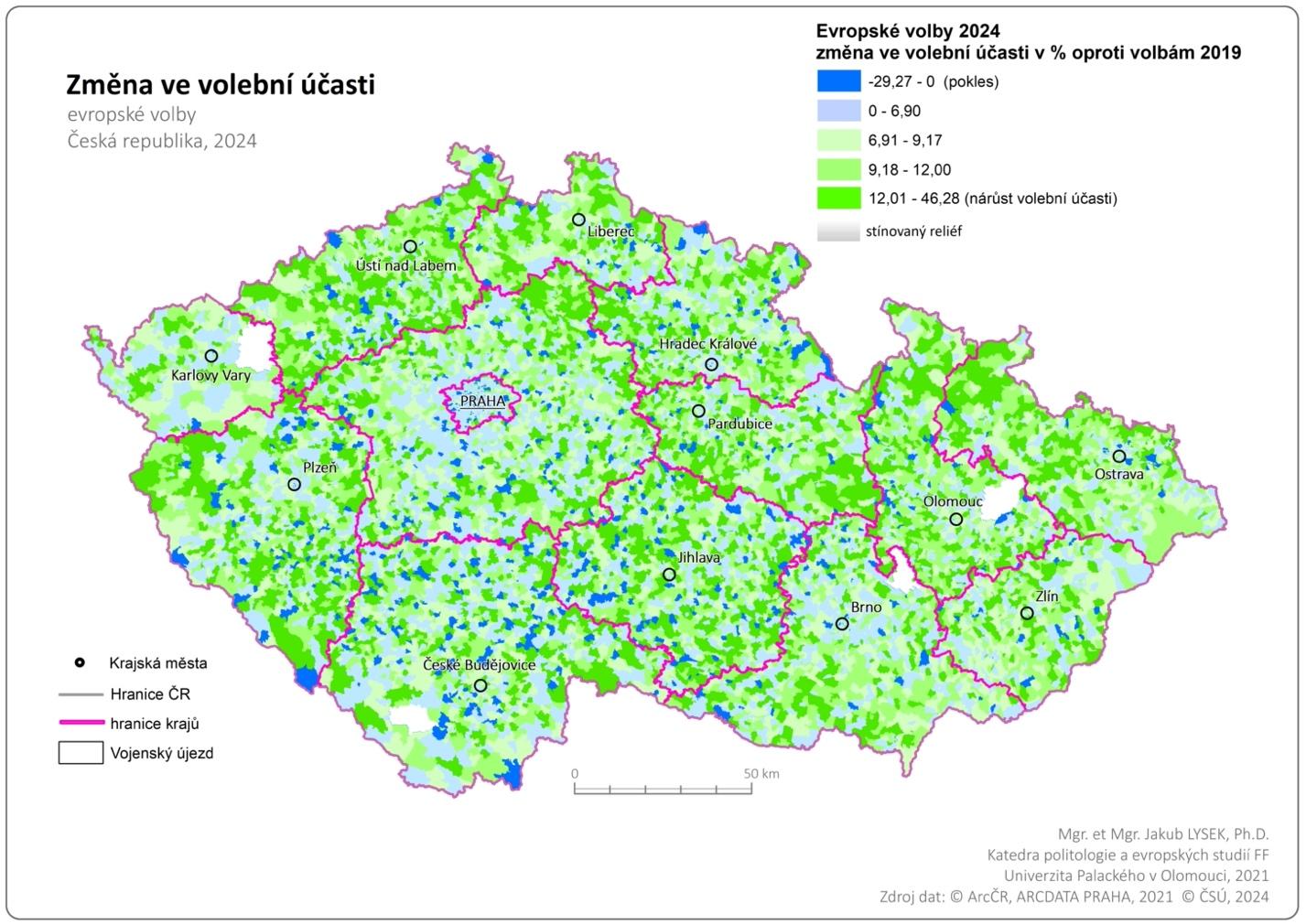
Map of changes in voter turnout, showing the increase in voters in the so-called peripheries. The darker the blue, the lower the turnout compared to 2019. Conversely, the greener the colour, the more significant the increase in turnout compared to the last European elections. Author: Jakub Lysek, Palacky University.

The outer (border) and inner peripheries share common characteristics. Low quality and availability of public services, poor transport infrastructure, more difficult access to jobs and significantly lower wages than the national average. Objectively, people who live here are more likely to send their children to lower-quality schools. They have trouble finding doctors, especially paediatricians and specialists. Dental care has completely disappeared in some areas. Regional hospitals are either privatised or have closed. The frequency of public transport services is low and insufficient. People here must rely on their own cars, often ten or twenty years old. In addition to objectively worse living conditions, several sociological studies show that people here also subjectively feel the decline of their surroundings, especially the collapse of traditional industrial firms. In short, citizens in the peripheries have little reason to trust the system (whether the state or the EU). And this election has also shown that they no longer believe in it.

Although the populist ANO movement won with 26.1 per cent of the vote, the real winners of this election are new entities with a stronger anti-system appeal. It was they who managed to mobilise the alienated voters of the Czech and Moravian peripheries by opposing the Green Deal, the migration pact and the so-called Brussels dictate. For example, the Enough! coalition, led by current Communist MEP Kateřina Konečná. The leader of the Czech Communists has managed to hide an unattractive old left-wing party behind a new brand and to attract independent candidates from the conservative nationalist left as well as from the alternative right and the disinformation scene. Socio-economic issues were ignored. Konečná actively campaigned against the Green Deal, held strong opposition to the migration pact and managed to carve out a particularly strong position on the issue of the war in Ukraine (no military aid, immediate peace). There were also people on the ticket with links to the disinformation scene and the anti-vaxxer movement, whose ability to use alternative forms of communication (mass emails, closed groups on social networks, etc.) allowed them to reach out to broad groups of disaffected citizens.

The other successful entity is the Oath and Motorists coalition, which also won two seats. They owe their success to their charismatic leader Filip Turek, who was a well-known figure on social media, where he often commented on political events. Turek is characterised by his arrogance, chauvinism, macho style and criticism of progressive politics. His most prominent theme was the protection of motorists, specifically the lifting of the ban on the production of cars with internal combustion engines. With this, Turk managed to appeal especially to young men and those who feared losing their beloved cars due to the EU regulations. In the peripheries, a car is necessary to get to work to the doctor or to a supermarket. Protecting cars from the ‘evils’ of Brussels was a simple and strongly mobilising issue with clear emotion. However, behind the seemingly trivial topic, there is a more complex sociological and psychological construct. People, especially those of lower socio-economic status, who have lost rather than gained ground in all the crises of recent years, have a subconscious fear of the challenges we will face as a society because of adaptation to climate change. Both Konečná and Turek tell these people that they will stop these changes. Symbolic of this is the Green Deal being pushed by the elites (right-wing government, progressives) versus the defenders of the internal combustion engine – signifying the old order (Konečna, Turek). The vote for anti-establishment was a vote against the system and for a world that people know and somehow still manage to make a living in.

Finally, a brief word about the result of the only democratic left – Social Democracy. After dropping out of the chamber of deputies in 2021, the Social Democrats are seeking a rebrand. However, they won only 1.9 per cent of the vote in the European election and have only a year to get out of the critical situation before the next parliamentary elections. Their efforts are hampered by a lack of funding compared to their competitors, limited opportunities to get their messages and new personalities into the media, and most importantly, a loss of relevance. Moreover, it is very difficult for them to take clear positions in the current polarised political debate and not fall into the trap of culture wars.

Photo Credits: Shutterstock.com/MichalKalasek

Find all related Progressive Post
Progressive Post
03/10/2024
Andreas SCHIEDER

A bigger bang

03/10/2024
Eva ZEGLOVITSMartin OPPENAUER

A far-right triumph: Austria’s 2024 election and the FPÖ’s historic win

03/10/2024
Felix BUTZLAFF

The revenge of the countryside

Post navigation

Previous: A summit of the future in New York
Next: A far-right triumph: Austria’s 2024 election and the FPÖ’s historic win
Sitemap
  • Newsletter
  • Themes
  • FEPS Logo
  • Search
  • About
  • Member Area
Logo feps
Contact

Foundation for European Progressive Studies
Avenue des Arts - 46, 1000 Bruxelles
+32 223 46 900 - info@feps-europe.eu
communication@feps-europe.eu

  • Legal
  • Disclaimer
  • Privacy Policy
© 2024 FEPS-EUROPE. All Rights Reserved.
REG 490049891801-93
Amofordesign
XThis website uses cookies. Some cookies are necessary for the proper functioning of the website and cannot be refused if you wish to visit the website.
Other cookies are used for Advertisement and Analytics (Sharing on social networks, video playing, analysis and statistics, personalized advertising ...) You can refuse them if you want to.
REJECTACCEPTCookie settings
Manage consent

Privacy Overview

This website uses cookies to improve your experience while you navigate through the website. Out of these cookies, the cookies that are categorized as necessary are stored on your browser as they are essential for the working of basic functionalities of the website. We also use third-party cookies that help us analyze and understand how you use this website. These cookies will be stored in your browser only with your consent. You also have the option to opt-out of these cookies. But opting out of some of these cookies may have an effect on your browsing experience.
Necessary
Always Enabled
Necessary cookies are absolutely essential for the website to function properly. These cookies ensure basic functionalities and security features of the website, anonymously.
CookieDurationDescription
cookielawinfo-checkbox-advertisement1 yearSet by the GDPR Cookie Consent plugin, this cookie is used to record the user consent for the cookies in the "Advertisement" category .
cookielawinfo-checkbox-analytics11 monthsThis cookie is set by GDPR Cookie Consent plugin. The cookie is used to store the user consent for the cookies in the category "Analytics".
cookielawinfo-checkbox-functional11 monthsThe cookie is set by GDPR cookie consent to record the user consent for the cookies in the category "Functional".
cookielawinfo-checkbox-necessary11 monthsThis cookie is set by GDPR Cookie Consent plugin. The cookies is used to store the user consent for the cookies in the category "Necessary".
cookielawinfo-checkbox-others11 monthsThis cookie is set by GDPR Cookie Consent plugin. The cookie is used to store the user consent for the cookies in the category "Other.
cookielawinfo-checkbox-performance11 monthsThis cookie is set by GDPR Cookie Consent plugin. The cookie is used to store the user consent for the cookies in the category "Performance".
csrftokenpastThis cookie is associated with Django web development platform for python. Used to help protect the website against Cross-Site Request Forgery attacks
JSESSIONIDsessionThe JSESSIONID cookie is used by New Relic to store a session identifier so that New Relic can monitor session counts for an application.
viewed_cookie_policy11 monthsThe cookie is set by the GDPR Cookie Consent plugin and is used to store whether or not user has consented to the use of cookies. It does not store any personal data.
Functional
Functional cookies help to perform certain functionalities like sharing the content of the website on social media platforms, collect feedbacks, and other third-party features.
CookieDurationDescription
__cf_bm30 minutesThis cookie, set by Cloudflare, is used to support Cloudflare Bot Management.
S1 hourUsed by Yahoo to provide ads, content or analytics.
sp_landing1 dayThe sp_landing is set by Spotify to implement audio content from Spotify on the website and also registers information on user interaction related to the audio content.
sp_t1 yearThe sp_t cookie is set by Spotify to implement audio content from Spotify on the website and also registers information on user interaction related to the audio content.
Performance
Performance cookies are used to understand and analyze the key performance indexes of the website which helps in delivering a better user experience for the visitors.
Analytics
Analytical cookies are used to understand how visitors interact with the website. These cookies help provide information on metrics the number of visitors, bounce rate, traffic source, etc.
CookieDurationDescription
CONSENT2 yearsYouTube sets this cookie via embedded youtube-videos and registers anonymous statistical data.
iutksessionThis cookie is used by Issuu analytic system to gather information regarding visitor activity on Issuu products.
s_vi2 yearsAn Adobe Analytics cookie that uses a unique visitor ID time/date stamp to identify a unique vistor to the website.
Advertisement
Advertisement cookies are used to provide visitors with relevant ads and marketing campaigns. These cookies track visitors across websites and collect information to provide customized ads.
CookieDurationDescription
NID6 monthsNID cookie, set by Google, is used for advertising purposes; to limit the number of times the user sees an ad, to mute unwanted ads, and to measure the effectiveness of ads.
VISITOR_INFO1_LIVE5 months 27 daysA cookie set by YouTube to measure bandwidth that determines whether the user gets the new or old player interface.
YSCsessionYSC cookie is set by Youtube and is used to track the views of embedded videos on Youtube pages.
yt-remote-connected-devicesneverYouTube sets this cookie to store the video preferences of the user using embedded YouTube video.
yt-remote-device-idneverYouTube sets this cookie to store the video preferences of the user using embedded YouTube video.
yt.innertube::nextIdneverThis cookie, set by YouTube, registers a unique ID to store data on what videos from YouTube the user has seen.
yt.innertube::requestsneverThis cookie, set by YouTube, registers a unique ID to store data on what videos from YouTube the user has seen.
Others
Other uncategorized cookies are those that are being analyzed and have not been classified into a category as yet.
CookieDurationDescription
COMPASS1 hourNo description
ed3e2e5e5460c5b72cba896c22a5ff98sessionNo description available.
loglevelneverNo description available.
Save & Accept