

23/10/2024
Policies that promote gender equality – investing in the professional care work sector, boosting recognition of unpaid care work and ensuring fair wages – can help to address demographic trends in a manner that supports a more competitive, human-centred and cohesive society.
The new EU political mandate has started with a strong focus on boosting the EU’s competitiveness. This orientation responds to the EU’s gradual economic decline over the past decades, which has been exacerbated by global crises, including the Covid-19 pandemic, Russia’s war of aggression in Ukraine and the recent wave of inflation.
Many proposals to boost the EU’s competitiveness tend to present the EU’s demographics as ‘fixed’, rather than as an element that could be harnessed and shaped by policymakers. The EU’s demographic composition and its outlook, however, are relevant and should be taken into account in policy decisions. This is because competitiveness could be viewed more broadly than the production of more economic output, but also more well-being. A more holistic conception of competitiveness – one that takes demographics into account – could be more sustainable and support the EU in meeting its goals more broadly, such as the European Pillar of Social Rights and climate neutrality by 2050.
The Draghi report on competitiveness mentions a shrinking labour force and ‘deep gender gaps in some occupations’. Promoting gender equality could address both challenges to some extent, but the report barely mentions it. Addressing gender inequality could not only go hand in hand with economic growth and competitiveness but could also boost them.
Women represent about half of society’s human capital potential, yet they are far less engaged in the labour market and more vulnerable to poverty and violence. Research has shown that the lower labour market participation of women is linked to the lack of access to affordable and quality care services and unequal distribution of caretaking tasks within households. There is a ‘vicious cycle‘ that has a consequence for growth and competitiveness especially in light of the ageing population and the increasing dependency ratio.
Policies that promote gender equality could be a stabilising force for demographic trends and also promote the EU’s competitiveness. What kind of policies could be considered?
First are policies that promote the quality, accessibility and the improvement of working conditions in the professional care sector, whose workforce is predominantly (90 per cent) women. Professional care workers include childcare workers, teacher aides and personal care workers providing long-term care. The EU could support investment in the sector and also improve the monitoring of care facilities. Such actions could lead to better working conditions, salaries and career progression in the sector, which is currently quite poor and unattractive. The mandate of the European Labour Authority could be expanded to include occupational health and safety: a key issue for care workers. As many professional care workers are migrants from other EU countries or from third countries, EU policies to ensure their rights to good working conditions could complement and reinforce measures in the area of gender equality to support a fairer society, a sounder economy and a more balanced demographic outlook.
While the first category would also support the possibility for households to have access to professional care, which is of growing importance in the context of an ageing population, the second category of policies would boost the recognition of unpaid care work provided within households. Policies could support a two-fold approach: favouring a more balanced division of care tasks within households and guaranteeing that caring for a dependent does not have a negative impact on one’s job security. Building on the Work-Life Balance Directive, the EU could do more to ensure the job security of carers (who are most often women) who take time off to care for a family member in need. A system of pension credits could also be considered to compensate carers and reduce the risk of elderly poverty.
The third category of policies concerns the assurance of fair wages. The Pay Transparency Directive is a step in this direction. To go further, more needs to be done to ensure that jobs that require similar qualifications and skill levels offer comparable wages regardless of whether the job is predominantly done by men or women. Moreover, the setting of fair minimum wages could also reduce the difference in earnings between men and women, since the majority of minimum wage earners in the EU are women.
These three sets of policies could reduce the level of precarious work, which disproportionately affects women in the EU, which could lead to greater engagement of women in the labour market. We estimate that the EU’s labour market could be about 20 per cent greater if women were as engaged in the labour market as men. Such an increase could counteract the projected decline in the working-age population and also reduce the level of elderly poverty, which disproportionately affects women at present due to the inequality of income over the lifespan. EU policies to tackle gender inequalities in the labour market could generate up to an estimated €153 billion annually.
Women’s improved labour market engagement could also potentially affect fertility rates. Recent research from Europe has found that precarious work harms fertility, which has strengthened over time.
In terms of economic output and productivity, the EU is less competitive than the United States and increasingly challenged by emerging economies, in particular China. However, in terms of mental health, which is known to affect workplace engagement, the US fares poorly – an estimated one in four have a mental health diagnosis – far higher than many European countries. An analysis of survey data in the US finds that women who are less happy are less likely to report intentions of having another child.
Demographic trends are an important reference and should be considered by policymakers. Policies that promote gender equality – investing in the professional care work sector, boosting recognition of unpaid care work and ensuring fair wages – can help to address demographic trends in a manner that supports a more competitive, human-centred and cohesive society.
Photo credits: Shutterstock.com
Find all related Progressive Post
Progressive Post


Find all related events
Events


FEPS HQ
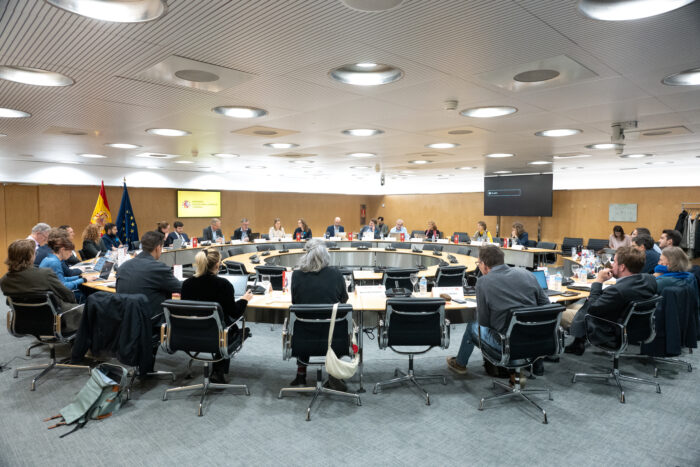
Madrid, Spain

European Parliament (Expert Meeting)

Brussels, Belgium
Load more...
Find all related publications
Publications

Find all related Audiovisual
Audiovisual
28/08/2026
28/08/2026
19/06/2026

20/05/2026
Find all related news
News
Find all related in the media
In the media
“Money is coming! Will Péter Magyar deliver on his promise?”
Video Interview published on KlikkTV (HU), featuring László Andor, FEPS Secretary General, discussing EU funds to Hungary, their political conditionality, and the importance of fair distribution, rule of law and social investment within the European Union.
España los forma, Europa los contrata: así es el mapa de la nueva fuga de cerebros
by El Confidencial 10/02/2026
“Back to the Future: The Great Reset”
Opinion article by FEPS Vice-President, Lina Gálvez reflecting on the current global crisis marked by rising authoritarianism, digital power and extreme inequality, and tracing its roots through a historical analysis of capitalism — from the post-1945 social and geopolitical settlement led by social democratic forces, through neoliberal financialisation, to what she describes as a new phase of fascist capitalism.