FEPS Reacts: State of the European Union 2026

The 2026 State of the Union felt more like ‘von der Leyen I’ than ‘von […]

16/09/2026

The 2026 State of the Union felt more like ‘von der Leyen I’ than ‘von der Leyen II’: strong on direction, lighter on delivery. The speech reaffirmed familiar priorities on simplification, social policy, AI, climate and Europe’s role in the world, but offered relatively few concrete new commitments. 

Several long-promised initiatives remain pending, while some of the strongest statements – on youth protection, climate ambition or the rules-based international order – still need to be matched by action. The political direction is visible, but in many areas, the gap between declarations and concrete implementation remains the central issue.

FEPS President Nicolas Schmit

Read the key insights on the SOTEU 2026 from FEPS team:

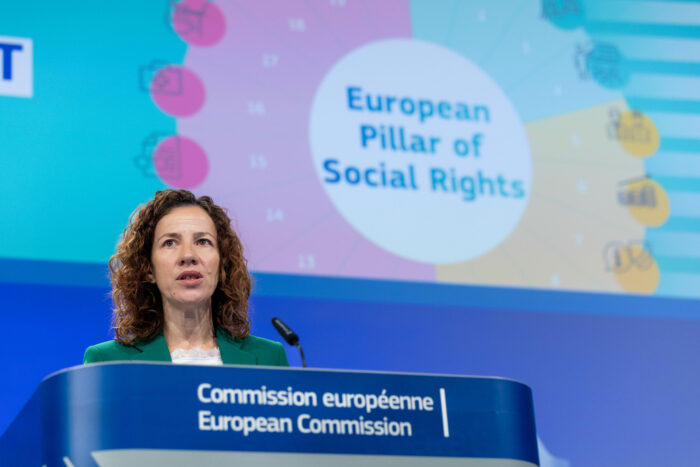
Social: By stressing social rights over privileges, the speech struck the right tone. The 2027 Social Summit, on the occasion of the 10th anniversary of the European Pillar of Social Rights, should be used as an opportunity to further advance social rights and equality across Europe, taking into account the transformation of the world of work and new aspirations for wellbeing, but also to define European sovereignty, through its social model. Addressing the cost-of-living crisis and eradicating poverty, investing in public services across all our regions, supporting our health and care sector, and ensuring access to affordable and sustainable housing will not be possible without a strengthened MFF, a dedicated European Social Fund, and cohesion policy

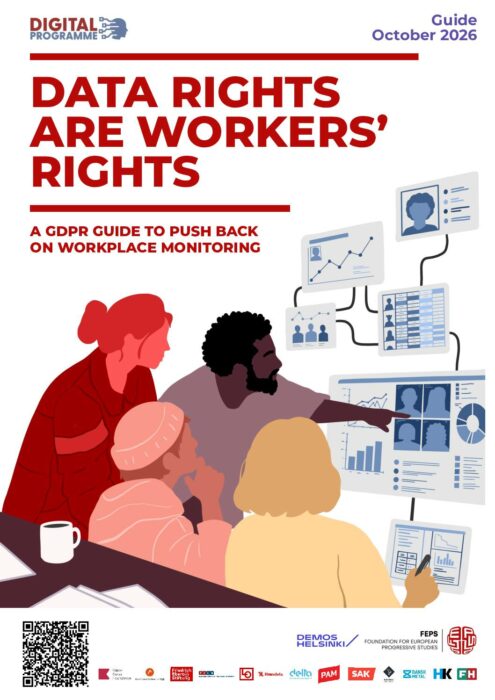
Digital: This year’s SOTEU positions AI as a defining tipping point, backed by funding for scaleups, a push for more (clean) European compute, and a focus on application over the model race. What was missing was a plan of action on the fragmented enforcement of the EU digital acquis, and silence on the Digital Omnibus’s rollback of rights. EU citizens need full, ambitious enforcement of the Digital Service Act, Digital Markets Act and AI Act against Big Tech, and scrapping the omnibus in favour of simplification that does not come at the cost of rights and worker protections. Zooming in on the dangers minors face on online platforms designed to make them addicted is welcome, as is the proposed KIDS Act (Kids Internet and Digital Safety Act) featuring a digital minimum age. 

World: Not surprisingly, this year’s SOTEU included reiterative references to the EU’s efforts for independence by continuing to support Ukraine, enhancing its defence capabilities and reducing dependencies on China and, implicitly, the United States (direct references to Trump and the US are opportunistically avoided). Canadian Prime Minister Mark Carney was this SOTEU’s guest of honour and received the puzzling invitation for Canada to become an associate member of the EU. Meanwhile, partnerships with other key actors, such as African countries, were downplayed. President von der Leyen failed to maintain a strong position in defence of international law, including support for the International Criminal Court and the multilateral system, both of which are under attack by Trump and other international actors. The reference to the support for Palestine was again insufficient and weak, shifting the responsibility to the member states for the failure of the EU to sanction Israel. If the EU wants to be an independent and strong global actor, it must be more proactive and credible by leading international diplomatic initiatives and building coalitions on global issues. 

Climate: Unsurprisingly, von der Leyen maintained her usual discourse on climate change: the EU is standing by its climate targets. However, her speech provided very little evidence of a coherent vision to achieve these targets and ensure the EU’s effective decarbonisation and adaptation. Von der Leyen highlighted the increased cost of fossil fuels, but conveniently left out the soaring profits of the oil and gas sector. She proposed plans for climate resilience and food security, but did not mention the need to protect biodiversity for these to be achieved. She defended quality jobs but forgot the importance of supporting a just transition for regions and workers affected by industrial changes. We need to ensure coherence between policies. We need to effectively enforce existing climate policies to reduce emissions fast, develop a transformational adaptation framework and design a fair financial contribution system to reduce inequalities and finance ambitious climate action, including through taxing windfall profits from the oil and gas sector and making polluters pay.

Migration: Borders. And borders again. EU border protection, strengthening Frontex (whose mandate is under review), accelerating returns and a new early warning system (Ceuta docet) dominated von der Leyen’s reference to migration. The announcement of a European Emergency Response Framework and the depiction of migrants as ‘weaponised mass movements’ reinforce a narrative that essentially casts migrants as a security threat. The risk of undermining their right to asylum is just around the corner: von der Leyen’s pledge to uphold the EU’s fundamental values and rights was quickly overshadowed by her insistence that border protection is non-negotiable. Mention of ‘hubs’ was omitted, yet their ghost pervaded the speech. Pointing out that the Pact exists was a necessary reminder to ‘forgetful’ member states. The new Mediterranean Youth Skills and Jobs Initiative was the sole silver lining in a speech that never mentioned legal pathways.

Economy: The economic policy proposals mentioned in the SOTEU have been around since the start of the current Commission: reducing internal market fragmentation in diverse domains (finance, energy grids) and simplification of processes for businesses. On the latter, the President stressed the need to speed up permit issuing and reduce member states’ gold plating. There was surprisingly little on the capacities and means to implement all the needed changes and investments. Implementing all the ambitious initiatives requires greater state capacity and more financial resources. The continuous reliance on markets for our industrial policy and innovation will just perpetuate the existing patterns of low-risk and fast-return investments. To make a true leap forward, we need to invest much more in the public sector’s capacity so that it does what it should: steer the economy towards a bold vision of an innovative economy serving the common good. This vision should be defined not just by corporate interests, but by all citizens through democratic economic governance mechanisms

Gender: In her speech, President von der Leyen calls for strong and immediate action to protect our fundamental values and tackle the backlash against women’s rights, in every field and particulary in relation to the digital sector. The speech made no mention of the upcoming Gender Action Plan IV and gender equality in external action. On a positive note, the launch of the EU Care Deal and the emphasis that care is a right, not a privilege, are highly due in a time when the climate crisis and demographic changes add additional strain on the sector. What is missing now are binding instruments and proper public investment to guarantee universal, equal and effective access to quality care services for all. Hence, the next MFF needs effective gender budgeting on all fronts to ensure we live in a world of democracy, not fear. For Progressives, gender equality and LGBTQI+ rights are universal concerns and their protection is the cornerstone of a healthy and democratic society.

Democracy: As Ursula von der Leyen stressed, democracy today faces pressure from the outside and inside. The European Commission’s new Centre for Democratic Resilience is a step forward in reacting to outside pressure, especially on external interference in elections across Europe. However, more is needed, especially to react to the pressure from inside, with far-right forces gaining more and more power across Europe. Above all, it is required to restore citizens’ trust in democratic institutions, including the EU institutions, by strengthening citizens’ engagement and expanding participatory democracy at both European and national levels.

Enlargement: Is enlargement suddenly a dirty word? At the close of her speech, von der Leyen offered the usual reassurance that the future of Ukraine, Moldova and the Western Balkan countries lies within the EU (any reference to Georgia was dropped). But it sounded like little more than a courtesy to those countries that have been trapped in a waiting room for over two decades. But the word ‘enlargement’ itself was not mentioned once. Nor was there any mention of how the Union will adjust its functioning to accommodate members larger than Montenegro. Instead came the bombastic offer to Canada to become the EU’s first associate member. The move carries geopolitical weight, but it has also crucial implications that were not addressed: what will such a new status entail for the candidate states? And for the EU’s institutional setting?

Political Europe: “Our institutions and our decision-making have not kept pace with the new reality”. President von der Leyen raised a good point. Any idea on how to make decision-making quicker and more efficient at the European level? On that, she didn’t say much. What about taking up the many ideas that had been discussed since the 2021-2022 Conference on the Future of Europe before calling for a new Congress of Europe?

The EU must reaffirm its commitment to its social and climate ambitions. Supporting a sustainable European sovereignty is not an end in itself: it is a means to a better quality of life for all. Join Executive Vice-President Teresa Ribera and other high-level speakers at the 2026 edition of the Policy Conference. Register now!

Introductory paragraph by FEPS President Nicolas SCHMIT. Content written by FEPS Directors, Heads of Programmes,
Policy Analysts and Coordinators on their respective portfolios, including: Monty AAL, Beatriz ABELLÁN, François BALATE,
Chloé DEFFET, Hedwig GIUSTO, Anna KOLESNICHENKO, Christian SALM, Ania SKRZYPEK and Julia WILD.

Photo credits: © European Union 2026 – Source : EP.


Find all related publications
Publications
28/08/2026

How can Europe’s missing middle be financed

Translating Chinese lessons for scaling industrial innovation
14/08/2026

A just transition in the Mediterranean

Rebalancing the burdens and benefits of EU-North Africa energy cooperation
31/07/2026

Beyond the “Gaza Riviera” Approach

Preserving identity and supporting Palestine’s landscape and social fabric
22/07/2026

How (not) to fight the far right

FEPS YAN papers 9th cycle
Find all related Progressive Post
Progressive Post
11/09/2026

Will you stand with civil society?

Attacks on civil society are no longer just a problem for those countries and organisations […]
04/09/2026

The axis and the alternative

90 years ago, in July 1936, the Bayreuth opera festival featured Richard Wagner’s Siegfried, as […]
16/07/2026

Good luck! And don’t f**k it up…

Hungary beyond the elections: a fragile chance for LGBTQI+
Find all related events
Events
Upcoming
30 - 01/10/2026
Brussels, Belgium

Policy Conference 2026

Towards a sustainable European sovereignty
Past
15/09/2026
Online

Unpacking Sweden’s election results

Following Sweden’s parliamentary election on 13 September 2026, this webinar discussed the electoral outcome, exploring […]
10/09/2026
Athens, Greece

Gender differences and politics in Generation Z

Equality talk among precarious youth in Europe and Greece
Load more...
Find all related news
News
23/07/2026

FEPS Reacts: European Commission communication on the Action Plan on the European Pillar of Social Rights

By Laszlo Andor, FEPS Secretary-General & François Balate, Policy Analyst on Social The communication on the […]
08/07/2026

Letter to Manfred Weber, Chair of the EPP Group, by FEPS President Nicolas Schmit 

Dear Mr Weber, You are European, but also German. One should be entitled to expect […]
23/06/2026

FEPS Reacts: 10 years after Brexit

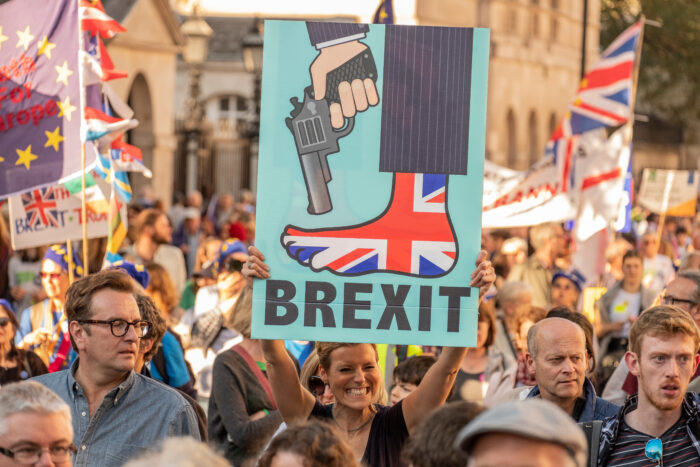
Written by FEPS Secretary-General László Andor 🔸 Brexit has been a case study in national self-harm. The […]
05/06/2026

Call for a progressive EU enlargement

Friends of the Western Balkans' Joint Statement
Find all related in the media
In the media

EU’s new cross‑border work rules favour recruitment, not workers, say critics

by EUObserver 16/09/2026
FEPS Policy Analyst on Social François Balate discusses the latest EU Labour Mobility Package under Commissioner Roxana Mînzatu zatu for the EUObserver.

Une révolution civique, pas encore une révolution sociale

by Fondation Jean-Jaurès 06/05/2026
“A civic revolution, not yet a social revolution” Interview with László Andor, FEPS Secretary General, published by Fondation Jean-Jaurès (FR), analysing the electoral defeat of Viktor Orbán, the emergence of a broad opposition movement in Hungary, and the prospects for democratic renewal, EU relations and social change following what he describes as a “civic revolution” that has yet to deliver a social transformation.

Jön a pénz! Magyar Péter beváltja az ígéretét?

by KlikkTV 04/05/2026
“Money is coming! Will Péter Magyar deliver on his promise?” Video Interview published on KlikkTV (HU), featuring László Andor, FEPS Secretary General, discussing EU funds to Hungary, their political conditionality, and the importance of fair distribution, rule of law and social investment within the European Union.