


18/07/2025
Fists and roses: a post-identitarian approach to Democratic Socialism
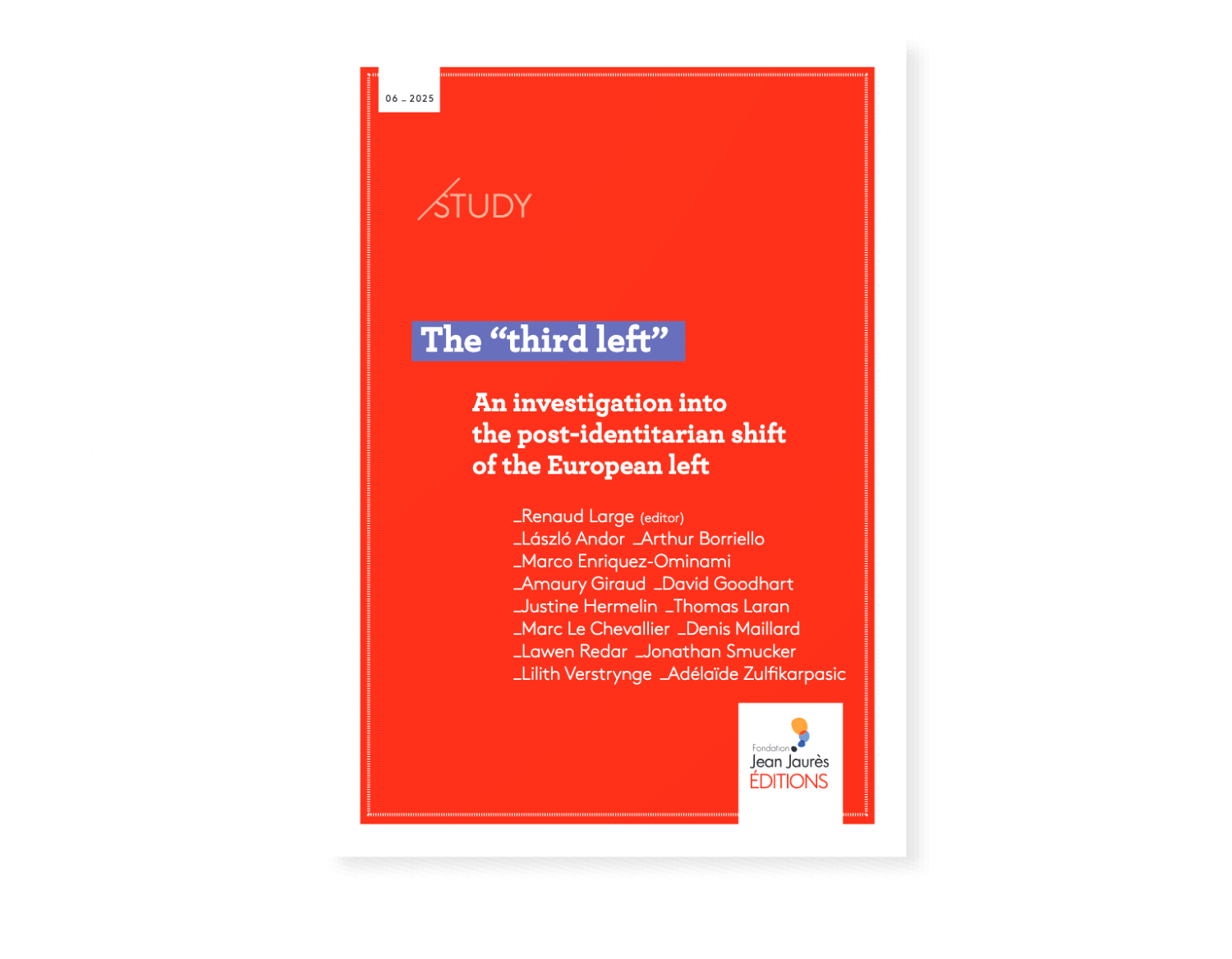
The Third Left: An Investigation into the Post-Identitarian Shift of the European Left
by Renaud Large, editor
Fondation Jean-Jaurès, Paris, June 2025
Facing the dire state of the centre-left, the collection of essays The Third Left, edited by Renaud Large, seeks to analyse not only the causes of the centre-left’s decline, but also the steps taken by various democratic socialist, social democratic and labour parties across Europe, and beyond, to address this phenomenon. It aims to offer an alternative path that enables Socialists to continue improving people’s lives in accordance with the principles of freedom, equality, solidarity, prosperity, security and social justice.
Had you asked an average member of a European Socialist party in the mid-1970s whether they believed Democratic Socialists and the moderate left would ever again face a situation akin to that of the late 1920s, they would likely have laughed and dismissed the idea as impossible. Unfortunately, they would have been wrong. Today, in a Europe increasingly reminiscent of that earlier period, Democratic Socialists across the continent are facing a deep crisis. Whether reflected in election results or the loss of narrative control, the decline is unmistakable. In today’s European Union – after decades of dominance of Social and Christian democrats – more and more countries are being drawn towards the far right. Although some centre-right parties have also been affected by this backsliding, the primary victims of the populist surge have been the Socialists and the centre-left more broadly. In the face of this decline, we must ask ourselves what went wrong – and, more importantly, what solutions are available.
According to Renaud Large and the other contributing authors, the origins of this crisis can be traced back to the late 1980s. The rise of neoliberalism and globalisation during that decade posed a formidable challenge to Democratic Socialism. Its foundational principles – Keynesianism, state intervention and the welfare state – were undermined by globalised markets, the independence of central banks and the unregulated movement of capital and labour. In adapting to these new realities, Socialist parties across Europe incorporated elements of neoliberalism into their platforms and rhetoric. While this shift was tempered by continued public investment and a robust welfare state, it also ushered in significant problems, including high unemployment and rampant speculation. These issues culminated in the 2007 subprime crisis and the Great Recession that followed.
Since that recession – and the subsequent failure of the Third Way – centre-left parties have steadily lost ground to both the centre-right and the far right. The hardship caused by sovereign debt crises, coupled with the inability of Third Way politics to alleviate suffering, bred resentment among traditional Socialist voters. Many felt that the parties they had supported – often for decades – no longer represented their interests. This sense of betrayal was compounded by what many perceived as a disproportionate focus on minority rights and environmental issues, the refusal to address concerns around security and immigration, and a condescending attitude towards working-class communities. As a result, many working- and middle-class voters began to feel that the parties which once improved their lives now viewed them as xenophobic, racist, or backwards.
In the face of the failure of what the authors call the ‘societal left’ – a minority-focused and hyper-individualistic strain of leftism that neither addresses material needs nor engages with issues such as security, immigration, patriotism and ecology constructively or pragmatically – they propose a promising alternative: the rise of a post-identitarian left. This emerging form of Socialism, quietly gaining traction, marks a significant shift in the priorities of the centre-left. It begins by rejecting the neoliberal consensus embraced by the Third Way, instead championing a universalist welfare state, workers’ rights, and state intervention through regulation and social dialogue. Unlike the societal left, this movement grounds its priorities in material concerns rather than cultural or social issues. Crucially, it does not shy away from taking clear positions on regulated immigration, public safety and a fair green transition that places people and the state at the centre of its discourse. It should be said, however, that when it comes to the issues of public safety and the green transition, the distinction between the two is mainly centred around the discourse and not on the measures. In these matters, what distinguishes this form of Socialism from other forms of it is that it recognises that security and a green transition that does not harm rural communities have become topics of concern for the general population and that there is a need to present social democratic answers for these problems in its discourse and narrative.
Moreover, in stark contrast with the societal left, this new movement embraces patriotism – not from a nationalist standpoint, but through a communitarian lens. It emphasises social and territorial cohesion, as well as the importance of institutions like trade unions and local associations. By doing so, the advocates of this democratic socialist model seek to reconcile the two traditional pillars of the movement. On one hand, as Renaud Large describes, they affirm institutional continuity, democratic sovereignty, security and republican order. On the other hand, they uphold social justice, redistribution and the unconditional defence of working-class interests. This reconciliation represents a return to the traditional purpose of Socialism, adapted for a post-globalised world.
Critics on the identitarian left often argue that this post-identitarian current represents a capitulation to conservatism and xenophobia. Nothing could be further from the truth. While the post-identitarian left prioritises material issues over identity-based concerns, this does not make it conservative or regressive. Rather, it reflects a belief that lasting progress on cultural and social issues can only be achieved once the material needs of the broader population are met. Socialist governments should promote inclusive policies, but such matters should not dominate the discourse or the political agenda.
This post-identitarian form of Socialism, though initially fragmented and informal, has recently gained new momentum. In countries where Socialist parties are currently in power – or leading in the polls – these principles are consistently reflected. With the partial exception of Spain, every recent Socialist success has been driven by a return to the foundational principles of Democratic Socialism, adapted for today’s challenges.
Reading this collection of essays has been a refreshing experience. Since the late 1980s, democratic socialist thought has either veered towards neoliberalism or shifted focus away from what made the centre-left a force for improving ordinary people’s lives. These essays offer a revitalised vision of Socialism – one that returns to its roots without appearing outdated. In an age where individualism has permeated every facet of society, including parts of the Left, encountering a communitarian form of Socialism that is both principled and electorally successful is truly uplifting. While perhaps not suited for casual bedtime reading, these essays are an essential starting point for every Socialist who dares, in times like these, to envision a future for Democratic Socialism.
Find all related Progressive Post
Progressive Post