

Director of FIERI, independent research institute on migration based in Torino, Italy
21/09/2026
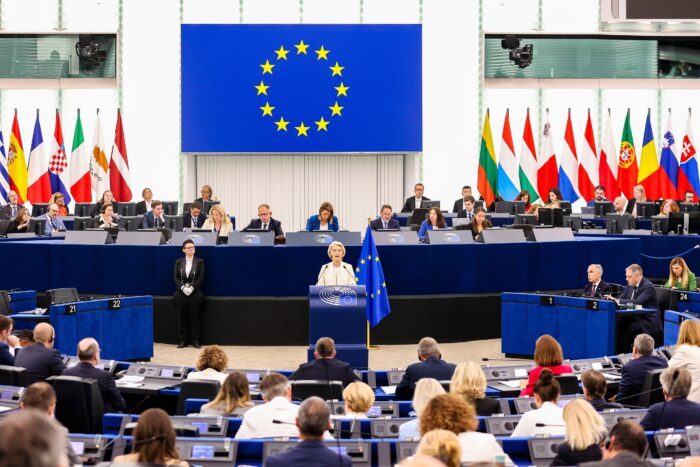
The final speech before the decisive battle. This is how one might describe the State of the Union address delivered on 16 September by EU Commission President Ursula von der Leyen to the European Parliament – though with the ambition of speaking to the whole of Europe and the world. It was the last major policy address before the fateful spring of 2027, when elections in France, Italy and Spain (not to mention possible snap elections in Germany) will shape the continent’s political future. An unmissable opportunity to try to spread a message capable of stemming the anti-democratic tide that risks paralysing, if not overwhelming, the entire European project.
This wave is fuelled, to an extent that many consider decisive, by anti-immigration rhetoric, which has become even more radicalised over the last two years. It no longer merely stirs up aversion to new arrivals, but also the desire to remove a ‘foreign element’ that has already ‘penetrated’ the social fabric. The myth of the threatened border – which continues to be vigorously promoted and acted upon – is now joined by that of the ‘fifth column’, which is said to be ‘corroding us from within’ and must be removed, or ‘remigrated’.
If the central aim of von der Leyen’s speech had truly been to stem the ‘black tide’ by countering the rhetoric driving it, we might have expected a different narrative on migration. This was not the case. Further emphasising a trend that has in fact been emerging for years, the President of the Commission has fully embraced the dominant ideology amongst the political forces that elected her. Indeed, in her speech on 16 September, stylistic features typical of leaders situated further to the right than the European People’s Party, to which von der Leyen belongs, are striking.
Perhaps the most telling example, the most recognisable ‘fingerprint’ (or rather ‘voiceprint’), is this:
“The message from Europe is clear: we will always comply with our values and fundamental rights. But we will never compromise on protecting our borders. It is we, Europeans, who decide who comes to our Union and under what circumstances. And not the smugglers and the traffickers”. Hearing these words, a bell rang in my head – as, I imagine, it did for many who follow Italian politics on migration issues. The echo I heard was this: “The issue is simple. Europe, as we have been saying for some time, must take responsibility for the problem because Italy can no longer accept that the selection is made by scafisti (the smugglers using small boats)”.
The person saying these words, in an interview with La Repubblica on 4 December 2022, just a few weeks after taking office at Palazzo Chigi, was Italian Prime Minister Giorgia Meloni, who subsequently repeated the exact same phrase on numerous occasions, turning it into a sort of mantra for the new Italian-style sovereignist approach to migration.
Listening to von der Leyen’s words, one is led to believe that Meloni has won, that her blunt exhortation from four years ago has been fully heeded. Taking up the invitation, the second European Commission, chaired by the former German defence minister, assures us that it has finally taken the helm once more, regaining control over who crosses our shared borders.
But are we sure this is enough? Are we sure that adopting the slogans and copying certain policy choices (I am thinking of von der Leyen’s own praise for ‘innovative solutions’ such as those trialled by the Meloni government in Albania) is sufficient to pull the rug out from under the feet of those on the right who are most openly hostile to immigration? The question concerns the speech in Strasbourg, but it could be directed at all those in power who are attempting to stem the tide of the radical right by proposing merely watered-down versions of the very same intoxicating xenophobic potions.
Everything seems to suggest the opposite. There are no clear precedents where such imitative strategies have proved successful. If anything, in Hungary as in Sweden, it is the failure of the right-wing parties when put to the test that has subsequently led voters to change course. Entire shelves of recent research, on the other hand, show that if an unemployed worker or a member of the impoverished middle class seeks a tonic for their identity in a particular political affiliation, a mere rhetorical shift by mainstream parties will not be enough to satisfy them.
Not least because such a rhetorical shift is unlikely to be complete. Having to answer to the business community as well, which calls (although often only half-heartedly, as is clearly the case in Italy) for flexible and cheap labour, von der Leyen and her political equivalents at various institutional levels cannot openly advocate demographic autarky or ethnic cleansing. Such an excess would be unwelcome to the more affluent sections of the electorate.
For decades, the formula by which moderate political forces have sought to resolve this (perhaps insoluble) equation has been that of rigorous and selective management of admissions: allowing in ‘useful and deserving’ foreigners, whilst keeping out or expelling (or at least declaring an intention to expel) all others.
In the speech of 16 September, which we might take as a paradigm of a (no longer) centrist ideology on migration, the open-door aspect has become almost invisible, veiled by technocratic references, but it has not disappeared entirely. In the booklet version of the speech – glossy and accompanied by carefully selected statistics and illustrative anecdotes – the references to the dramatic labour shortages hampering the European economy are more pronounced. And the references to the need to make Europe more attractive to foreign ‘talent’ are more explicit, focusing first and foremost on removing the remaining obstacles to intra-EU mobility.
In Strasbourg, von der Leyen also alluded – albeit in a manner that was, to be honest, rather cryptic for non-specialists – to two new initiatives: the Gateway Offices in selected ‘partner countries’ (the first of which was inaugurated in India in February) and an imminent Mediterranean Youth Skills and Jobs initiative. It is to be hoped that such experiments will flourish and proliferate. But is a policy aimed at attracting talent credible if it does not set itself the goal of making the European social and cultural environment truly welcoming? In a highly competitive global labour market for highly skilled workers, can a recruitment policy succeed whilst continuing to aggressively preach ‘law and order’ and a de facto ‘national preference’? In short, can a fortress be made attractive?
Photo credits: Shutterstock/Berit Kessler
Find all related Progressive Post
Progressive Post