
Chair of the Board of the Democratic Dialogue Network (Belgrade) and Secretary General of the CEE Gender Network
28/10/2026
The student list has won an outright majority in Serbia‘s snap parliamentary elections of 25 October 2026, ending fourteen years of rule by Aleksandar Vučić‘s Serbian Progressive Party (SNS). The result is less a routine alternation in power than a verdict on a model of governance – and it leaves Serbia‘s divided Social Democrats with uncomfortable questions.
According to the preliminary results of the Republic Electoral Commission (RIK), the student list (‘Students Are Winning’) received 52.7 per cent of the vote and around 140 of the 250 seats in the National Assembly. The SNS-led coalition ‘Aleksandar Vučić – United Serbia’ secured 39.2 per cent and around 104 seats. Apart from lists representing national minorities, which are exempt from the 3-per-cent-threshold, no other list entered parliament, producing the most concentrated assembly since the return of multiparty politics in 1990.
This outcome has been long in the making. On 1 November 2024, the newly renovated canopy of the Novi Sad railway station collapsed, killing sixteen people. In the wake of the tragic event, A student movement emerged, protesting mainly against the endemic corruption and authoritarianism in the country. But the movement did not initially seek elections; its demands were institutional: publication of the reconstruction documentation, prosecution of those who attacked protesters and accountability for the abuse of state power. Only after the Serbian institutions repeatedly refused to deliver what any functioning democracy would offer unprompted, the students started to focus on elections. In September 2026, Vučić dissolved the assembly, resigned from the presidency and led his coalition’s list as its candidate for prime minister.
The student list was an unusual vehicle. Its 250 candidates – professors, doctors, scientists, workers and activists, mostly unknown to the wider public – were selected through faculty plenums and student assemblies, an experiment in bringing direct-democratic practice into mainstream politics. The list was formally headed by Novi Sad cardiologist Ilija Srdanović, but the movement deliberately avoided a single figurehead. The opposition consolidated around the students: the Democratic Party (DS), the Green-Left Front (ZLF), the Party of Free Citizens (PSG) and the ‘People’s Serbia’ coalition all backed the students. The campaign thus became akin to a referendum under the slogan ‘Serbia or the mafia’.
The most surprising moment came on election night, when Vučić, citing a stratified sample, conceded: “it is clear that we have lost the election”. As in Hungary in April, fears of a contested count did not materialise. Yet the subsequent framing deserves scrutiny. SNS officials now portray Serbia as an ordinary democracy in which governments alternate in a regular cycle, and themselves as a ‘constructive opposition’. This narrative obscures fourteen years in which the ruling party effectively privatised the state: applying the constitution and laws selectively, presiding over opaque state contracts, exerting influence over the judiciary, hollowing out independent institutions and controlling most of the media. That legacy will not disappear with a change of government.
The student list has enough seats in the National Assembly to govern alone, and a presidential election is due by 27 December. The movement’s real test is internal: whether an ideologically diverse movement, held together by a shared moral demand, can become a coherent governing majority.
The three issues that shaped the campaign
First, corruption and accountability. The Novi Sad canopy came to symbolise what many citizens had long felt but could not articulate collectively: an unaccountable system staffed by loyalists, in which public money disappears into opaque contracts. An IRI survey from mid-2026 ranked corruption as the single most important problem, ahead of the economy. Every opposition list campaigned on it, from the students’ agenda on procurement and judicial independence to European Serbia’s proposed law on the origin of assets.
Second, ‘stability‘ versus change. Vučić presented himself as the sole guarantor of stability, casting his opponents as foreign-paid agents who would sell out the country, ruin the economy and steal public money. Rather than engage with the students’ programme, the ruling camp sought to discredit candidates personally, at times with AI-manipulated images in pro-government tabloids. The strategy’s returns diminished: Olof Palme International Center focus groups in 2025 already found the stability message ringing hollow even among softer government supporters.
Third, social and economic security. The students paired their democratic agenda with a distinctly social one: free school textbooks, permanent employment contracts after twelve months in the public sector, affordable housing and ‘a doctor in every village’. The government responded with the fiscal instruments of incumbency. In September, shortly before the vote was called, around 1.66 million pensioners received one-off payments of 20,000 to 35,000 dinars – approximately €377 million in total – alongside transfers to recipients of social assistance and child allowance, veterans and other adults. Social support is legitimate; timing it to the electoral calendar is not.
Record participation on an uneven playing field
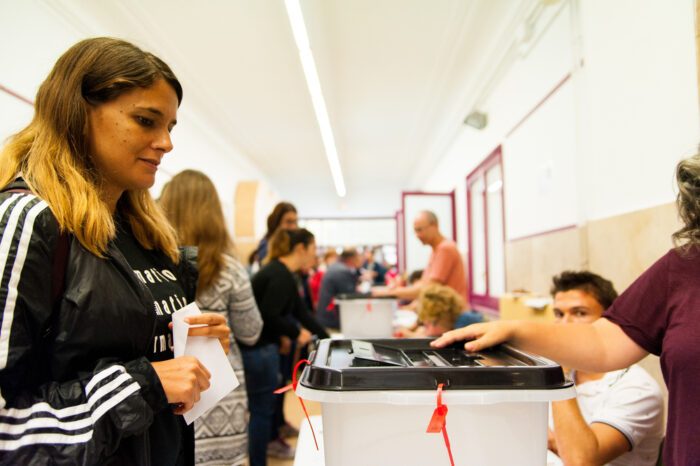
Turnout reached 68.8 per cent, with more than 4.3 million ballots cast. Crossing the four-million mark had been widely seen as decisive, since high turnout dilutes the weight of controlled votes and irregularities. Two years of street mobilisation were translated into votes. The international observation mission led by OSCE/ODIHR captured the paradox: a vigorous contest with ‘seriously compromised equal opportunities’. Observers cited the misuse of state resources, close to €1 billion in benefits announced before and during the campaign that blurred the line between state and party, and coverage by the public broadcaster RTS and private national channels that favoured the governing list. They also reported pressure on voters, candidates and civil society, as well as allegations of vote-buying.
The information space remains split into two realities: pro-government television for older and smaller-town voters, and social networks – now ahead of television in reach – for younger citizens. Online, observers documented coordinated inauthentic activity and AI-generated disinformation, alongside unresolved reports of illegal digital surveillance.
A striking feature of these elections was the mobilisation of the diaspora. Although the law provides for polling stations wherever more than 100 voters register, the Ministry of Foreign Affairs declined to open them in many cities. Citizens nonetheless travelled hundreds, sometimes thousands, of kilometres to vote – a telling measure of the stakes as they perceived them.
Europe: an open door, a cautious partner
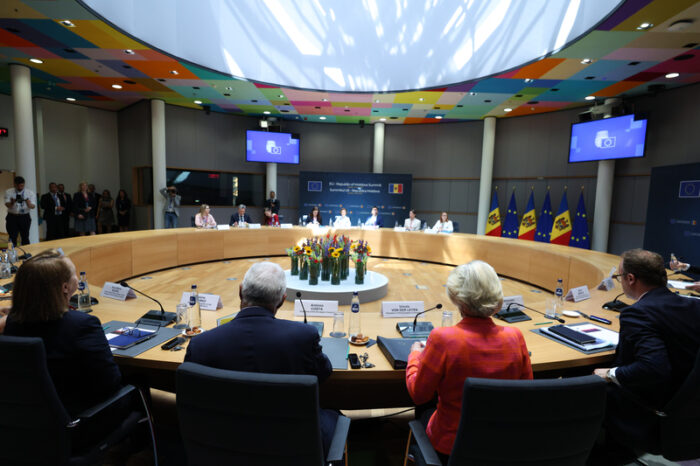
Brussels reacted within hours. Enlargement Commissioner Marta Kos declared that “the door to the EU is open”, Ursula von der Leyen, António Costa and Hungary’s new prime minister Péter Magyar were among the first to offer congratulations. Not all responses were celebratory: one widely shared reply called Kos’s message ‘the cynical tweet of the night’, arguing that Brussels had tolerated Vučić in the name of stability. However harsh, the remark captures a genuine credibility deficit.
It should be stressed that these elections were about restoring democracy – not about the EU, Russia, Kosovo or Republika Srpska. Foreign policy was deliberately kept at the margins of a broad and ideologically diverse movement whose programme is almost entirely domestic: judicial independence, anti-corruption, transparent procurement, media freedom and depoliticised institutions. Where the movement did address external questions, it signalled continuity rather than rupture, including on sanctions against Russia and on Kosovo. Analysts describe its approach to the EU as cautious – repair the system at home first, then negotiate as a credible partner. Yet the agenda on which it was elected corresponds precisely to the ‘fundamentals’ of the accession process.
This matters because, over the past decade, many citizens of Serbia have come to feel left behind by those who personify the EU – most often representatives of the European Commission. Bureaucratic formulas and political embraces of Vučić, particularly during previous election campaigns and invariably in the name of stabilitocracy, have left a bitter taste among citizens whose values align with the idea of Serbia as part of the Union. It is worth recalling that during their years-long protest, the students walked and cycled to Strasbourg and Brussels – not to Moscow.
The EU therefore needs to rebrand itself in Serbia in terms of making real and visible efforts. That means abandoning bureaucratic and at times empty messaging in favour of an alliance of common sense, so that citizens who already share European values also recognise genuine partners in the institutions that are the face and soul of the Union. Brussels should resist demanding immediate geopolitical realignment as the price of engagement: the rule-of-law agenda is itself the strongest driver of convergence. In July 2026, eight member states blocked the opening of Cluster 3 over democratic backsliding with Serbia – the very problem voters now have addressed. Alignment with the Common Foreign and Security Policy will remain a condition of membership, but it is more likely to follow from support for democratic transition, technical assistance and investment than from pressure on a government still finding its feet.
Social Democrats: divided, squeezed and partly vindicated
For Serbia’s Social Democrats, the election was a paradox. DS chose not to run and backed the student list, while the Freedom and Justice Party (SSP) ran within the European Serbia coalition with SRCE and the Solidarity movement. Throughout the campaign, officials of the two parties exchanged sharp public criticism, while the students stayed out of these quarrels.
European Serbia offered a coherent programme – dismantling the SNS system within 100 days, a fund for victims of the regime, a law on the origin of assets and an explicitly pro-European orientation – and argued that a separate list would widen the anti-government majority. Its result of 0.3 per cent shows that the referendum logic left no room for any third option: voters seeking change concentrated on the list most likely to deliver it. Low trust in established parties after years of fragmentation and boycotts, the weakened appeal of a ‘Brussels’ brand and internal dissent compounded the effect. To their credit, European Serbia’s leaders congratulated the student list on its victory over the regime.
The most consequential shift occurred elsewhere. The Socialist Party of Serbia (SPS) – founded by Slobodan Milošević in 1990, self-described as Social Democratic and in government for most of the multiparty era – won only 2.2 per cent. For the first time in 36 years, it has no MPs. Its collapse after an open internal split deprives the SNS of its most important coalition partner.
The deeper lesson is that Social Democratic values performed far better than Social Democratic parties. The students’ platform – public healthcare, quality education, secure employment, affordable housing, solidarity and accountable institutions – is Social Democratic in substance, even if it does not carry that label. The demand for such politics exists. Voters rejected the organisational form in which it was offered.
Strategic takeaways
Competitive authoritarian regimes can be defeated at the ballot box. Hungary in April and Serbia in October share a pattern: exceptional turnout, an election framed as a referendum on the regime, and a challenger that consolidated the opposition vote. Uneven conditions did not prevent change; they raised the threshold to a level only extraordinary mobilisation could reach.
Consolidation now comes from outside the party system. In Serbia, the unifying force was a non-partisan movement whose legitimacy derived precisely from its distance from parties – reflecting a wider European disaffection with established political actors. Social Democrats cannot and should not compete with such movements on authenticity; they can act as partners, offering programmatic depth, governing experience and European networks. Rivalry within the progressive camp, as this campaign shows, is punished.
Enlargement credibility depends on standing with citizens, not incumbents. The era of stabilitocracy in the Western Balkans is losing its foundations. The EU’s support for the new government on the rule of law, media freedom and anti-corruption will be the measure of its credibility across the region – and Serbia’s students may become a reference point for young people protesting elsewhere in Europe.
The transition will be harder than the victory. The SNS retains a large parliamentary group, local networks and media influence; captured institutions will resist; expectations are high and governing experience limited. The European progressive family should offer practical support while encouraging cooperation with pro-democratic forces now outside parliament.
On 1 November, Serbia marks the second anniversary of the Novi Sad tragedy. Two years ago, a falling canopy exposed the cost of a captured state. This time, citizens have answered with the most powerful democratic instrument at their disposal. Whether institutions will now reflect that change is the question that will define Serbia’s next chapter – and its European future.
Find all related Progressive Post
Progressive Post