

15/07/2026

Have you ever tried to define ‘Social Europe’?
Dominic Afscharian
Ideas of Social Europe – Enhancing or Eroding European Integration?
Edward Elgar Publishing, 2025
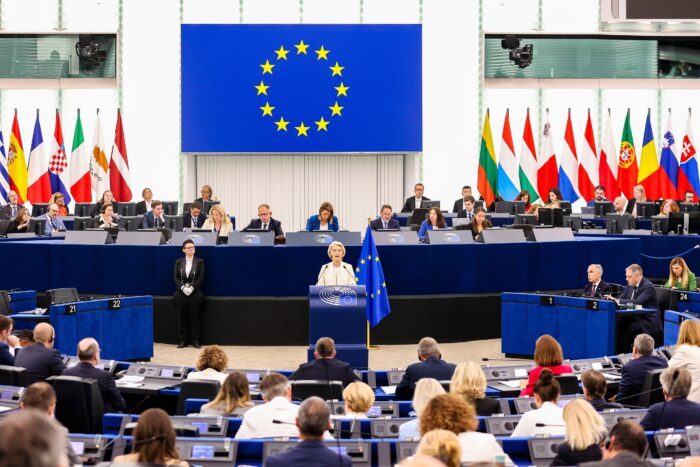
In a room in the European Parliament, a handful of people are discussing political strategy. Public opinion and narratives are on the table, then suddenly someone raises the question of ‘Social Europe’. Eyes are rolled. Not because the advancement of social rights for people in Europe is not worth considering, but mainly because the concept of ‘Social Europe’ seems impossible to understand. What does fighting for a ‘more social Europe’ mean? How do you translate this concretely? The book Ideas of Social Europe – Enhancing or Eroding European Integration? by Dominic Afscharian would have been handy.
Afscharian’s book has a similar starting point to this anecdotal meeting in the European Parliament. From the outset, the book states that ‘Social Europe’ is a broad term with countless possible meanings. To address this hurdle, the author returns to the foundational aspect of politics: ideas. Big and small ideas are often the first step in major societal transformations. Ideas allow a vision for society to be crafted and its components articulated. For ‘Social Europe’, ideas are therefore a good place to start.
From the very beginning, the author highlights the challenge of defining ‘Social Europe’. What is the focus point? Is it the ‘social’ or the ‘Europe’? To try and define it, we are presented with various keys to unlock this conundrum: a limited or extended understanding of the policy fields (from poverty prevention to a wider range of policies, such as education, health and housing), the underlying principles of social policy (solidarity, universalism…) and its goals (equality), the methods and policy tools (from coordination to hard legislation), and finally the degree of European integration pursued (from loose support to national welfare states to a more centralised approach). Ideas can be diverse, and one needs to know which to pursue.
In a very pedagogical manner, Afscharian then walks us through the roles of the different actors in the European social policymaking game: the Council of the European Union, the European Parliament, the European Commission, European political parties and the Court of Justice. He presents a widely shared assumption by those who keep a close eye on interinstitutional dynamics: ‘Social Europe’ does not become a reality because the Council blocks it, because the European Commission is driven by neoliberalism and because the European Parliament is both too weak and dominated by conservative forces, despite being the voice of the people.
It is against this backdrop that Afscharian’s book comes into its full strength. Drawing on the theoretical background of social constructivism and discursive institutionalism, the author presents a robust analytical framework that examines interactions among ideas, actors, institutions, power dynamics and evolving knowledge markets to deconstruct the assumption presented above. He digs deep into political party manifestos and European Commission working documents to see how and where ‘Social Europe’ was actually made. Without giving away any conclusion, the assumption does not really hold. In Afscharian’s opinion, the still-to-be-defined ‘Social Europe’ would not suddenly become a reality if the European Parliament were to have much more power, as it tends to adopt a minimalist consensus.
One great added value of the book is its extensive case study on the European Unemployment Benefit Scheme. Afscharian applies his analytical framework in detail to show the evolution of an idea that was first proposed in 1975 in the report on the Economic and Monetary Union by Robert Marjolin (a strong supporter of former French Prime Minister Léon Blum’s Popular Front and a close colleague of Jean Monnet). Afscharian shows that this idea only became a reality in 2020 with the temporary SURE instrument (Support to mitigate Unemployment Risks in an Emergency), introduced during the Covid-19 crisis to save millions of jobs affected by the economic downturn, notably thanks to the support of then-Commissioner Nicolas Schmit.
While the line between these two dates is long, it is also far from being straight. With his analytical framework and detailed research, Afscharian shows that the European Commission is not necessarily the only source of neoliberal proposals and that dynamics within member-state governments (namely Germany) play an important role. Meanwhile, the European Parliament – the so-called expression of the will of the people – and political parties were rather distant or were late adopters of the idea for SURE, which originated within the administration and advanced towards a more ‘Social Europe’.
All in all, Afscharian’s book leaves us with some important conclusions and one invitation.
One must be careful not to fall for the widely shared assumption noted earlier or into a discursive trap. Ideas that become political reality are not necessarily the ones shouted the loudest or branded in the glitziest way. They rely on complex dynamics and on the role of individual actors, regardless of where they belong on the interinstitutional chessboard. Ideas take time, persuasion and constant work to be defined clearly. This is the complex task of policymaking.
The book invites us, Socialists and Social Democrats, to do the internal work to see if we really have a clear grasp of what kind of ‘Social Europe’ we stand for. What is our ‘Social’? What is our ‘Europe’? Which levers are we ready to activate in the European Parliament? What kind of debate are we ready to organise inside our political family to advance social rights for all in Europe?
Afscharian’s book is built on extensive material from 2009 to 2019, as well as on some of the crisis-reaction initiatives of the early 2020s. However, the landscape is different now. Today, the dominant ideas – or at least words – in Brussels are competitiveness and deregulation. The dominant forces are the conservatives with the support of the far right. When it comes to ‘Social Europe’, they have a clear definition: no ‘Social’, no ‘Europe’. It is for this reason that Socialists and Social Democrats need to join forces to redefine their socio-economic agenda and offer a clear vision of what ‘Social Europe’ is, when the cost of living and affordability are today the number one concerns for citizens across the Union.
The book Ideas of Social Europe – Enhancing or Eroding European Integration? invites us to work and to reassess our ideas and strategies. Hopefully, next time, people will then seem less puzzled in that room in the European Parliament.
Find all related Progressive Post
Progressive Post