

05/03/2026
In 2024, more than 93 million Europeans, representing 21 per cent of the EU-population have been exposed to the risk of poverty, among them 19.5 million children. 7 per cent of Europeans suffer from severe material and social deprivation that does not allow them an adequate life. 8 per cent of workers in the EU are considered working poor, people who cannot afford a decent life from their work.
These figures are appalling and contradict major objectives of the European Union, namely to “combat social exclusion” and to “promote social justice and protection”. The causes and levels may differ from member state to member state, but none, even the wealthiest ones, escape the poverty challenge.
The Union has not been inactive. The 2000-2010 Lisbon Strategy had already aimed to combat poverty through the open method of coordination, which consists of setting common goals, benchmarking, and sharing best practices. The Europe 2020 strategy set a quantified target of reducing the number of poor people (minus 20 million). Finally, the Porto Action Plan endorsed at the May 2021 Social Summit in Porto committed the EU to reducing the number of people at risk of poverty or social exclusion by at least 15 million by 2030, with a key target of 5 million children out of poverty. Since the last round of EU enlargement, the risk of poverty in the union has increased dramatically from 16 per cent in 2007 to 21 per cent in 2024, and it is unlikely that the objective of the Social Pillar Action Plan to reduce the number of poor people by 15 million by 2030 will be achieved.
Different important measures have been adopted since the Porto Social Summit in 2021: the minimum wage directive that should guarantee adequate wages for a decent life; the recommendation on minimum income that aims to combat poverty and social exclusion by promoting adequate income, access to essential services and labour market integration; the Child Guarantee adopted in 2021, that pursues the objective to break the intergenerational cycle of poverty and social exclusion.
Despite some improvements, progress appears rather modest. European societies are facing different major challenges that enhance the risk of poverty and social exclusion. Low growth rates affect public budgets and tend to reduce social spending. Technological change excludes less-skilled groups from the labour market. Precarious work affects particularly young people, migrants, but also women, especially single mothers, often stuck in part-time work. Deindustrialisation affects numerous regions, increasing structural unemployment and with general impoverishment as a durable consequence.
These multiple causes weaken European societies, excluding millions of people not only from general prosperity but also from contributing to general wealth. They provoke new divides with dangerous political consequences. What is needed is a comprehensive political approach that takes into account the various aspects and causes of poverty.
This implies a better coordination between policies and underlines the importance of a strong European cohesion policy with adequate resources and priority targets. Access to social services, strong skills and upskilling policies also need to be available to the most vulnerable. Housing has become one of the most urgent social issues, increasing poverty and becoming a major factor of exclusion. The EU should therefore contribute more to develop affordable housing.
All this shows that the European Union needs an Anti-Poverty Strategy that is comprehensive and multidimensional. Europe will not become more competitive with less solidarity and an increasing number of excluded people. It is also time to give up the ‘trickling down’ approach that only legitimises the growing inequalities and wealth concentration. Joseph Stiglitz, in his book The Great Divide writes about the major culprits being trickle-down economics: “if the rich get richer and use their talents and resources to create jobs, everyone will benefit. It just doesn’t work, the historical data now prove that”.
An Anti-Poverty Strategy cannot just rely on soft law and coordination as it did in the past. We have to build an adequate governance framework and address the root causes of poverty as the S&D group in the European parliament proposes in its strategic paper. A European Anti-poverty law, including concrete objectives and resources with a precise timetable, should be the basis of such a strategy. The European Child Guarantee, an initial proposal by the S&D group, with its multiple fields of action, is a valuable approach under one essential condition: sufficient resources. The proposal to allocate €20 billion to implement the Child Guarantee is an important step. It represents a social investment, making our societies stronger and fairer by creating equal opportunities.
Announcing the eradication of poverty by 2050 may be an ambitious goal – but it is a valuableone. It means that at least 4 million people should not be exposed to poverty anymore each year. To achieve that objective, declarations are not enough: actions are needed, as well as innovative approaches. This also includes a more ambitious and better organised EU multi-annual financial framework.
Photo credits: Shutterstock / wjarek
Find all related Progressive Post
Progressive Post



Find all related events
Events

FEPS HQ
Madrid, Spain

European Parliament (Expert Meeting)
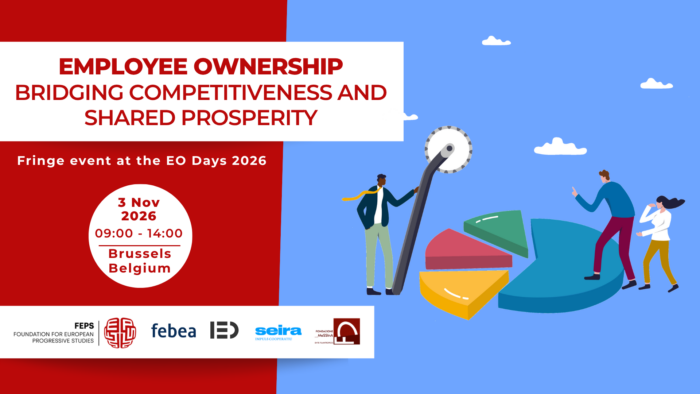
Brussels, Belgium
Load more...
Find all related publications
Publications
Find all related Audiovisual
Audiovisual
28/08/2026
28/08/2026
19/06/2026

20/05/2026
Find all related news
News
Find all related in the media
In the media
“Money is coming! Will Péter Magyar deliver on his promise?”
Video Interview published on KlikkTV (HU), featuring László Andor, FEPS Secretary General, discussing EU funds to Hungary, their political conditionality, and the importance of fair distribution, rule of law and social investment within the European Union.
España los forma, Europa los contrata: así es el mapa de la nueva fuga de cerebros
by El Confidencial 10/02/2026
“Back to the Future: The Great Reset”
Opinion article by FEPS Vice-President, Lina Gálvez reflecting on the current global crisis marked by rising authoritarianism, digital power and extreme inequality, and tracing its roots through a historical analysis of capitalism — from the post-1945 social and geopolitical settlement led by social democratic forces, through neoliberal financialisation, to what she describes as a new phase of fascist capitalism.