


Head of the Dutch S&D Delegation in the European Parliament and vice-chair of the Intergroup on fighting against poverty
05/03/2026
On 12 February, the European Parliament voted on the report of the parliament’s committee on employment and social affairs (EMPL) led by rapporteur João Oliveira and proposing an ambitious new EU Anti-Poverty Strategy that calls for the eradication of poverty in the EU by 2035.
The responsible Vice-President of the European Commission Roxana Minzatu will present the Commission’s Anti-Poverty Strategy before the summer of 2026. The S&D Group’s input provides the Commission with a number of good, implementable suggestions and proposals.
Nowadays, the European Commission and the European Council focus mostly on security and competitiveness. Both topics make sense in the volatile world we live in. However, security is not just physical security and a strong competitive economy; it also means security in daily life: strengthening our society’s social fabric and ensuring people can participate and feel included.
With the parliamentary intergroup on fighting against poverty, we prepared several discussions on the report. We explicitly included people experiencing poverty and representatives of their organisations. It is important that we listen to them and ensure they are part of the strategy’s development and implementation.
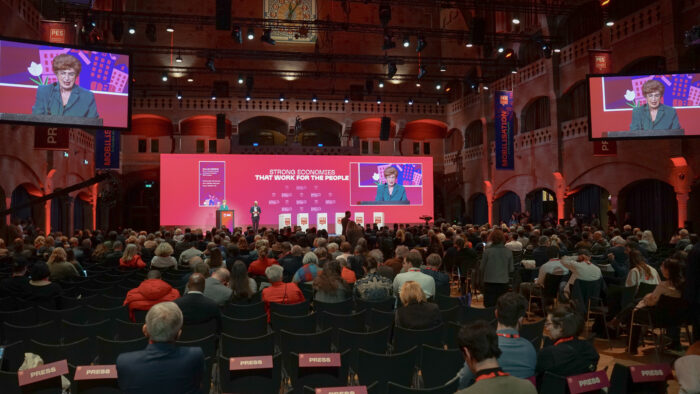
The insights of people experiencing poverty are not just valuable; they are imperative for a policy that has a chance of being successful and supportive. During an event organised by this intergroup and the European Anti-Poverty Network (EAPN) inside the European Parliament where we welcomed more than 150 guests across Europe. One lady told us about a municipal institution that helped her finish her degree, which could absolutely facilitate her entry into the labour market. She, however, also needed childcare to be able to study, which was provided by a different municipal department under different policies and regulations. A one-stop shop and communication between these departments would have helped her much faster and more efficiently. People who experience poverty must be involved from the start in shaping every measure. No policy should be made without them.
An important focus of the report is fighting child poverty. Children growing up in poverty have a disadvantage at the start of their lives, which is very difficult to catch up on. The S&D shadow rapporteur Aodhán Ó Ríordáin, who has experience in education, uses the example of the number of words a child knows when entering school at the age of 4: children from socially disadvantaged backgrounds know two to three times fewer words than children from more advantaged social backgrounds. For these children, the start in early education is very different, and rapidly the gap becomes almost impossible to bridge. As a consequence, their start in life is impacted too.
Therefore, it is a win that we were able to again confirm the need for the Child Guarantee. The objective of Child Guarantee is to prevent and combat social exclusion by guaranteeing effective access of children in need to free early childhood education and care, free education, free healthcare, healthy nutrition and adequate housing. But the Child Guarantee should not just be words, it also needs funds. The report calls for a minimum budget of €20 billion for the Child Guarantee in the next multiannual financial framework (MFF).
And I am very proud of the adoption of my amendment on menstrual poverty in plenary. The amendment was adopted by only a three-vote margin. With this amendment, the report now asks to include a specific strategy to make hygiene products available in places such as reception centres and shelters for homeless people. Women in these places are already in vulnerable situations, and their need for hygiene products should not worsen their situation. But it also asks for hygiene products in public venues such as schools, workplaces, and government buildings. No girl or woman should miss school or work because she cannot afford basic hygiene products. We provide toilet paper as standard – menstrual products should be just as normal.
The Anti-Poverty Strategy will have to be holistic and inclusive, and linked to several other European Commission. An important element is the Quality Jobs Act. We need to appreciate that the EU’s and the common market’s main strength is its people, its workforce. We need well-paid jobs and a good social security system. Exploitative systems that create jobs that keep working people poor should be abolished.
If we do not tackle poverty, no defence plan, no market reform and no competitiveness strategy will make people feel secure. Security also means being able to pay your rent and your groceries. A strong Europe starts with people who live, not with people who survive from pay-check to pay-check. Poverty is not inevitable; it is a result of political choices, and we must choose differently now.
Photo credits: Shutterstock / Gagarin Iurii
Find all related Progressive Post
Progressive Post
Find all related events
Events
FEPS HQ
Madrid, Spain
Brussels, Belgium
Dublin, Ireland
Load more...
Find all related publications
Publications
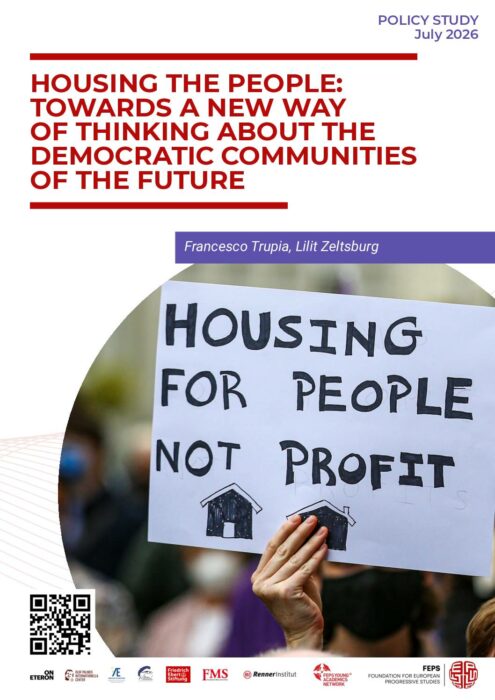
Find all related Audiovisual
Audiovisual
28/08/2026
28/08/2026

20/05/2026

09/04/2026
Find all related news
News
Find all related in the media
In the media
“Money is coming! Will Péter Magyar deliver on his promise?”
Video Interview published on KlikkTV (HU), featuring László Andor, FEPS Secretary General, discussing EU funds to Hungary, their political conditionality, and the importance of fair distribution, rule of law and social investment within the European Union.
España los forma, Europa los contrata: así es el mapa de la nueva fuga de cerebros
by El Confidencial 10/02/2026
“Back to the Future: The Great Reset”
Opinion article by FEPS Vice-President, Lina Gálvez reflecting on the current global crisis marked by rising authoritarianism, digital power and extreme inequality, and tracing its roots through a historical analysis of capitalism — from the post-1945 social and geopolitical settlement led by social democratic forces, through neoliberal financialisation, to what she describes as a new phase of fascist capitalism.
“What will the EU develop from now on?”
Analysis by FEPS Secretary General László Andor in Portfolio (HU), highlighting the new MFF’s shift toward increasing EU own-resources, boosting funding for strategic domains like defense, stabilisation and competitiveness, and calling for a flexible crisis-response mechanism such as the proposed Emergency Crisis Response Mechanism