Search
Skip to content
progressive-post home
  • About
  • The magazine
  • Progressive Pages
  • Dossiers and debates
  • Election Observatory
  • Reads & Views
The Progressive Post

Latvia: elections in the shadow of war

Case studiesElectionsSocial Democracy
Authors
Progressive Post
Jānis Urbanovičs
Search author
Share:
Tweet this Share on Facebook Share on Linkedin Print

Jānis Urbanovičs

Saskaņa Social Democratic Party, Chairman of the Board and Chairman of the parliamentary group
07/10/2022

In the Latvian parliamentary elections on 1 October, the main ‘player’ was the war started by the neighbouring country Russia in Ukraine. The war indirectly determined both the winners and the losers of these elections. All four parties that achieved the highest results in the previous elections were pushed below the 5 per cent parliamentary threshold – among them the Social Democratic party ‘Saskaņa’. Very surprisingly, the war also handed victory to the party, that – blatantly unsuccessfully – had led Latvia in the previous four years through the crises of the pandemic, energy security and unprecedented inflation growth.

The Russian Question

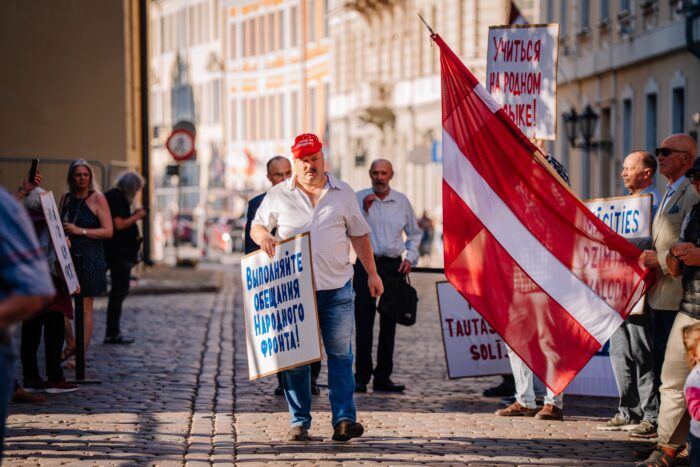
Since the restoration of independence, the main problem of Latvia has always been the tensions between the two main components of its society. The Latvian majority and the Russian-speaking minority have not been able for decades to unite in a single political nation. The Latvian-speaking community underlines the atrocities of the Soviet regime, while the Russian-speaking part insists on its dissatisfaction with the experiences of the last 30 years. The right-wing political parties shamelessly use these divisions, making a third of the country’s citizens ‘strangers’, even though they have built and protected this country side by side with the founding nation.

Since 24 February, Latvia has become a border country to a war. Initially, the conservative and right-wing parties of the government tried to address the Russian-speaking citizens, and support their patriotic mood. As the elections approached, however, everything was done to make Latvian Russians feel guilty for Russia’s aggression in Ukraine. The outcome was predictable – the response of Russian-speaking citizens is radicalisation.

Saskaņa’s dilemma

For several decades, ‘Saskaņa’, the Social Democratic Party, had received the unequivocal support of the Russian-speakers in elections, which has allowed us to be regularly the biggest party in parliament. When we woke up in a completely different world on the morning of 24 February, we faced a dilemma: to fundamentally condemn the war started by Russia or remain silent about it, which would have meant morally supporting the aggressor. 

Latvian Russians are connected to their ethnic homeland in many ways – through family ties, family history, culture, and language. Therefore, the Russian aggression was a complete shock to them, and they struggle to accept the new reality. If acting out of mercenary considerations, perhaps it would have been more beneficial for us to remain silent. But we chose the only right position, in alignment with that of the government: we took a sharp stand against Russia’s military invasion. And even now, after we dropped out of Parliament because of this position, we consider this stand to be the only possible for our party. On the other side, the populist party ‘For Stability!’ won a significant number of votes based on a campaign that accused Saskaņa of ‘betraying’ Russians.

The division of society is deepening

During the electoral campaign, when the war had become the central subject, the right-wing parties not only turned against the aggressor-country Russia, but also against everything that is Russian, repeatedly violating European principles on minority rights. Suppression of the Russian language from the public media, from the education system, restrictions in pre-election campaigning and even in the private sector…, – all these elements were used in the name of ‘strengthening the position of the Latvian language’. This was followed by a fanatical fight against Soviet-era monuments, despite the fact that in the eyes of many Russians, these monuments are emorials to their ancestors who fell in the war against fascism.

Not only extreme nationalist parties followed this campaign agenda, but also the more moderate right-wing parties, which should have realised how dangerous exacerbating tensions is during wartime.

The result is that we have been pushed back decades in the creation of a unified society, and a political nation. Latvia has become a target for the propaganda of war aggressors, arguing that Russian-speaking people are oppressed in Europe.

Significantly, the elections caused important changes not only in the preferences of Russian-speaking voters. The entire electorate also expressed a clear refusal of the liberal ‘Attīstībai/PAR’ party, and of the conservative ‘Konservatīvie’. Thus, Attīstībai and Konservatīvie ministers who were responsible for defence, justice, education and healthcare were removed from government. On the other side, the centre-right party ‘Jaunā Vienotība’ (‘Unity’) of Foreign Minister Edgars Rinkēvičs, won the most votes and unprecedented popularity. 

It is possible that, in this way, Latvian voters sublimate their concerns about everything that is happening in the country’s internal politics and link their hopes with help from the outside – the European Union, NATO, and international institutions. 

Some big questions remain: doesn’t the lack of trust in the politicians who shape Latvia’s internal policy make our country a weak link when there is war in the neighbourhood? And are the winners of the elections, ostensibly happy that Saskaņa has lost its leading position, aware of the responsibility that lies in their hands?

Photo credits: Shutterstock/Radowits

Find all related Progressive Post
Progressive Post
03/10/2024
Andreas SCHIEDER

A bigger bang

03/10/2024
Eva ZEGLOVITSMartin OPPENAUER

A far-right triumph: Austria’s 2024 election and the FPÖ’s historic win

03/10/2024
Felix BUTZLAFF

The revenge of the countryside

Post navigation

Previous: A summit of the future in New York
Next: A far-right triumph: Austria’s 2024 election and the FPÖ’s historic win
Sitemap
  • Newsletter
  • Themes
  • FEPS Logo
  • Search
  • About
  • Member Area
Logo feps
Contact

Foundation for European Progressive Studies
Avenue des Arts - 46, 1000 Bruxelles
+32 223 46 900 - info@feps-europe.eu
communication@feps-europe.eu

  • Legal
  • Disclaimer
  • Privacy Policy
© 2024 FEPS-EUROPE. All Rights Reserved.
REG 490049891801-93
Amofordesign
XThis website uses cookies. Some cookies are necessary for the proper functioning of the website and cannot be refused if you wish to visit the website.
Other cookies are used for Advertisement and Analytics (Sharing on social networks, video playing, analysis and statistics, personalized advertising ...) You can refuse them if you want to.
REJECTACCEPTCookie settings
Manage consent

Privacy Overview

This website uses cookies to improve your experience while you navigate through the website. Out of these cookies, the cookies that are categorized as necessary are stored on your browser as they are essential for the working of basic functionalities of the website. We also use third-party cookies that help us analyze and understand how you use this website. These cookies will be stored in your browser only with your consent. You also have the option to opt-out of these cookies. But opting out of some of these cookies may have an effect on your browsing experience.
Necessary
Always Enabled
Necessary cookies are absolutely essential for the website to function properly. These cookies ensure basic functionalities and security features of the website, anonymously.
CookieDurationDescription
cookielawinfo-checkbox-advertisement1 yearSet by the GDPR Cookie Consent plugin, this cookie is used to record the user consent for the cookies in the "Advertisement" category .
cookielawinfo-checkbox-analytics11 monthsThis cookie is set by GDPR Cookie Consent plugin. The cookie is used to store the user consent for the cookies in the category "Analytics".
cookielawinfo-checkbox-functional11 monthsThe cookie is set by GDPR cookie consent to record the user consent for the cookies in the category "Functional".
cookielawinfo-checkbox-necessary11 monthsThis cookie is set by GDPR Cookie Consent plugin. The cookies is used to store the user consent for the cookies in the category "Necessary".
cookielawinfo-checkbox-others11 monthsThis cookie is set by GDPR Cookie Consent plugin. The cookie is used to store the user consent for the cookies in the category "Other.
cookielawinfo-checkbox-performance11 monthsThis cookie is set by GDPR Cookie Consent plugin. The cookie is used to store the user consent for the cookies in the category "Performance".
csrftokenpastThis cookie is associated with Django web development platform for python. Used to help protect the website against Cross-Site Request Forgery attacks
JSESSIONIDsessionThe JSESSIONID cookie is used by New Relic to store a session identifier so that New Relic can monitor session counts for an application.
viewed_cookie_policy11 monthsThe cookie is set by the GDPR Cookie Consent plugin and is used to store whether or not user has consented to the use of cookies. It does not store any personal data.
Functional
Functional cookies help to perform certain functionalities like sharing the content of the website on social media platforms, collect feedbacks, and other third-party features.
CookieDurationDescription
__cf_bm30 minutesThis cookie, set by Cloudflare, is used to support Cloudflare Bot Management.
S1 hourUsed by Yahoo to provide ads, content or analytics.
sp_landing1 dayThe sp_landing is set by Spotify to implement audio content from Spotify on the website and also registers information on user interaction related to the audio content.
sp_t1 yearThe sp_t cookie is set by Spotify to implement audio content from Spotify on the website and also registers information on user interaction related to the audio content.
Performance
Performance cookies are used to understand and analyze the key performance indexes of the website which helps in delivering a better user experience for the visitors.
Analytics
Analytical cookies are used to understand how visitors interact with the website. These cookies help provide information on metrics the number of visitors, bounce rate, traffic source, etc.
CookieDurationDescription
CONSENT2 yearsYouTube sets this cookie via embedded youtube-videos and registers anonymous statistical data.
iutksessionThis cookie is used by Issuu analytic system to gather information regarding visitor activity on Issuu products.
s_vi2 yearsAn Adobe Analytics cookie that uses a unique visitor ID time/date stamp to identify a unique vistor to the website.
Advertisement
Advertisement cookies are used to provide visitors with relevant ads and marketing campaigns. These cookies track visitors across websites and collect information to provide customized ads.
CookieDurationDescription
NID6 monthsNID cookie, set by Google, is used for advertising purposes; to limit the number of times the user sees an ad, to mute unwanted ads, and to measure the effectiveness of ads.
VISITOR_INFO1_LIVE5 months 27 daysA cookie set by YouTube to measure bandwidth that determines whether the user gets the new or old player interface.
YSCsessionYSC cookie is set by Youtube and is used to track the views of embedded videos on Youtube pages.
yt-remote-connected-devicesneverYouTube sets this cookie to store the video preferences of the user using embedded YouTube video.
yt-remote-device-idneverYouTube sets this cookie to store the video preferences of the user using embedded YouTube video.
yt.innertube::nextIdneverThis cookie, set by YouTube, registers a unique ID to store data on what videos from YouTube the user has seen.
yt.innertube::requestsneverThis cookie, set by YouTube, registers a unique ID to store data on what videos from YouTube the user has seen.
Others
Other uncategorized cookies are those that are being analyzed and have not been classified into a category as yet.
CookieDurationDescription
COMPASS1 hourNo description
ed3e2e5e5460c5b72cba896c22a5ff98sessionNo description available.
loglevelneverNo description available.
Save & Accept