


Member of the European Parliament, S&D, Spain. Former President Young European Socialists
25/09/2026
What does gender equality mean if you can work full-time and still not afford to live independently, or if caring for others comes at the cost of your career? For Gen Z, equality cannot be reduced to rights on paper. It must mean having the real freedom and the material means to choose how to live.
Gen Z has grown up with more formal gender equality than any previous generation. Yet the material freedom needed to make that equality real is becoming harder to secure. Young people have more rights, more awareness and more freedom on paper, but increasingly fewer of the material conditions needed to turn that freedom into real choices.
So, what does it mean to be equal? If you cannot afford to leave your parents’ home, if you are forced to leave your region to get a job, if caring for others means giving up your career, or if having children is economically unfeasible, equality on paper starts to look very different in practice. For Gen Z and the generations to come, gender equality must mean more than equal rights: it must mean an equal capacity to exercise those rights and build an independent life.
The feminist movement has transformed our societies. Women have gained rights and achieved key successes in education, labour participation and representation. Yet none of these advances has fully guaranteed autonomy. Many stand as formal guarantees of equality still to be translated into material equality. Consequently, the question should no longer be only whether young women and men have the same rights, but whether they have the same real possibilities to exercise them. This means confronting the material foundations of gender equality: decent work, affordable housing, quality public services and, above all, care.
These are not gender-neutral issues. Economic independence is indeed one of the great pillars of women’s equality. However, women’s economic position remains more vulnerable due to insecure employment, lower-paid sectors and career interruptions linked to care responsibilities in 2026. At the same time, men continue to face outdated expectations that still link masculinity with the role of head of household. A progressive agenda for gender equality must challenge both sides of this equation. In this regard, decent work and affordable housing must become gender policies. A young woman can be well qualified, have a quality job and earn a decent wage, and still be unable to afford decent housing or build the real economic security needed to make long-term choices. This is both the result of precarious working conditions and unequal care responsibilities, and a cause of delayed family formation.
Opportunities, too, are determined by where you live. As an MEP from the Balearic Islands, I know what insularity means for younger generations: a silent constraint on autonomy. Equality cannot mean the same rights regardless of place if the conditions for exercising those rights are radically different. Insularity creates clear disadvantages for Gen Z compared with young people on the mainland: a smaller labour market, limited professional diversification, excessive dependence on a handful of sectors, high mobility costs, housing pressures and unequal access to services can turn mobility from a choice to a need. And this also has a clear gender dimension. Women are overrepresented in many of the sectors on which island economies depend, particularly tourism, hospitality, care and other service activities. These sectors are essential to our economies, but too often combine lower pay, seasonal employment and limited career progression.
The Balearic Islands illustrate these tensions with clarity – not as a Balearic exception, but as a concentrated version of a wider European problem. Few regions combine such a dynamic, internationally attractive economy with such acute difficulties for the young people trying to build a life there. Tourism drives growth and employment, yet the same model pushes up housing costs, multiplies seasonal contracts and leaves many young islanders unable to start building an independent life despite working full-time. And when the consequences fall disproportionately on women, the housing and labour market crisis becomes a gender equality issue too.
This gendered pattern points to a wider European contradiction. Europe is ageing, and our welfare systems will increasingly depend on the next generation to work, pay taxes, provide care and raise children. Yet that same generation is struggling to leave home, find stable employment, afford to have children and reconcile work with caring responsibilities. Europe cannot respond to demographic change by expecting women to absorb the costs of a care system that society has failed to build.
Whenever public systems have failed to provide adequate care, that gap has historically been filled by women, through unpaid work, reduced working hours, career interruptions or lower pensions later in life. A progressive response to demographic change must socialise care rather than reproduce the expectation that women will absorb it privately.
Turning these ideas into policy does not require a long list of measures, but a small number of guiding principles: a new social contract for Gen Z, built around four freedoms.
• The freedom to stay: affordable housing, decent work and public services, so young people can remain in their region if they choose.
• The freedom to leave: mobility as a genuine choice, not something forced by the absence of opportunity at home.
• The freedom to return: real conditions to come back and build a career and a life in one’s home region.
• And the freedom to care: the possibility of caring for others without losing economic independence, professional opportunities or social protection later in life.
Gender equality for Gen Z should ultimately be about freedom. The freedom to stay or leave, to work and care, to have a family or not, and to build a life on equal terms. Formal rights matter because they make these choices possible. But rights alone are not enough. A progressive Europe must ensure that gender, geography and economic circumstances do not determine the choices available to a young person.
The promise of equality should not be limited to equal rights. There should be equal freedom to build a future.
Photo credits: Shutterstock/Wolf-photography
Find all related Progressive Post
Progressive Post

Find all related events
Events
No upcoming events at the moment.
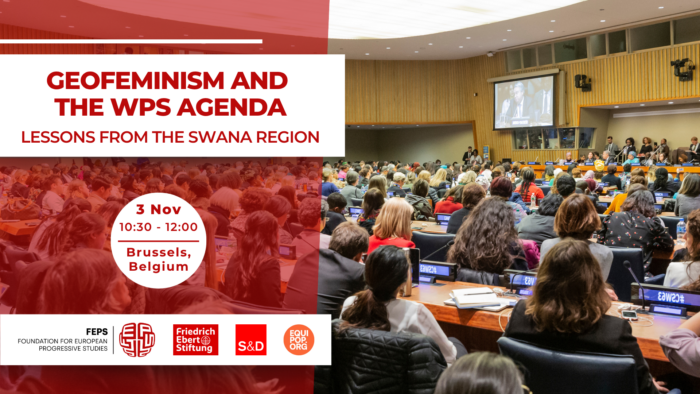
Brussels, Belgium (Expert meeting)

Dublin, Ireland

Dublin (expert meeting)

Dublin, Ireland (Expert meeting)
Load more...
Find all related publications
Publications
Find all related Audiovisual
Audiovisual

23/04/2026
09/03/2026
09/03/2026

04/02/2026
Find all related news
News

Find all related in the media
In the media