

05/03/2025
The far right’s push against gender equality and women’s rights – especially sexual and reproductive health and rights –, has become the cornerstone of its narrative and its strategies to promote its authoritarian, nationalist, xenophobic and austerity-driven agenda. But faced with this offensive, we cannot let feminist demands be pushed to the periphery of our political strategy, just because, as the excuse goes, it is a divisive issue.
Gender equality and women’s rights are the very essence of universal democracy, the principle of equality itself, that is now being questioned by the reactionary wave in substance as well as in form. We need more feminism, not less, because we need more democracy, not less!
Anti-feminism is a central theme of the far-right international. It cannot be otherwise, given that feminism is the most profoundly democratic movement of the 20th and 21st centuries, and the most progressive one. It is normal that reactionaries want to combat it by appealing to tradition and what they call ‘common sense’, which is nothing but the unequal and discriminatory principles of patriarchal and colonial society.
The far right has made it clear, especially to young men, that their loss of space in society and the economy is due to the supposed privileges that equality policies have given to women. The reality, however, is that these policies have removed existing discrimination and barriers, allowing for real equality – or at least opening the path in this direction.
A good example is the field of higher education, where, for several decades, women have outnumbered men among university graduates in Europe and the USA. This slowly impacts the labour market, with more women occupying better positions and achieving more autonomy from men. This positive trend, however, is perceived as an example of loss of power by some men as if it was the direct consequence of positive actions to achieve gender equality rather than a consequence of a level playing field. In a hopeless neoliberal framework of dispossession and post-Covid uncertainty, the dream of a bygone past when men had, at least, power over women, seduces many of them. These trends have extreme consequences in voting behaviour among young men worldwide. Education is becoming a divide in politics and society, as young men achieve lower levels in education, and career achievements wages, and, oftentimes, as a consequence, tend to support far-right parties.
2025 marks 30 years since the Beijing International Conference on Women, a turning point in the demands, unity and institutionalisation of the global feminist movement and its transformative capacity. Since then, the counter-reaction started getting organised effectively, through international conferences with enormous resources and amplifiers.
There is compelling evidence that at least since 2013, very powerful and well-funded interests from around the world have been meeting in forums that call for a return to traditional family values and control over women’s bodies, promoting restrictions on abortion rights worldwide. These meetings and conferences are part of the genesis of the far-right international, which has always had anti-feminism as an essential and unifying objective of its political action. Controlling women and their bodies implies controlling who reproduces and who does not, thus controlling the ethnic and demographic balance of countries, which is essential to nationalist, new colonial, xenophobic and exclusionary political proposals.
These proposals have been very successful in convincing men that feminism is not a movement for equality, but for women’s privileges, which undermines their masculinity and subjugates them, depriving them not only of their privileges – which they do not perceive as such – but also of their supposedly superior role in the natural order of things. This trend has also reached progressive forces, leading to a kind of diversity trap diluting class consciousness and political priorities.
Moreover, the international far-right’s strategy has also targeted women. It has done so intelligently on different fronts: by making the return to a so-called ‘natural order’ attractive also to some women through well-funded trends on social media, such as the ‘tradwives’, who show their ‘happiness’ of accepting their ‘complementary’ role; scaring women with the sexual violence of immigrants – as if Dominique Pelicot and his fellow perpetrator-neighbours had arrived on a migrant boat to France – and by scaring mothers and making them believe that their sons would be denounced as rapists for flirting with girls.
The international far right exploits the fear and the social exhaustion of women in our multiple roles, as the equality we were promised has not yet materialised. We are still the ‘natural’ caregivers, we do not occupy the same positions of responsibility as men, we do not earn the same, nor enjoy the same prestige. The promised equality is not yet fully here. For that, we would need universal public services, more investments in care infrastructure for example through a European Care Deal, improved parental leave, and fair wages for care workers across the EU.
In addition, the international far right is taking advantage of the divisions between a part of the feminist movement and the LGBTQI+ movement. It is using this division like a Trojan horse, fuelling the debate against equality and feminist conquests. Our democracies have still only given partial responses to women’s demands, such as real equal pay and participation in decision-making, equal job opportunities and care, free contraception and abortion, financial and legal independence, an end to discrimination against and freedom from violence, and sexual coercion. The reality is that we are still being killed or raped simply for being women, that we still are poorer and far away from economic equality even though we achieved higher and better education than men, and that we still have less autonomy and freedom.
Therefore, to defeat the far-right international’s attack on democracy we need more democracy and the inclusion of feminist proposals at the very core of our institutions and political action. For us Progressives, this must be essential because the Socialist and Democratic parties have been the main defenders of women’s rights and the extension of rights such as LGBTQI+ rights, in short, the principle of equality itself. Women know this, which is why female voters clearly lean toward progressive political forces over conservative and far-right ones. We want to continue deciding for ourselves. We want to continue being an end in ourselves, rather than a means to an end for others, such as solving the demographic problem or the fiscal and economic policy options of austerity-supporting elites with the chainsaw that takes us directly back home to give birth and take care of others, cutting in social expenditure which impact especially women as the main users of social services, employers, or ‘natural substitutes’ of these welfare provisions.
That is why equality needs to be put truly at the centre of our politics and policies. We want more equality, not less. Equality is not divisive: it is an essential democratic principle without which other fundamental principles, such as freedom, cannot be developed. Every day must be an International Women’s Day for Progressives. Women have been the dam against the return of fascism in Europe. Now we need more men to join us to formulate and promote proposals that will ensure the well-being and future of our citizens and the growth of the European project of peace and respect.
Photo credits: Shutterstock.com/ElenaBaryshnikova
Find all related Progressive Post
Progressive Post
Find all related events
Events
No upcoming events at the moment.
Vienna, Austria
Kazincbarcika, Hungary
Nyírbátor, Hungary
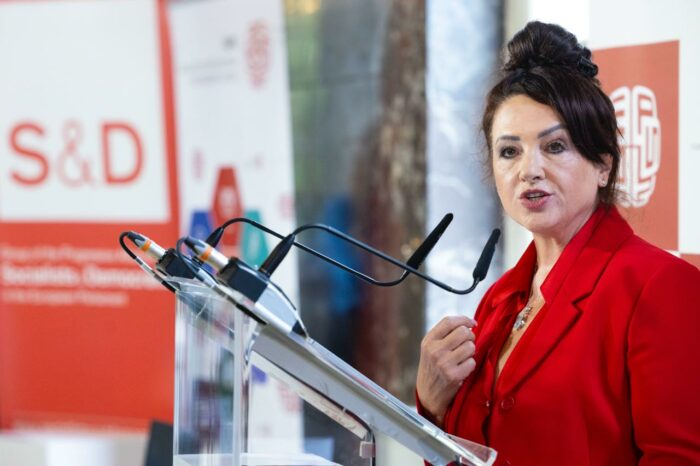
Académie Royale, Brussels
Load more...
Find all related publications
Publications


Find all related Audiovisual
Audiovisual
03/03/2025
03/03/2025
06/12/2024
07/09/2024
Find all related news
News

Find all related in the media
In the media