


Associate Professor, Borys Grinchenko Kyiv University, and Visiting Researcher, Catholic University Louvain
22/02/2023
“This present moment used to be the unimaginable future”
Stewart Brand, The clock of the long now
Using the quote of Stewart Brand resonated with me, describing the last 365 days. A long-awaited vacation, apartment renovation, research and new business development… – these were the ordinary plans of Ukrainians in 2022. Instead, many had to leave their ‘normal’ life, families, their homes. You will have seen it on photos or in video streams: children’s toys are pressed together with stones and metal, mixed with rests of food, cupboards and other debris. An immense force reduced the three-dimensional living space of millions of apartments into two dimensions. This has caused unspeakable pain for those who have witnessed it.
I don’t like to call it the ‘sad anniversary of a full-scale invasion.’ Apart from all the atrocities and suffering, let me call it a year of full-scale transformations: personal, professional, regional and national.
It’s precisely the time when ordinary Ukrainian people have started to do extraordinary things. These extraordinary issues were related to knowing how to evacuate yourself, your relatives, or a person whom you have seen for the first time in your life.
Ukraine has made a civilisational choice in favour of democracy, having come a long way, as all European countries once did. Independent Ukraine has never participated in armed conflicts in other territories as an aggressor, but only defended itself.
One of the significant consequences of the war with Russia was a radical reforming of domestic political life in Ukraine. First of all, these developments were related to those regions and citizens who, despite Russia’s aggressions since 2014, had been pro-Russian. Polls conducted in Ukraine in March, May, October 2022, as well as in February 2023, confirmed that more than 86 per cent of Ukrainians believe that their country will win the war, 80 per cent among those who had been neutral before the full-scale invasion, are completely against Russian actions now.
Ukrainian politics has undergone sweeping changes since 24 February 2022. Never before have we been so united. The first lesson the country has learned is that only in unity can we continue to fight, and to exist. Ukraine chose a ‘one voice policy’ and to call the whole world to support us.
On 20 March 2022, the National Security and Defence Council suspended the activities of parties in Ukraine that had ties to the Russian Federation, this concerned 11 parties in total. One of them, the ‘Opposition Platform – For Life’ has elected members in the parliament and in numerous local councils of all levels throughout the territory of Ukraine. Two more parties – ‘Shariy Party’ and ‘Nashi’ – had a stable electorate before the war and, according to the polling data, could have overcome the 5 per cent electoral threshold in the elections.
Ukrainian people have understood that our future is in the EU. Therefore, at the end of February 2022, President Volodymyr Zelensky announced a request for the candidacy status which the EU granted at the end of June 2022. The basis for the candidacy was the successful implementation of 63 per cent of the Association Agreement between the EU and Ukraine prior to February 2022. As of the beginning of 2023, the progress reached in total 73 per cent of implementation – which is a remarkable feat: a country carrying out reforms during a full-scale invasion. These reforms are related to the sectors of the judiciary – in particular anti-corruption –, but also in economic development and the military.
At the same time, support for Ukraine’s accession to the EU is steadily growing. In April 2014, Ukrainian’s support for EU membership was at 54 per cent, in March 2022 it had reached a record 91 per cent.
Trade between Ukraine and the European Union and the country’s integration into the EU internal market is key to preserving the Ukrainian economy in war conditions and to a rapid economic recovery afterwards.
Currently, our domestic agenda is focused on ‘self-screening’: Ukraine is checking to what extent its legislation is in line with the EU acquis. In practice, this will also mean the implementation of a host of reforms – again: reforms that are undertaken under the conditions of a full-scale invasion.
On 3 February 2023, the European Commission (EC) published a report on Ukraine’s ability to fulfil the obligations tied to the EU candidacy status. On the progressive side, the document states that Ukraine has a good level of preparation in the field of customs control, energy policy, and foreign relations, particularly in foreign commercial relations. The country also has a good level of advancement in the sectors of security and defence. The EC positively assesses Ukraine’s cooperation with the EU in the fight against cyber threats and disinformation. The ratification of the Rome Statute of the International Criminal Court and related documents remains an unresolved issue, however. At the same time, Ukraine is at an early stage of preparation for the implementation of EU legislation in the field of environment and climate change, agriculture, social policy and employment.
In addition, the EU emphasised the progress needed in judicial reform “in accordance with the recommendations of the Venice Commission, including the reform of the Constitutional Court and the procedure for the selection of politically independent and qualified constitutional judges.”
At the same time, significant progress has been made in ensuring the independent and effective work of anti-corruption institutions and in bringing Ukraine’s media legislation in line with the EU acquis regarding audio-visual media. Ukrainian experts and MPs emphasise that our fight against corruption is now inevitable. Cleaning up corruption is a requirement for EU accession. Consequently, in June 2022, the Ukrainian Parliament approved its Anti-Corruption Strategy (2021-2025), one of the benchmarks of an effective implementation of anti-corruption legislation. It is actually a step-by-step plan on how to reform 15 socially important areas with the highest level of corruption. At present, the adopted initiative is somewhat inhibited by the government, but the corruption scandals which we have heard of in January and February 2023, prove that anti-corruption institutions in Ukraine are working.
This present moment is our unimaginable future. Ukraine’s geopolitical integration into the West and its institutions is no less critical than Leopard or Abrams tanks for the defence of Ukraine. If you watch how fast Ukraine is moving ahead with its transformation and reforms, it seems the EU rides bicycles while Ukraine is on a hyperloop.
But will that be enough? That’s a very difficult question.
It is true that the speed with which the Ukrainians prepared for candidacy and, at the same time, made political, economic and military ‘breakthroughs’ is simply breath-taking for Europeans.
However, it is widely known in the EU that Kyiv’s path to full membership will be a long process that could take years. At the same time, the EU also needs to deal with the expectations of other EU candidates, particularly from the Western Balkans.
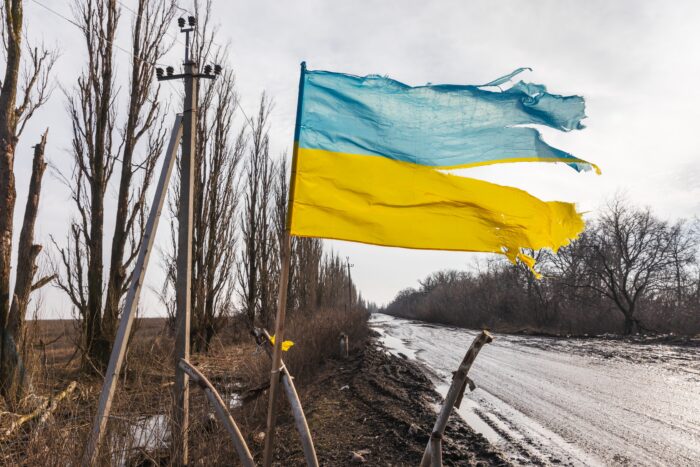
Photo credits: Shutterstock.com/Drop of Light
Find all related Progressive Post
Progressive Post
Find all related events
Events
No upcoming events at the moment.

Find all related publications
Publications

Find all related Audiovisual
Audiovisual
16/09/2025
16/09/2025
27/03/2025
17/02/2025
Find all related news
News


Find all related in the media
In the media