


15/10/2024
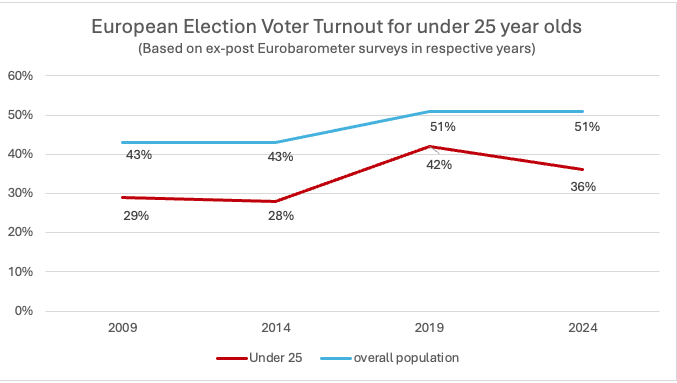
The 2024 European elections witnessed a decline in voter turnout among young people under 25. Only 36 per cent of eligible voters in this age group participated, marking a 6 per cent decrease from the 42 per cent turnout in the 2019 elections. This downturn raises critical questions about youth engagement in European elections.
In the 2019 elections, there was a notable surge in youth participation, with turnout among young voters increasing by 14 per cent compared to 2014. This rise was largely attributed to the heightened salience of climate issues and the peak of global climate protests, which mobilised young people across Europe. The 2024 elections did not sustain this momentum, suggesting that the 2019 spike may have responded to specific circumstances rather than a long-term shift in youth electoral engagement.
While overall voter turnout remained relatively stable between 2019 and 2024, at 51 per cent, the decline among the youngest voters indicates a potential disengagement from electoral politics that merits attention from policymakers, political parties and civil society organisations. The following text provides some key numbers and observations based on the EU Post-electoral Survey 2024 by Eurobarometer.
Sources: Eurobarometer Post Election Surveys 2009, 2014, 2019, 2024
Youth voting patterns and motivations
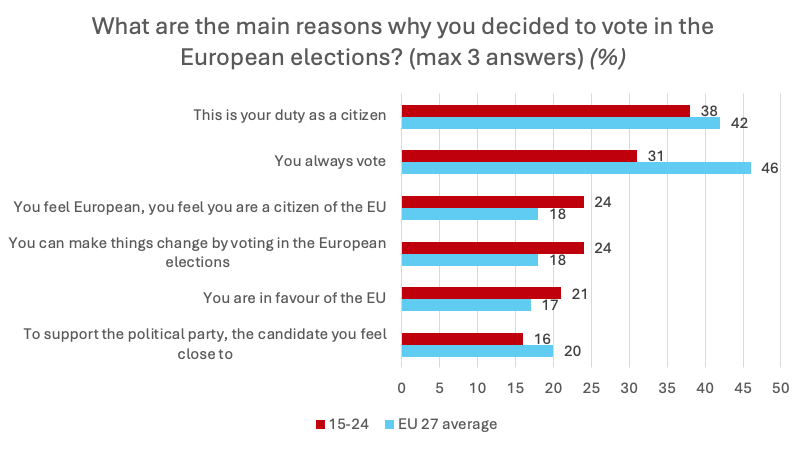
According to the finding of Eurobarometer’s survey, the primary motivations for young voters to cast their vote includes civic duty (38 per cent), closely aligning with the population average of 42 per cent. Habitual voting was cited by 31 per cent of young voters, lower than 46 per cent among the general population, likely due to their younger age and limited voting history. Affinity for the EU was a stronger motivation for young voters compared to older ones: 21 per cent were motivated by support for the EU (compared to 17 per cent overall), and 24 per cent said their senses of feeling European or seeing themselves as EU citizens (versus 18 per cent overall) made them vote. Additionally, 24 per cent believed their vote could make a difference at the EU level versus 18 per cent of all voters.
Sources: Eurobarometer Post Election Survey 2024
Among young non-voters, the main reason for staying away from the polls was a lack of interest in politics (28 per cent), higher than the 20 per cent among the overall population. Yet only 14 per cent among the youngest age group cited distrust in politics, compared to 21 per cent overall, and 10 per cent felt their vote would not change anything, less than 17 per cent among all age groups. These findings suggest that a lack of interest in politics, rather than cynicism or lack of trust, is a more significant barrier to youth participation, indicating a need to make politics more relevant and engaging to young people. While a lack of interest is a factor, the data does not support the myth that young people are apathetic; over 70 per cent of non-voters indicated other reasons for not voting.
An analysis of when young people decided to vote reveals they are likelier than older generations to make last-minute decisions. Among voters under 25, 29 per cent chose to vote in the weeks and days leading up to the elections. In comparison, only 9 per cent of voters over 55 decided so late. Among young non-voters, a significant portion decided not to turn up at the polling stations in the days before (11 per cent) and 21 per cent on election day. This pattern underscores the importance for institutions and political parties to continuously engage with young voters, as efforts to mobilise them can be effective until the last moments before the polls close.
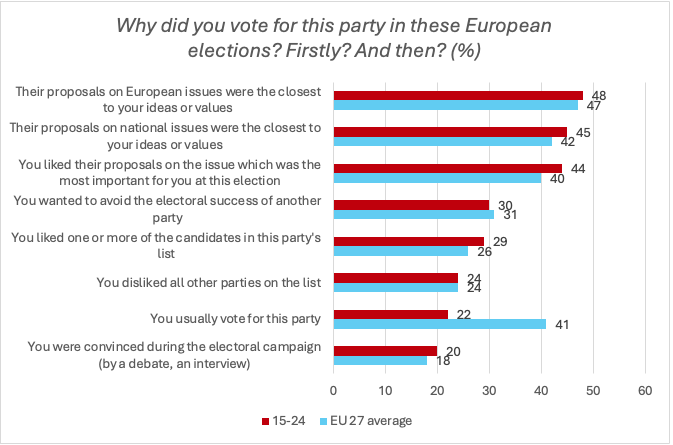
The Eurobarometer data shows that young voters show less attachment to political parties than older voters, with only 22 per cent stating that they usually vote for the same party, compared to 41 per cent overall. The data also reveals that more than half of young people only decided in the weeks (24 per cent), days (18 per cent) or election day (11 per cent) whom to vote for, much later than their older peers. The key factors influencing young voters’ choice of the party were alignment with their ideas or values on European issues (48 per cent) and national issues (45 per cent), as well as favouring proposals on the most important issues to them (44 per cent). This suggests young people are open to persuasion, making late campaign efforts impactful, and are influenced more by values and issues than partisan loyalty.
Sources: Eurobarometer Post Election Survey 2024
What drives young voters
Key issues motivating young voters included the rising cost of living (38 per cent) and economic situation (36 per cent), though these motivated them slightly less than older voters. Climate change was slightly more important for young voters (32 per cent vs. 28 per cent overall), while education played a much more significant role for under 25-year-olds (29 per cent vs. 13 per cent of the overall population). Conversely, defence, security and fighting crime were less influential. For young people who did not vote, the top issues that could have encouraged them to participate were similar to those that motivated young voters. However, non-voting young people also indicated that addressing unemployment (21 per cent) and housing (18 per cent) might have spurred them to vote far more than young voters.
Declining youth turnout in the 2024 European elections highlights the urgent need for sustained engagement with young voters. Their issue- and value-based voting indicates that continuous, targeted efforts by parties to address specific concerns are as crucial as late campaign pushes recognising young voters’ late voting decisions. Focusing on issues that matter most to young people – economic opportunities, education and climate change – and making politics more accessible and engaging can captivate this critical demographic.
For progressive parties, this means sharpening their profile around job creation, addressing the cost-of-living crisis and enhancing recognisability on climate change and quality education. Progressives must analyse why they failed to motivate many young non-voters who cited housing and unemployment as key concerns. While late campaign pushes are promising, it is essential to continuously highlight progressive successes and contributions to young people’s lives. As an ongoing FEPS project suggests, in their communication, progressives should directly engage with young people, recognise their diversity and offer concrete takeaways in a dialogue-driven manner.
FEPS addresses these issues in a research, on and with young people, carried out through large-scale youth surveys that aim to identify young people’s concerns, hopes, and needs. Currently, in partnership with the Friedrich-Ebert-Stiftung and Democracy Reporting International, FEPS is also undertaking a project that investigates how political parties targeted young people on social media during the 2024 European elections. This project examines whether the targeting aligned with the topics most important to young people and which type of messaging effectively captured their engagement on various platforms.
Photo credits: European Union 2024 – EP
Find all related Progressive Post
Progressive Post

Find all related events
Events
No upcoming events at the moment.


Find all related publications
Publications


Find all related Audiovisual
Audiovisual

23/04/2026
18/07/2025
17/12/2024
17/12/2024
Find all related news
News


Find all related in the media
In the media