

Alberto-Horst Neidhardt is Head of the European Migration and Diversity Programme of the European Policy Centre (EPC)
02/07/2026
The EU migration and asylum reforms became applicable on 12 June, but their impact and credibility will depend on what happens next. At the border, screening, border procedures and Eurodac – the EU’s asylum database – must work together. If legal and operational gaps persist, they risk undermining rights, solidarity and the Schengen area.
Screening and border procedures, alongside an expanded Eurodac system, are meant to create a seamless process: people arriving irregularly should be registered, vulnerabilities assessed and security checks carried out. Screening at the external border should be completed within seven days. People should then be channelled towards the appropriate follow-up procedure, including the regular asylum process, the border procedure or return.
Border procedures are mandatory for certain applicants, including those from countries with low recognition rates. The pact also sets country-specific ‘adequate capacity’: the reception and human resource capacity required to process a set number of cases in the border procedure at any given moment. All this is operationally and administratively demanding. It requires financial resources, facilities, trained staff, consistent Eurodac registration, clear workflows, legal counselling, fundamental rights monitoring and judicial capacity, among others.
An uneven start for screening and border procedures
Official reports from the European Commission show that member states reached 12 June, ‘implementation day’, with uneven levels of readiness. Around early May, the situation had improved compared to mid and late 2025. Yet gaps remained. In total, 15 member states had the facilities and human resources required for adequate capacity, 17 had notified border-procedure locations and 20 were considered on track for screening. Greece, Poland and others had not yet notified the locations where border procedures would take place. A larger group, including Germany, Greece, Italy, Spain and Poland, still faced obstacles to managing screening and border processing because of limited accommodation, staffing gaps or incomplete operational and administrative arrangements
At the same time, health-check arrangements still needed finalising in, among others, Germany, Slovenia and Spain. Eurodac readiness was also uneven: in total, 11 member states reported being fully on track, while 16 still faced challenges, even though the central system was ready for the core functionalities needed by June. A third of member states had also not finalised legislative changes for free legal counselling, while monitoring arrangements were still being concluded in several countries.
EU member states’ progress in implementation readiness
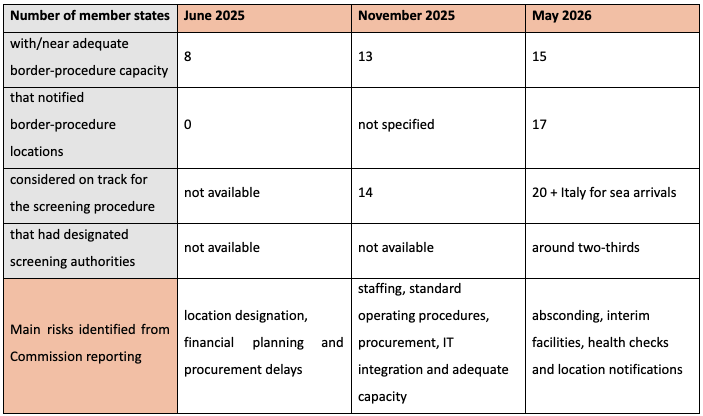
Source: European Commission, State of play on the implementation of the Pact on Migration and Asylum,
June 2025, November 2025 and May 2026.
While developments at the legal and operational levels continued until the last minute before the rules became applicable, and while implementation readiness is expected to improve, uncertainty and challenges will persist longer than anticipated.
The risks of uneven implementation for asylum, solidarity and Schengen
Delays and gaps, as well as the prospect of divergent practices, pose risks to asylum seekers, national administrations, the Common European Asylum System, and Schengen. For asylum seekers, the first risk is that of a ‘procedural lottery’. If staff are insufficiently trained or legal counselling is uneven, for example, similar cases may be treated differently from one member state to another. Vulnerabilities, family links or medical needs may also be missed if screening is rushed. Civil society organisations have warned that screening will often be conducted by police or border guards who may lack the expertise to identify vulnerabilities. The result would be unfair for applicants and would undermine convergence across national practices.
A second risk concerns fundamental rights. The pact’s border model relies on people remaining available to authorities during screening and border procedures. In practice, uneven readiness and divergent national approaches may mean that some people go through a tightly managed, rights-compliant process, while others face improvised confinement in interim facilities, movement restrictions or detention. Safeguards, therefore, become central. Yet delays also mean that the right to challenge a decision could vary across member states.
The administrative risks are just as serious. Without enough caseworkers, judges or interpreters, faster procedures could miss deadlines and generate backlogs. There is also a risk of resource diversion. Administrations that are not ready may spend a longer transition phase firefighting: temporary facilities, emergency staffing, manual workarounds, urgent procurement or even litigation. Onward movements may also occur before people are screened, registered and referred to the right procedure. When that happens, another member state must carry out the screening on its territory, shifting the administrative burden to authorities who may themselves be unprepared.
Uneven implementation could thus weaken mutual trust. The potential limited use of Eurodac amplifies the risk. The database is not just an IT tool. It is considered essential to determine which country is responsible and to monitor cross-border movements. If data are incomplete or registration is inconsistent, it will be harder to define responsibility allocation and carry out transfers. Other member states may also hesitate to make or implement solidarity pledges or resort to internal border controls in the presence of continued secondary movements. All this should not be read as a prediction of inevitable or lasting failure. Rather, it points to a period of uneven adjustment, during which national practices should gradually move closer to the pact’s requirements. In fact, the pact has instruments to identify and correct bottlenecks and capacity constraints before they become systemic – including monitoring and reporting, support from EU agencies and fundamental rights mechanisms.
The next milestone will come in autumn 2026, with the first annual report after application and the start of the new implementation cycle. This will show whether the gaps have begun to close before decisions are made on which member states are under migratory pressure, and which must contribute through solidarity. That moment will matter more than 12 June itself.
Photo credits: Shutterstock/Savvapanf Photo
Find all related Progressive Post
Progressive Post