


28/06/2022
By granting candidate status to Ukraine and Moldova and by recommitting to the EU membership of the Western Balkans, the European Union opened a new phase of its enlargement which will redesign the European political map again. It was undoubtedly the right decision to assert European sovereignty and also to welcome an embattled country which is showing with bravery that it belongs to the European future and not to a war of the past. A war of the past in Europe because it combines the clash of empires of WW I with the clash of political regimes of WW II.
The future in Europe is being created by the values of freedom, equality, solidarity, democracy and sustainability and by a process of European integration which involves enlargement but also deepening. Deepening is a pre-condition for successful enlargement. But as enlargement has now become a political and moral imperative, the issue today is not about choosing between one or another. It is rather about how to make both with a new approach.
Enlargement with a new approach requires putting political and geopolitical unity at the top of the agenda, with strong coordination of external policy and defence, swifter integration in the European energy, transports, digital, research and education networks, promotion of joint investment for a new development model – adding to the classical approach of market access and adjustment to the acquis communautaire. This new approach also means greater and stronger convergence in governance, including the rule of law and the coordination of economic, social and tax policies. The idea of a European Political Community should only be considered if it is used in this direction and not as a process to delay EU membership.
Nevertheless, a larger European Union cannot afford to run the risk of being paralysed in its internal decisions precisely when the world order is being redesigned and humankind confronted with planetary and existential challenges. The EU’s capacity to act should be strengthened with a precise plan to deepen EU integration involving all member states willing to participate.
The world is now at a moment of bifurcation: either the multilateral system can reinvent itself to respond to global challenges with more cooperation in this multipolar world, or global governance will be fragmented according to different faulting lines: the US vs China, the G2 vs the others, a shrinking West vs the others, and Global South vs Global North. The European Union urgently needs to position itself as a global actor striving for a multipolar world framed by an effective, fair and inclusive multilateral system. The war in Ukraine is its first high-level test so far.
Among several worrying military conflicts, the one in Ukraine is particularly worrying because it can trigger these major fragmentations in the world order. Supporting Ukraine with decisive action against Putin’s tyranny and providing it EU candidate status are important precisely to enable an acceptable peace settlement and to prevent these risks of fragmentation. To prevent a global food security crisis and to deactivate this new Russian weapon will be a second important test.
This conflict also reveals how multifaceted war and warfare can become today, from military confrontation, financial and economic sanctions and counter-sanctions, to the weaponisation of energy, food and migration. In addition, a decisive dimension of 21st-century wars seems to be the digital one, not only because of cybersecurity but also because of the battle of narratives and visions of reality in the media space – which, among others, will decide for how long the Russian people will support president Vladimir Putin’s leadership.
Is Europe equipped to ensure security in these fields and to protect its sovereign democratic choices? As, clearly, the answer is no, we need to develop the EU’s capacity to act, first of all, externally by promoting multilateral solutions to secure peace, to address climate and health challenges, to support fundamental rights and to reduce social inequalities across the world. The priorities should also be clear in all EU bilateral relationships. Beyond being an active and committed member of NATO and G7, the EU must assert itself as a global actor with its own global vision, a larger concept of external action as well as more robust diplomatic and defence capacities – including in cybersecurity.
We also need to strengthen our capacity to act to step up the transition towards a new development model, low-carbon, with less energy dependencies and with a European-driven digital transformation – while tackling social and regional inequalities.
Nevertheless, these two high ambitions can only be met if the EU deploys the necessary means. New financial means will require a large-scale and long-term investment capacity, mobilising all possible private and public tools. They should also involve a more robust permanent European budgetary capacity based on common issuance of debt backed by new own resources as well as national budgets with room to invest while keeping sustainable debts. A significant overhaul of the European tax system will be crucial not only to tackle tax avoidance but also to focus on new own sources of taxation.
Finally, new political means will be decisive for all this to happen. First, by enforcing the rule of law, strengthening democracy and fighting corruption. Secondly, by enabling the European political system to overcome veto obstacles with updated rules of qualified majority voting and a role given to the European Parliament. Finally, by engaging civil society and citizens at large through renewed channels of participatory democracy, building on the recent experience of the Conference on the Future of Europe. That is why the follow-up of this Conference will require bold and courageous decisions.
Photo credits: © European Council
Find all related Progressive Post
Progressive Post
Find all related events
Events
No upcoming events at the moment.
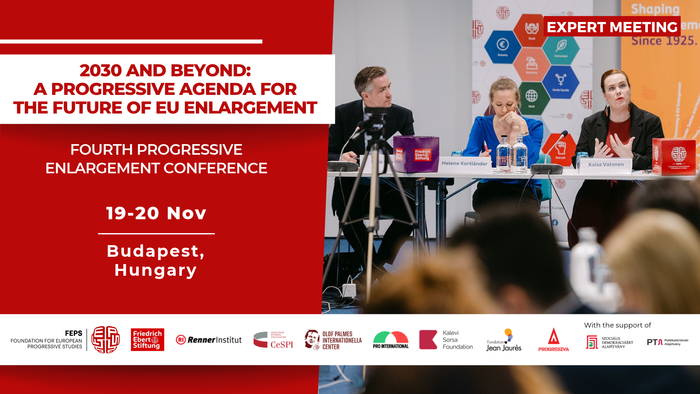
Budapest, Hungary (Expert meeting)
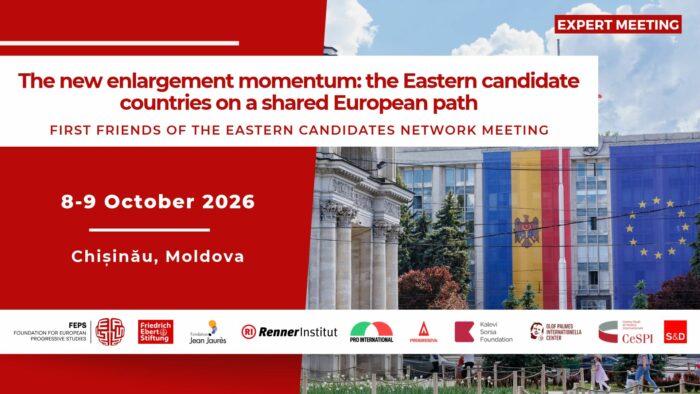
Chișinău, Moldova (Expert Meeting)
FEPS HQ
Podgorica, Montenegro (Expert Meeting)
Load more...
Find all related publications
Publications
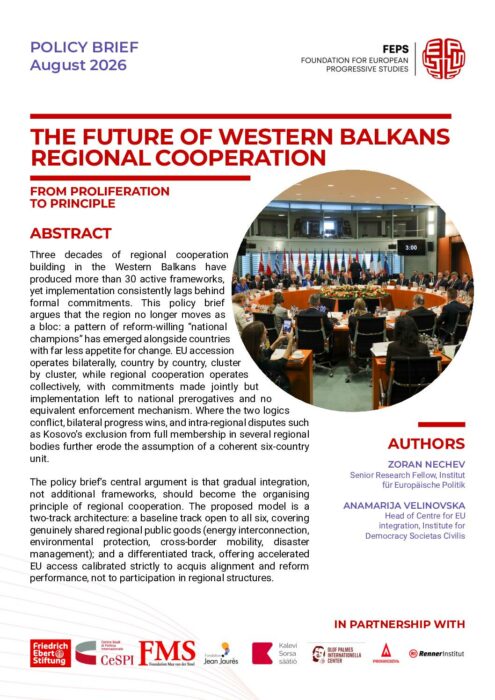
Find all related Audiovisual
Audiovisual

05/06/2026
24/04/2026
24/04/2026

23/04/2026
Find all related news
News
Find all related in the media
In the media
NATO-bővítés sok vitával: érvek, ellenérvek és lobbik a Clinton-elnökség idején
by BBC History 07/07/2024