
Download
FoWB Montenegro Joint Statement
05/06/2026
Podgorica, 5 June 2026
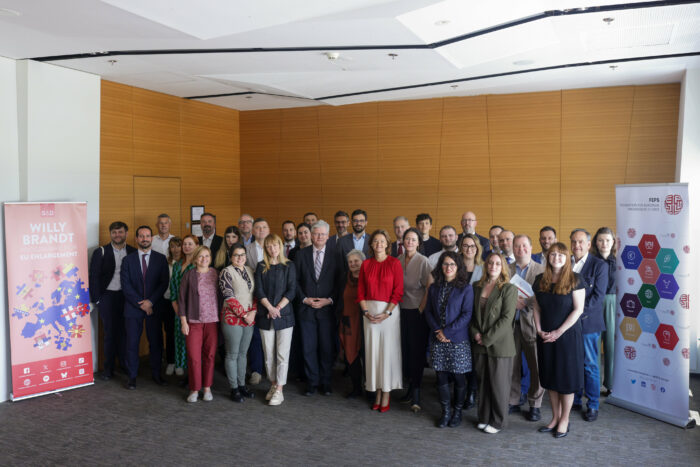
We, the Friends of the Western Balkans (FoWB) – representatives of the European social democratic community, including members of national and European parliaments, political foundations, parties and civil society organisations from across Europe and the region – have convened for our ninth meeting in Podgorica, ahead of the EU-Western Balkans Summit, to discuss the situation in Montenegro, regional cooperation in the Western Balkans, the implications of the elections in Hungary for the enlargement process and challenges and opportunities related to the Just Transition in the Western Balkans. While new proposals on reforming the EU enlargement methodology circulate in Brussels and beyond, we reiterate that enlarging the Union is and will always remain primarily a matter of political will – both among Member States and in the candidate countries.
28th EU Member by 2028: Montenegro’s Moment of Truth
The Friends of Western Balkans fully and wholeheartedly support Montenegro’s ambitious goal to become an EU Member State by 2028. We welcome the establishment of the Ad Hoc Working Group for the drafting of Montenegro’s Accession Treaty, a process launched, for the first time in over a decade, by the Cypriot Presidency, bringing Montenegro one step closer to the EU.
Yet, the final phase of the negotiations will depend not only on technical alignment with EU legislation but also on Montenegro’s ability to demonstrate credible and sustained reforms, particularly when it comes to rule of law, judicial independence, anti-corruption policies, and the functioning of democratic institutions.
Any steps backwards, such as the recent adoption of the Law on Internal Affairs and the Law on the National Security Agency, triggering strong reactions from the opposition, numerous civil society organisations and the President, divert the attention from the EU agenda. Identity politics can be instrumentalised, straining relations with its neighbours. Malign foreign interference, destabilising activities, hybrid threats and disinformation campaigns by third-country actors will only intensify as the country moves towards the EU. A clear exampe of such interferences is the report that, only two days ago (on 3 June), President Vucić’s supporters flew to Tivat in an attempt to destabilise the EUWestern Balkans summit. The accession process can therefore only be successful to the extent that it is inclusive, mobilising cross-party alliances, building on societal resilience and ownership, with no compromises on rule of law, democracy, and human rights
The Friends of the Western Balkans call:
- on the Montenegrin actors to ensure that the accession process is inclusive, driven by a crossparty consensus and cooperation with civil society and social partners;
- on the European Commission to ensure that the process remains merit-based, that progress is recognised, while shortcomings are transparently and publicly addressed;
- on the EU Member States to match the pace of reforms in candidate countries and prepare the ground for Montenegro’s accession;
- on the European progressive political family to actively engage with the broad public ahead of future EU enlargement ratification campaigns.
Progressive Solutions for EU Enlargement
The question of Ukraine’s fast-track accession triggered a wave of new proposals on revising the enlargement methodology: the ‘reverse enlargement’, ‘Rama and Vučić proposal’, the German, the French or the Lithuanian non-papers. The Friends of the Western Balkans are open to find a new creative way forward on EU enlargement, and examine any genuine proposals put forward by the Commission, the Member States or other stakeholders.
However, any such revised approach must be based on the following key principles:
- No compromises on fundamentals, as outlined in the Copenhagen criteria – rule of law, democracy, human rights and good governance. Only democratic states will strengthen the EU. Accession treaties must contain strong safeguards to ensure that the EU has stronger and more flexible tools in case of backsliding. The same safeguards should be extended to existing Member States to strengthen the Union’s democratic resilience. After all, commitment to rule of law is reversible also in the current Member States. The EU must be ready to use its existing tools and develop new ones to counter any signs of backsliding.
- Full alignment with Common Foreign and Security Policy (CFSP). Countries which do not share EU’s geostrategic outlook risk to further undermine its unity.
- EU social acquis as a guarantee of prosperity. The EU must strengthen the social dimension of EU enlargement, ensure upward convergence and have a clear answer to the risk of social dumping and communicate this transparently to citizens.
- Same offer for all candidates. The EU accession of Ukraine will inevitably be discussed in the context of the provision of security guarantees. Whichever process is offered to Ukraine, the same offer must be available to all other candidate countries as well, and the Western Balkans in particular.
Regardless of the methodology employed, we strongly believe that EU enlargement is ultimately a matter of political will. Unless European leaders find the courage to take the right decisions for the peace, security and prosperity of the continent, tweaks of the methodology on their own will not deliver on this goal. On the contrary, methodological discussions have been used in the past as an excuse to delay EU accession and keep candidate countries in the waiting room. This mirrors the false dilemma of ‘deepening versus enlarging’ the Union; in reality, both dynamics must go hand in hand.
Non-enlargement will come with a great cost: security risks, destabilisation, economic loss, realignment with Russia or China. Each successive delay increases those risks. Member States must now deliver on their responsibility and bring candidate countries to the table through a credible and merit-based enlargement process.
The Friends of the Western Balkans conclude that:
- To deliver on the 2028 timeline, Montenegro’s EU accession must be as whole-of-society process where no individual actor can be solely responsible for its success or lack thereof. Key challenges still remain in the areas of rule of law, judicial independence, anti-corruption policies, and the functioning of democratic institutions.
- The full integration of all Western Balkan countries into the EU remains a strategic objective. At the same time, the credibility of the enlargement process requires clear conditionality: political actors and governments that obstruct reforms, fail to align with the EU’s foreign and security policy, or actively hinder the European path must face stronger diplomatic accountability.
- We are ready to discuss any genuine proposals that aim to update the enlargement methodology for the current geopolitical times. At the same time, enlargement will be ultimately a question not of methodology but of political will. We call on European leaders to take concrete steps to advance EU enlargement and foresee it in the next MFF.
- If instead methodological discussions are used as a delaying tactic, this will have direct negative consequences for the prosperity, stability and security of the European continent. Now is the time to act.
Signatories
Adis Ahmetović, Member of the German Bundestag, Foreign Policy Spokesperson for the Social Democratic Party (SPD), Germany
Aleksandar Bogdanović, President, Political Academy of DPS, Montenegro
Anamarija Velinovska, Head of Centre for EU Integration, Institute for Democracy, North Macedonia
Andreas Schieder, Member of the European Parliament, S&D Group, Austria
Andrija Nikolić, Head of MP Group of DPS, DPS in the Parliament of Montenegro, Montenegro
Anna Pic, Member of the National Assembly, Parti Socialiste, France
Balsa Božović, Chair of the Executive Committee, Regional Academy for Democratic Development – ADD, Serbia
Belmin Zukan, International Secretary, Social Democratic Party of BiH, Bosnia and Herzegovina
Berta López Domènech, Policy Analyst, European Policy Center (EPC), Spain
Biljana Ćulafić, Member of the Main Board, Former SDP Councillor, Montenegro
Ćazim Lisičić, Executive Director, Fund for Progressive Policies, Montenegro
Chloé Ridel, Member of the European Parliament, S&D Group, France
Christian Castagna, President, VoisinageS, France
Čogurić Rašović, President of Ecopatriotism, Eco Ambassador for the Environmental Protection Agency, Montenegro
Daliborka Uljarević, Executive Director, Centre for Civic Education (CCE/CGO), Montenegro
Daniele Frigeri, President, CeSPI, Italy
Danijel Zivkovic, Party Leader, Democratic Party of Socialists (DPS), Montenegro
Denis Begic, Member of the Riksadag, Social Democratic Party, Sweden
Didier Marie, Senator, Vice-Chair of the French Senate’s Committee on European Affairs and Member of the Parliamentary Assembly of the Council of Europe (PACE), France
Emir Đikić, Director, consultED d.o.o., Bosnia and Herzegovina
Gledisa Çelaj, Program Coordinator, Centre for Labour Rights (CLR), Albania
Hélène Conway-Mouret, Senator, Socialists at the Senate, France
Ivan Vujovic, Vice President of DPS, Member of the Parliament of Montenegro, Former Chair of the European Integration Committee, Montenegro
Jasmin Bojadzic, International Secretary, DPS, Montenegro
Jasmina Hostert, Member of the German Bundestag, Germany
Jonas Andersson, Programme Manager PAO Western Balkans, Olof Palme International Center, Sweden
Jovana Karaulic, Member of the Presidency, Vice President of the Board, Democratic Party / Foundation “Ljuba Davidovic”, Serbia
Jovana Vukovic, Main Board Member, Social Democratic Party SDP, Montenegro
Kathleen van Brempt, Member of the European Parliament, S&D Group, Belgium
Kido Koenig, Director, Foundation Max van der Stoel, Netherlands Knut Fleckenstein, Political Advisor, FEPS, Germany
Lana Prlić, Member Of Parliament, Parliament of the Federation of Bosnia and Herzegovina, Bosnia and Herzegovina
László Andor, Secretary General, FEPS, Hungary
Lauri Finér, Director, Kalevi Sorsa Foundation, Finland
Levente Bazin, International Secretary, Hungarian Socialist Party (MSZP), Hungary
Maja Pupovac, Research Fellow, Institute for Philosophy and Social Theory, University of Belgrade, Serbia
Markus Kauppinen, Former Member of Parliament and Committee on Foreign Affairs, Social Democratic Party, Sweden
Marta Temido, Member of the European Parliament, S&D Group, Portugal
Matjaz Nemec, Member of the European Parliament, S&D Group, Slovenia
Nacho Sanchez Amor, Member of the European Parliament, S&D Group, Spain
Nataša Kovačević, Campaigner for District Heating Decarbonisation for the Western Balkans, CEE Bankwatch Network, Montenegro
Nataša Popović, Member of the Managing Board, Foundation Direction Europe, Serbia
Neva Grašič, State Secretary, Ministry of Foreign and European Affairs, Slovenia
Nicolo Carboni, National Executive – Dept. of International Affairs, Partito Democratico, Italy
Paul Stich, Member of the Austrian National Council, Austria
Peter Hurrelbrink, Director, FES Serbia, Montenegro and North Macedonia, Germany
Pia-Maria Wieninger, Member of the Austrian National Council, Austria
Pierre Pribetich, Member of the National Assembly, Parti Socialiste, France
Plejada Gugashi, Programme Manager, Olof Palmes Internationella Center, Albania
Rachid Temal, Senator and Head of the Senate Committee on Foreign Affairs and Defense, Socialists at the Senate, France
Romina Kuko, Member of the Parliament of Albania, Socialist Party of Albania, Albania
Sara Čabarkapa, Active Citizenship Programme Coordinator, Centre for Civic Education, Montenegro
Sarah Hees-Kalyani, Director, FES BiH, FES SOE, Germany
Sascha Obrecht, Director of Karl Renner Institut, Austria
Sébastien Gricourt, Head Balkans Observatory, Fondation Jean Jaurès, France
Sokol Zeneli, Director of Research and Programmes, Regional Action Lab (Re-ACT Lab), Kosovo
Tanja Vujičić, Technical Secretary, Evropski savez, Montenegro
Thijs Reuten, Member of the European Parliament, S&D Group, Netherlands
Tobias Mörschel, Director, FES EU Office, Germany
Tom van der Lee, Member of Dutch Parliament for Progressief Nederland (PRO), European Affairs & Economic Affairs, Netherlands
Tonino Picula, Member of the European Parliament, S&D Group, Croatia
Vladimir Medjak, Vice President European Movement Serbia, Serbia
Network



Find all related publications
Publications
Find all related Progressive Post
Progressive Post
Find all related events
Events
No upcoming events at the moment.
Chișinău, Moldova (Expert Meeting)
Podgorica, Montenegro (Expert Meeting)
Brussels, Belgium (Expert meeting)
Belgrade, Serbia
Load more...
Find all related news
News
Find all related in the media
In the media
NATO-bővítés sok vitával: érvek, ellenérvek és lobbik a Clinton-elnökség idején
by BBC History 07/07/2024
EU-VÍZIÓ, Dull Szabolcs újságíró Andor Lászlóval beszélget
by MÚOSZ Magyar Újságírók Országos Szövetsége 11/04/2024