The Progressive Post

Illiberal Gender Politics in Central Europe

The ban on Gender Studies and is a key pillar of the illiberal transformation.
28/10/2018

The ban on Gender Studies reminds us that a gender analysis is crucial to understand the Central European regime transformations. Illiberal governments challenge the liberal equality paradigm and infrastructure while at the same time introducing policies that benefit many women, forcing us to rethink illiberal gender politics outside of the simplistic backlash framework.


In August 2018, the international community learned that the Fidesz-KDNP government introduced legislation proposing to ban Gender Studies programs offered by universities in Hungary. Officially, the decision was justified on economic grounds, arguing that the program is not “economically rational”. Yet in their statements over the years, Hungarian illiberal politicians have increasingly evoked a different rhetoric on Gender Studies, framing it as a threat to traditional, Christian “way of life”, a discourse well known from global campaigns against ‘gender ideology’ that turned gender into an enemy figure. Right-wing actors exploited the confusing ambiguity of the term ‘gender’ in progressive theory and activism itself, where it is increasingly used to denote not just an analytical category describing relations of power, but also different identities.

Ever since Orbán’s famous 2014 proclamation of Hungary building an alternative to liberalism, and the 2015 victory of Law and Justice party in Poland, works discussing the illiberal transformation in Central Europe have proliferated, specifically on legal and institutional mechanisms. However, in those mainstream political analyses, gender was often missing. Yet the current attempts to ban Gender Studies in Hungary remind us that analysing gender politics is crucial to make sense of the current wave of right-wing illiberalism. ‘Gender’ became a symbol of the rejected liberal project, and gender politics has been one of the pillars illiberal governments are building their counter-proposal on. During his annual programmatic speech in Tusványos in 2018, Viktor Orbán announced that the next stage of his political transformation will focus on culture, the key goal being to safeguard the gendered construct of the ‘traditional family’.

What have been the gendered tools of the illiberal transformation in the region? The first, which has received much international attention, has been the rolling back of the liberal equality paradigm and infrastructure: the securitization of feminist and human rights activism, and the restructuring of the heretofore existing progressive civil society and institutions responsible for advancing women’s rights. The proposed ban on Gender Studies in Hungary clearly falls under this category, accompanied by an array of other undertakings in the region: campaigns against gender equality advocates as foreign-steered agents, the defunding of women’s rights NGOs, attempts to further restrict reproductive rights in Poland, and the replacement of policies and bodies dealing with gender equality with those dedicated to family and demographics. Given these ongoing changes, it is understandable that the dominant framework employed by progressives to make sense of the events in Central Europe has been that of anti-feminist backlash and the rolling back of women’s rights.

The proposed ban on Gender Studies in Hungary clearly falls under this category, accompanied by an array of other undertakings in the region: campaigns against gender equality advocates as foreign-steered agents, the defunding of women’s rights NGOs, attempts to further restrict reproductive rights in Poland, and the replacement of policies and bodies dealing with gender equality with those dedicated to family and demographics.

Yet the second tool of illiberal gender politics, which has received less attention, has often uncomfortably escaped the backlash framework. It relates to socio-economic policies which have served women’s ‘practical gender interests’ – the interests Maxine Molyneux defined as arising from women’s differing gender roles in the society and formulated in response to their perceived needs. A paradigmatic example has been the Family 500 plus program in Poland which offers families an unconditional monthly cash transfer of 500 PLN (120 EUR) for every second and subsequent child till 18 years of age, which already succeeded in reducing child poverty. For Hungary’s Fidesz, family mainstreaming holds a key role: the budget allocated to family support amounts to 4.7 per cent of GDP, while the OECD average is 2.5 percent. Moreover, Poland lowered its retirement age for women, while Hungary now grants women who went on maternity leave early retirement provisions. On top of these gendered policies, both Fidesz and PiS have introduced universal socio-economic reforms which – while not addressing women specifically – have profited some women alongside men. In fact, Anikó Gregor and Eszter Kováts have recently found that the main problems Hungarian women see themselves facing are primarily structural ones they share with men, albeit in gendered ways: issues related to living standards, employment conditions and healthcare.

The ban on Gender Studies and the rolling back of the liberal equality infrastructure is a key pillar of the illiberal transformation which seeks to safeguard ‘traditional’ ways of life. But it is not the whole story, and we should be more curious about why many women see the project as a beneficial and legitimate alternative to the (neo)liberal equality paradigm.


Find all related Progressive Post
Progressive Post
05/11/2026

If you want peace, prepare for equality

I have always been struck by how little attention we pay to patriarchal culture when […]
05/11/2026

The Women, Peace and Security agenda amid shifting geopolitics

While the current conflictual and geopolitical environment makes the Women, Peace and Security agenda ever […]
05/11/2026

The EU’s next WPS plan must act on tech, not just mention it

The EU is drafting its next action plan on Women, Peace and Security, and technology […]
Find all related events
Events
03 NOV 2026

Geofeminism and the WPS agenda: Lessons from the SWANA region

Brussels, Belgium (Expert meeting)
17 OCT 2026

Building a digital Europe of equal opportunities

Dublin, Ireland
16 OCT 2026

Big tech in Ireland and the EU

Dublin (expert meeting)
16 OCT 2026

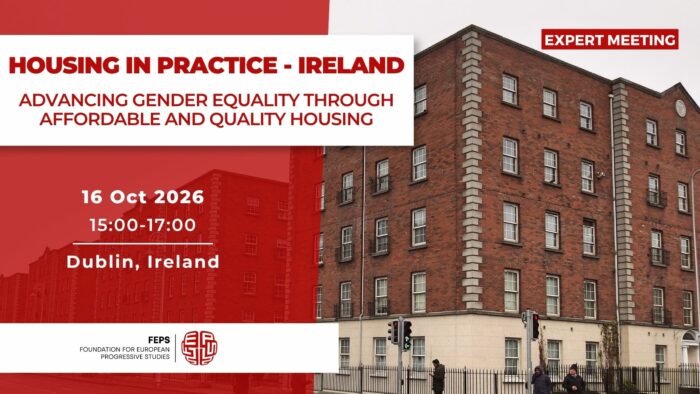
Housing in Practice – Ireland

Dublin, Ireland (Expert meeting)
Load more...
Find all related publications
Publications
13/07/2026

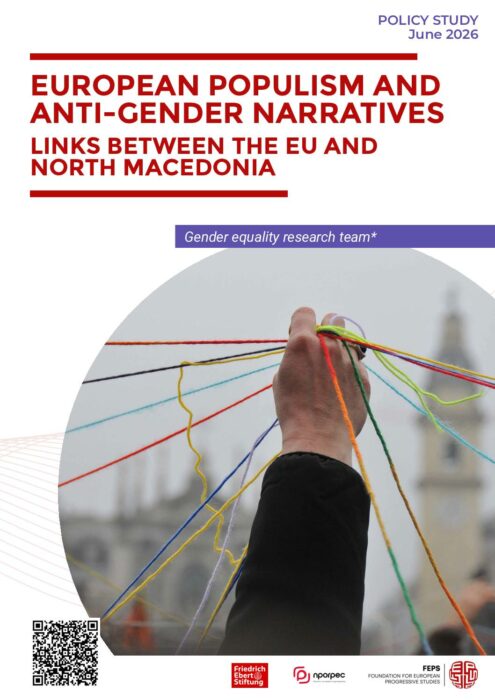
European populism and anti-gender narratives

Links between the EU and North Macedonia
17/04/2026

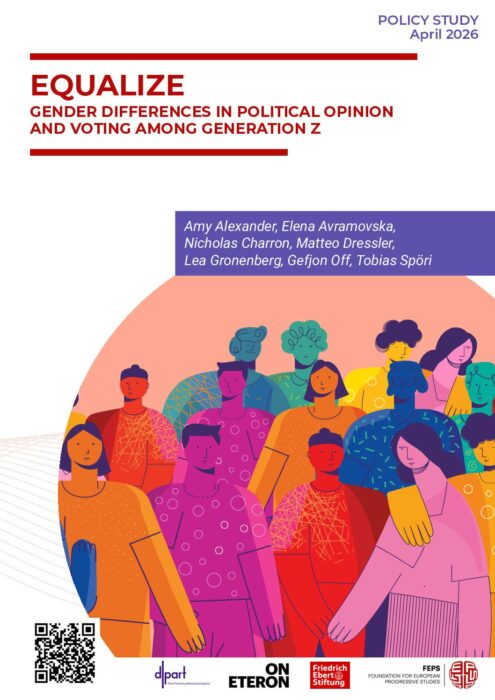
EqualiZe

Gender differences in political opinion and voting among Generation Z
17/03/2026

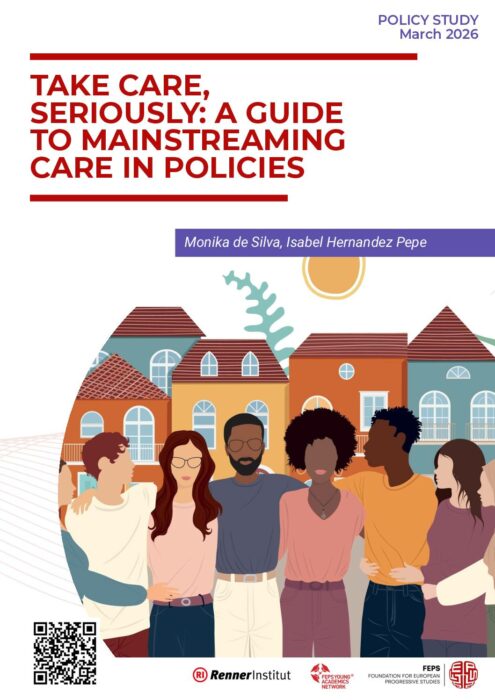
Take care, seriously. A guide to mainstreaming care in policies

FEPS YAN papers 9th Cycle
29/01/2026

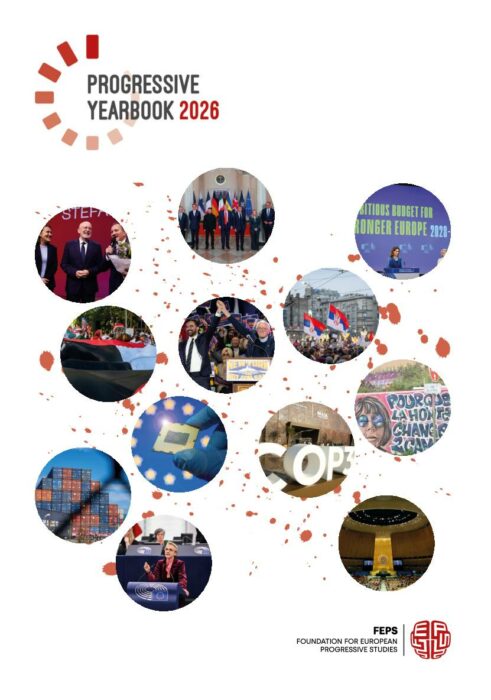
Progressive Yearbook 2026

In an eerie manner, 2025 resembled the ‘time of monsters’, which, according to the great […]
Find all related Audiovisual
Audiovisual
23/04/2026

‘An enlargement for a new generation ’ better natures; is it feasible?’ Flickr album

Photo album of the ‘An enlargement for a new generation‘ event in Brussels, Belgium. The […]
09/03/2026

“Muscular MASCULINITY is reinforcing itself in the realm of SECURITY” Toni Haastrup & Lina Gálvez

🎧 In the spirit of #IWD2026, listen to the latest episode of FEPS Talks focusing […]
09/03/2026

“Muscular MASCULINITY is reinforcing itself in the realm of SECURITY” Toni Haastrup & Lina Gálvez

🎧 In the spirit of #IWD2026, listen to the latest episode of FEPS Talks focusing […]
04/02/2026

‘Developing a clean industry gender agenda in times of deregulation and policy backlash’ Flickr album

Photo album of the ‘Developing a clean industry gender agenda in times of deregulation and […]
Find all related news
News
23/10/2026

Notice of vacancy – Policy Analyst on Gender Equality

Apply before 23 November 2026
16/09/2026

FEPS Reacts: State of the European Union 2026

The 2026 State of the Union felt more like ‘von der Leyen I’ than ‘von […]
05/03/2026

The new EU Gender Equality Strategy 2026-2030

Commentary by the Feminist Foreign Policy Progressive Voices Collective (FFPPVC)
10/03/2025

FEPS reaction to the Roadmap on Women’s Rights

On Friday 7 March, the European Commission presented its Roadmap for Women’s Rights ahead of […]
Find all related in the media
In the media

Frågan om jämställdhet splittrar unga svenskar

by dagens arena 29/10/2026
"The issue of gender equality divides young Swedes" - FEPS Policy Analyst on Democracy Matteo Dressler discusses the findings of the EqualiZe policy study in the Swedish context.

Nedostatak brižnosti

by Vox Feminae 31/01/2025
"Lack of care" The Croatian feminist magazine Vox Feminae highlights the chapter by Annica Kronsell in FEPS book "A new Gender Equality Contract for Europe", which is dedicated to imagining a new gender contract for the climate

Brussels, my love? Ursula von der Leyen cracks the whip on gender parity

by Euronews 07/09/2024
FEPS Director for Research and Training Ania Skrzypek participated in this episode of Euronews’ show ‘Brussels my love’.