
Policy Study
17/04/2026
A new political gender divide is often said to be defining Gen Z in Europe: young women moving left; young men moving right. But is this really the case?
Drawing on European Social Survey Data across the EU and beyond, as well as focus groups with young people in Germany, Greece, Poland, Spain and Sweden, this policy study offers a more nuanced answer. It shows that gender differences among young Europeans are real but uneven across countries and issues. The clearest gaps appear in ideological self-placement and attitudes towards gender equality, while differences in voting behaviour are less pronounced than public debate often suggests.
Rather than a simple cultural clash between young women and men, the study reveals a generation shaped by shared insecurity: rising living costs; housing pressures; unstable labour markets; climate anxiety; and weakening trust in political institutions. It argues that the emerging divide is best understood not as a deep ideological rupture, but as a reflection of precarity, uncertainty and contested interpretations of gender equality, as well as the different importance young women and men attach to it, despite the principle itself remaining broadly shared.
By linking gender equality to economic security, social protection, mental wellbeing, inclusive social norms and effective governance, this policy study sets out forward-looking recommendations for rebuilding trust, opportunity and democratic resilience across generations.
Case study – Spain – Beware of neoliberal feminism: Why Spanish young people are less sexist but more antifeminist by Javier Carbonell
This Policy Study is also available in Spanish.
Despite Spain’s position as a European leader in gender-equality policy, anti-feminist sentiment is growing among its youngest generation. The Spanish case study reveals a clear rightward shift among Spanish Gen Z, particularly among young men, who have moved significantly to the ideological right. Since 2022, a similar trend has emerged among young women. Yet most young people are still not right-wing, and they express less sexism than older generations — making their simultaneous rejection of feminism paradoxical.
The study argues this paradox is largely explained by the rise of neoliberal, individualist feminism, which emphasises personal success over collective action and overlooks structural inequalities. Combined with deep economic insecurity and widespread distrust of political institutions, this leads many young people to view feminism as part of a distant, ineffective establishment rather than a transformative force.
Case study – Sweden – Shared instability, divergent interpretations: Explaining Sweden’s Gen Z gender divide by Megan Rådesjö
Despite being one of the world’s most gender-equal countries, Sweden exhibits one of Europe’s sharpest gender divides among Generation Z. Yet, this divide does not stem from fundamentally different social realities. The Swedish case study reveals that young women and men live through the same conditions of instability — but interpret them differently, leading them to support different political solutions.
The study argues that closing this divide requires policies that restore material security and rebuild trust in democratic institutions and the welfare state. Strengthening social cohesion further depends on visible political action, the promotion of inclusive gender norms, and measures that connect structural conditions to young people’s lived experiences of instability.
Case study – Greece – Precarity and gender equality among Greek youth by Georgios Samaras
This case study is available in Greek.
What happens to gender equality when a generation feels it is fighting over shrinking opportunities? This policy brief examines how young adults in Greece understand gender equality. The study shows that young Greeks support equal rights but often discuss gender equality as a competition, a pattern called “zero-sum equality talk”. This framing is most visible in discussions of jobs. Around consent and bodily autonomy, participants use firmer language of rights, leaving less room for competitive comparisons.
The findings suggest that support for gender equality is driven by the material conditions of everyday life. Policies to support young people and support gender equality will be more effective when linked to efforts to fight inequality and promote affordability.
Listen to EqualiZe co-authors Lea Gronenberg and Gefjon Off discuss the findings of the policy study for Deutschlandfunk’s segment on the “Warum die Gen Z politisch auseinanderdriftet” in German.
Equalize was mentioned in an article in Der Standard. Read it now!
For more information regarding the project and this publication, please do not hesitate to contact Matteo Dressler, Policy Analyst on Democracy and Participation, FEPS (matteo.dressler@feps-europe.eu) and Julia Wild, Project Officer, FEPS (julia.wild@feps-europe.eu).
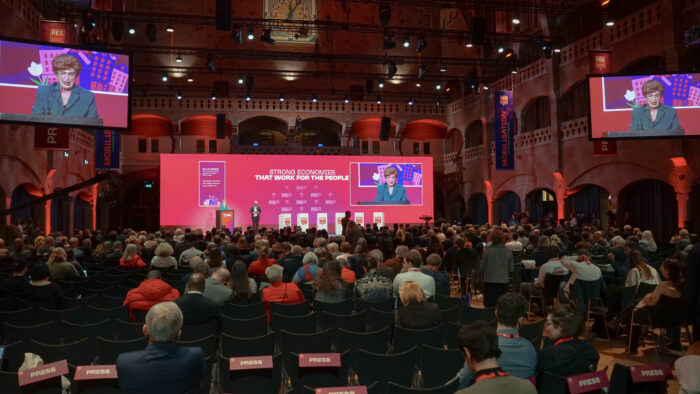
Watch the launch of ‘Equalize’ at the Global Progressive Mobilisation in Barcelona at the panel Gender, politics, and the understanding of equality among Generation Z with Friedrich-Ebert-Stiftung Madrid and Friedrich-Ebert-Stiftung Vienna.
With:
- Gefjon Off, Postdoctoral Researcher, University of Hamburg (co-author of FEPS Policy study)
- Elena Avramovska, Senior Researcher for Democracy, Society and Youth, Friedrich Ebert Foundation (editor of FEPS Policy Study)
- Irja Vaateri, Secretary General of Young European Socialists (YES)
- Lina Gálvez Muñoz, S&D Member of the European Parliament; Chair, Committee on Women’s Rights and Gender Equality (FEMM); Chair of the FEPS Scientific Council
- Philipp Türmer, Federal Chair of the Young Socialists (Jusos) in the SPD
Moderated by Matteo Dressler, FEPS Policy Analyst on Democracy and Participation
Network


Find all related publications
Publications
Find all related Progressive Post
Progressive Post
Find all related events
Events
Dublin, Ireland
Dublin (expert meeting)
Dublin, Ireland (Expert meeting)
Brussels, Belgium
Load more...
Find all related Audiovisual
Audiovisual
27/06/2026

23/04/2026

17/04/2026
09/03/2026
Find all related news
News
Find all related in the media
In the media
“A civic revolution, not yet a social revolution”
Interview with László Andor, FEPS Secretary General, published by Fondation Jean-Jaurès (FR), analysing the electoral defeat of Viktor Orbán, the emergence of a broad opposition movement in Hungary, and the prospects for democratic renewal, EU relations and social change following what he describes as a “civic revolution” that has yet to deliver a social transformation.
“Money is coming! Will Péter Magyar deliver on his promise?”
Video Interview published on KlikkTV (HU), featuring László Andor, FEPS Secretary General, discussing EU funds to Hungary, their political conditionality, and the importance of fair distribution, rule of law and social investment within the European Union.
“Back to the Future: The Great Reset”
Opinion article by FEPS Vice-President, Lina Gálvez reflecting on the current global crisis marked by rising authoritarianism, digital power and extreme inequality, and tracing its roots through a historical analysis of capitalism — from the post-1945 social and geopolitical settlement led by social democratic forces, through neoliberal financialisation, to what she describes as a new phase of fascist capitalism.