


Head of the Euro-Mediterranean Policies department at the European Institute of the Mediterranean
28/05/2026
A year and a half ago, with the nomination of the first-ever European Commissioner fully dedicated to the Mediterranean, hope and expectations rose across the region amidst growing mistrust and strained relations due to the tragic war in Gaza. There was the promise of a pact to reinvigorate relations – but is it able to repair what had been broken?
The answer is not straightforward. At a time when frustration with Europe as a partner is widespread across the Southern neighbourhood, the fact that civil society organisations, experts, local authorities, business representatives and regional stakeholders still chose to contribute to the development of the Pact for the Mediterranean, the more recent update of the EU’s strategy in the region– despite the short timeline to feed into the process, the repetition of consultations at each review of the EU policy cycle and a real sense of fatigue – is an important political signal. This mobilisation should not be underestimated: it shows that, even though trust has been damaged, the relationship has not been abandoned.
This is reflected in IEMed’s EuroMed Survey 2025 results: in a context marked by increasing geopolitical competition, shifting alliances and growing engagement by other international actors, a large majority of the more than 700 respondents from all across the Mediterranean still identified the EU as the primary actor in the region. In addition, compared with others, the EU’s comparative advantage was seen as lying in its values-based perspective and in its long-term, reliable and comprehensive approach.
The creation of the new directorate-general dedicated to the region was therefore an important step. It responded to the expectation that the Mediterranean should no longer be treated as a fragmented policy space, divided between crisis management, migration control, trade and security. The pact also delivered on several long-standing recommendations: it speaks the language of co-creation, recognises civil society and local actors, acknowledges people-to-people ties and seeks to move beyond a narrow migration/security lens.
This is not nothing. But it is still not enough.
A pact on paper, for now
Even though its first Action Plan has been published, the pact remains stronger on paper than in practice. Its success will depend less on the ambition of its language than on the mechanisms, resources and political courage needed to make it real.
First, participation must be institutionalised. Civil society and local actors cannot be brought in only through one-off consultations: they need structured roles, advisory channels and monitoring mechanisms linked to the pact’s governance, as well as core funding rather than project-by-project access. Without this, co-ownership will remain rhetorical, and stakeholders will feel consulted merely to validate a process rather than empowered to shape it. A more representative model is essential if non-state actors are to contribute to strategy, implementation and oversight, echoing calls made at last year’s Euro-Mediterranean Civil Society Conference and in the work of the European Economic and Social Committee on the pact.
Second, the pact needs funding to match its ambitions. The next multiannual financial framework must provide adequate resources for the Euro-Mediterranean partnership, because the pact will be judged less by its promises than by the funding behind them. Yet funds must also be accessible and accountable. Consultations showed that rigid conditionality and bureaucracy deter local civil society organisations, municipalities, youth initiatives and SMEs. Access must be simplified, incentives shared and monitoring made transparent.
The pact must also address the everyday barriers that prevent cooperation from becoming real. Mobility is one of them. The EuroMed Survey showed that it remains the number one priority for Southern partners, while visa obstacles remain a main barrier to cooperation. The people-to-people pillar needs usable instruments, including decoupling mobility from migration conditionality and creating fast-track Euro-Mediterranean visa pathways for students, researchers, entrepreneurs, artists, civil society actors and professionals. Without these instruments, regional cooperation and integration risk remaining mere language.
Finally, co-ownership must evolve into shared governance. Southern partners should not simply implement priorities set elsewhere; they should help define, monitor and adapt them. A stronger role for the Union for the Mediterranean and its multi-stakeholder platforms, alongside multi-bilateral clusters and greater use of the Team Europe Initiative approach, could help turn co-creation into practice.
The security question
Yet even if these implementation gaps are addressed, the pact will still face its most difficult test: trust and credibility. How can there be a pact for peace, stability and shared prosperity when partners in the region are openly in conflict? How can the EU speak of trust while war continues, and impunity is perceived to prevail?
The pact tries to separate long-term development from immediate political fires, leaving the most urgent questions to a future Middle East strategy that is still awaited. This may be institutionally convenient, but it is politically unsustainable. Europe cannot look away and expect the partnership to deliver. The growing incoherence of EU foreign policy continues to damage its standing as a values-based partner, precisely the comparative advantage that many regional stakeholders still recognise.
If the EU loses credibility on values, it loses more than just moral authority: it loses strategic influence. A change of paradigm is therefore needed in its approach to regional security. This must not be reduced to border control, counterterrorism or crisis containment, but reframed as a shared responsibility rooted in mutual interdependence, with Southern neighbourhood countries treated as equal security partners and regional initiatives taken seriously. Rebuilding trust will require consistency: aligning EU policy with its declared values, supporting inclusive regional diplomacy, putting rights and dignity at the centre of peacebuilding and establishing a coherent EU-wide security framework that connects military, civilian and governance efforts.
The EU should also use its instruments strategically, applying conditionality in cases of systemic human rights abuses while maintaining flexible pathways for re-engagement. Above all, it should build relational trust through long-term, visible and people-focused cooperation, because tangible results remain the best antidote to scepticism and geopolitical competition.
The pact has opened a door, but the next phase will be decisive. To deliver, it must move from consultation to co-governance, from ambition to funding, from promises to real solutions and from values-based language to values-based action. The Euro-Mediterranean relationship is not beyond repair, but it cannot be repaired by avoiding the issues that broke it.
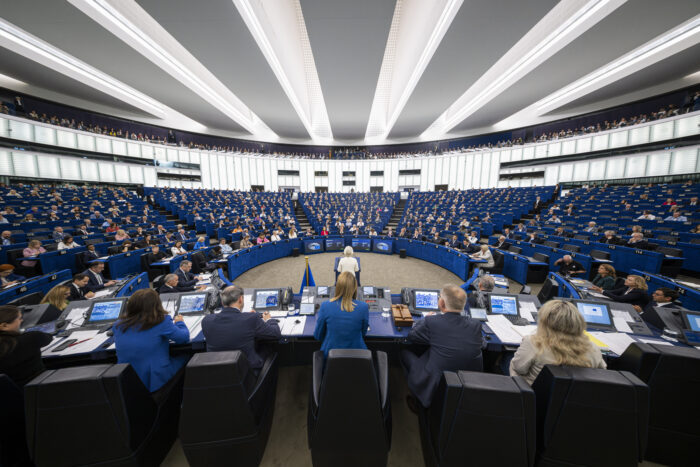
Photo credits: EC – Audiovisual Service/European Union, 2025
The contents of this article are the sole responsibility of the author and can in no way be taken to reflect the views of the European Institute of the Mediterranean or the European Union.
Find all related Progressive Post
Progressive Post
Find all related events
Events
No upcoming events at the moment.
Amsterdam, Netherlands
Brussels, Belgium (Expert meeting)
European Parliament
FEPS HQ
Load more...
Find all related publications
Publications
Find all related Audiovisual
Audiovisual

01/07/2026

30/06/2026

30/06/2026

30/05/2026
Find all related news
News

Find all related in the media
In the media
‘Bruselas, ¿te Quiero?’ Tras un verano cruel, Von der Leyen pide a Europa que “luche”
by Euronews 16/09/2025
“It’s a mistake to think we can go back to the old normal after Trump”. Interview with FEPS Secretary General László Andor in Telex (HU), where he discusses the global trade tensions triggered by Trump-era tariffs, the shifting US-China dynamic, and the need for the EU to develop a new strategic approach in a permanently changed world order.