

Javier Carbonell, is director of Future Policy Lab, a policy analyst at the European Policy Centre, a teaching associate at Sciences Po, Paris and has recently completed his PhD at the University of Edinburgh. His latest publication is “Beware of neoliberal feminism: Why Spanish young people are less sexist but more antifeminist”. His work focuses on inequality, youth politics and the far-right
25/09/2026
Progressives risk misreading Generation Z by treating social media, the manosphere and changing gender norms as the main explanation for young people’s political divergence. These forces matter. But the evidence points to something deeper: economic insecurity, institutional distrust and individualisation are shaping an entire generation, even if men and women often express that malaise differently.
When progressives discuss young people, one story increasingly dominates. Young men are drifting to the right because TikTok, YouTube and the manosphere expose them to antifeminist ideas; young women, meanwhile, are becoming more progressive as gender equality becomes more salient to them. There is truth in parts of this story. Recent elections have shown significant gender differences among young voters, particularly in support for the far right. Young men and women also differ in some gender attitudes, while online ecosystems can amplify highly divergent content. But treating gender conflict as the master explanation risks confusing one of the languages through which discontent is expressed with its deeper sources.
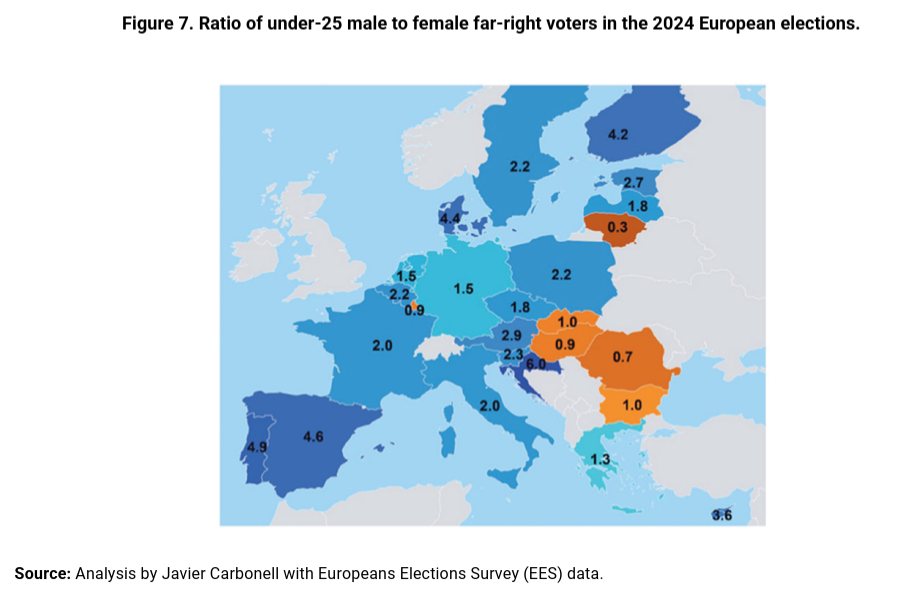
The first problem is empirical: there is no single European Gen Z gender divide. The EqualiZe project, combining European Social Survey data with 17 focus groups involving more than 100 young people in Germany, Greece, Poland, Spain and Sweden, finds substantial cross-national variation. Sweden displays a comparatively pronounced divide; Germany much less; Greece, Poland and Spain show mixed patterns. Voting differences are also less consistent than ideological or attitudinal gaps. In the last EU elections, there was a huge gender gap in far-right voting among the young. In some countries, such as Portugal and Sweden, more than four young men voted for the far right for every young woman who did, while in some South-Eastern European countries, there is almost no difference at all, or the tendency is even reversed (see map). If broadly similar digital platforms and culture-war debates coexist with such different national trajectories, they cannot provide a sufficient explanation on their own.
Moreover, young women are not always moving in the opposite direction. In Spain, while young men have moved markedly to the right since around 2018, young women have also shifted to the right since around 2022. The gender gap remains, but increasingly it reflects different speeds of movement rather than opposite directions. This is also reflected in attitudes: young women remain more supportive of gender equality than young men, but feminist identification has weakened among young people more broadly. That is difficult to reduce to a simple battle between progressive women and reactionary men.
Recent elections reinforce the point. In the recent elections in the German state of Saxony-Anhalt, the AfD was substantially stronger among young men, but it was also the most popular party among young women: election analysis put its support at 49 per cent among men and 38 per cent among women. The gender gap clearly matters, but in each election, the far-right gains more votes from young women. While a significant minority of young women are clearly moving left, most young women are not necessarily moving away from the far right; they are simply moving towards it at a slower pace.
Nor is youth politics uniformly moving right. In Germany’s 2025 federal election, Die Linke won 27.3 per cent of the vote among voters under 25, its strongest age group. In Britain, YouGov found the Greens leading among 18-24-year-olds in early 2026. And in New York City’s 2025 mayoral election, exit polls indicated that 75 per cent of voters aged 18-29 backed Zohran Mamdani. These cases are not directly comparable, but together they demonstrate something important: youth dissatisfaction has no predetermined ideological destination.
A better starting point is what young people share. Younger generations face growing difficulties in building the material foundations of adult life: affordable housing, stable employment, sufficient income and the ability to accumulate wealth. Being young increasingly means postponing economic independence and major life decisions. The meritocratic promise that hard work will reliably produce security and upward mobility has become less credible.
This dissatisfaction with the economic system can, in turn, feed dissatisfaction with the political system when institutions appear unable to address young people’s problems. In some cases, this affects overall support for democracy, not because young people do not hold meritocratic principles, but because their criticism of the current system is so deep that some youngers believe they do not live in a real democracy. This can also affect attitudes towards feminism when it is perceived as part of the political establishment.
But this is only one side of the coin. Across the EqualiZe focus groups, participants repeatedly returned to living costs, housing, insecure work, blocked independence and frustration with political institutions. They were often pessimistic about the direction of their societies while remaining relatively confident in their own ability to adapt. This is where individualisation becomes crucial. Many young people recognise large structural problems but increasingly understand solutions through personal agency: work harder, adapt, move, retrain, cope. The research finds something similar even in discussions of feminism. Young women frequently stressed their ability to overcome discrimination through their own efforts, while young men could support equality in principle yet reject policies they believed redistributed scarce opportunities unfairly.
Individualisation also has political consequences. Collective institutions become harder to imagine as vehicles for change precisely when the problems facing young people become harder to solve individually. Put simply, many young people support gender equality while distrusting political feminism.
Seen this way, gender conflicts are often a translation mechanism for a deeper malaise. Young women may experience insecurity through discrimination, safety, unequal care responsibilities or reproductive autonomy. Young men may experience it through status, recognition, fairness and the erosion of predictable routes from education and work to independence. These experiences are not identical. But beneath them lie many of the same material pressures.
This distinction matters. If insecurity is interpreted mainly as a gender culture war, attention naturally shifts towards better messaging, regulating online environments or changing attitudes towards masculinity and feminism. Those elements matter. But they leave untouched the material conditions that can make far-right and antifeminist narratives attractive in the first place.
Progressives should therefore refocus on the economic insecurity young people experience. Otherwise, we risk focusing on symptoms while overlooking the underlying condition. Gender shapes how this crisis is experienced, but it should not obscure the crisis itself. Social media matters. Masculinity matters. Feminism matters. But the deeper story of Gen Z politics may be much more prosaic: whether young people can afford a home, build an independent life and believe that collective institutions can improve their future.
Photo credits: Shutterstock/davide bonaldo
Find all related Progressive Post
Progressive Post