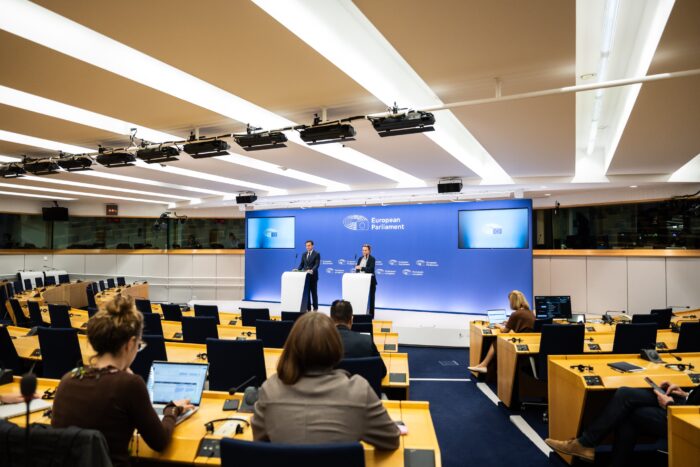

Conference: Enlargement in perspective: How the candidate and potential candidate countries perceive accession in the light of the current crisis?

Enlargement in perspective: How the candidate and potential candidate countries perceive accession in the light […]
Speakers

06/03/2013
00:00 - 00:00
European Parliament, Brussels
Conference: Enlargement in perspective: How the candidate and potential candidate countries perceive accession in the light of the current crisis?
55948
81-conference-enlargement-in-perspective-how-the-candidate-and-potential-candidate-countries-perceive-accession-in-the-light-of-the-current-crisis
0

In order to give you access to our events, FEPS processes your personal data together with any other organiser of this event mentioned in the description of the event and in accordance with 'FEPS’ data protection policy.

Enlargement in perspective: How the candidate and potential candidate countries perceive accession in the light of the current crisis?


Organised by Maria Eleni Koppa (MEP, Greece, S&D Group in the EP) with help from FEPS and SOLIDAR, in cooperation with Friedrich-Ebert-Stiftung.

This international conference is a follow up of the European Parliament report “Enlargement: policies, criteria and the EU’s strategic interests” drafted by Ms Koppa and adopted almost unanimously last November and will be joined by Commissioner Štefan Füle (responsible for enlargement and European neighbourhood policy)  and Hannes Swoboda (MEP, Austria, President S&D Group in the EP).


During this conference academia, trade unions and civil society from aspirant countries in the Western Balkans and Turkey will give their views on the future European enlargement process, on the basis of the following main questions:

–       How is the EU accession process currently perceived amongst citizens in the countries of the Western Balkans and Turkey? And what lessons can be learned from that for the future integration process?

–       What was the impact of the economic crisis on the enlargement countries and how has it influenced their aspiration to join the EU?

–       What are key priority aspects within the countries of the Western Balkans, related to the EU social acquis, which would demand immediate attention within the accession negotiations?

–       Could civil society and trade unions develop common initiatives to promote social cohesion, active inclusion, decent work and quality employment and what specific issues could be highlighted?

Speakers at this conference will include representatives from Albania, Bosnia and Herzegovina, Croatia, Serbia, Kosovo, Former Yugoslav Republic of Macedonia, Montenegro and Turkey, joined by Members of the European Parliament, European Commission, and experts of Oxford University, Netherlands Institute of International Relations, Friedrich-Ebert-Stiftung, and International Trade Union Confederation.


Register by 27 February here


(Programme attached in pdf)

Network
Friedrich-Ebert-Stiftung
Solidar
Find all related publications
Publications
17/04/2026

The open future and its enemies

How we can protect free society from AI dictatorship
17/04/2026

EqualiZe

A new political gender divide is often said to be defining Gen Z in Europe: […]
27/03/2026

Laboratories of counter-hegemony

Orbán, Trump and the transatlantic far-right ecosystem
25/03/2026

The European Green Deal tracker

How well is your member state implementing key policies of the Green Deal? The European […]
Find all related Audiovisual
Audiovisual
25/03/2026

‘The European Green Deal tracker’ Flickr album

Photo album of ‘The European Green Deal Tracker” event at FEPS HQ. In this event, […]
09/03/2026

“Muscular MASCULINITY is reinforcing itself in the realm of SECURITY” Toni Haastrup & Lina Gálvez

🎧 In the spirit of #IWD2026, listen to the latest episode of FEPS Talks focusing […]
09/03/2026

“Muscular MASCULINITY is reinforcing itself in the realm of SECURITY” Toni Haastrup & Lina Gálvez

🎧 In the spirit of #IWD2026, listen to the latest episode of FEPS Talks focusing […]
26/02/2026

“Those who have A LOT, must PAY MORE” Nicolas Schmit | FEPS Talks Podcast

🎧 Listen to the latest episode of FEPS Talks with FEPS President Nicolas Schmit! 🇪🇺 […]
Find all related news
News
13/04/2026

Hungary’s civic revolution

FEPS' commentary on the outcomes of the Hungarian election
05/03/2026

FFPPVC commentary on the new EU Gender Equality Strategy 2026-2030

Commentary by the Feminist Foreign Policy Progressive Voices Collective (FFPPVC)
03/03/2026

Wag the dog?

FEPS commentary on the US-Israel attack on Iran
03/03/2026

Closing ceremony of the Progressive Ukraine programme

The graduation ceremony completed the programme which was part of the Open Progressive University (OPU).
Find all related in the media
In the media

Orban loses despite Trump backing: Hungary enters a new era with a landslide win for Peter Magyar

by The Print India 16/04/2026
Watch FEPS SecGen László Andor's interview on the election in Hungary and the defeat of Viktor Orbán, despite visible support from JD Vance. What drove this shift? Why did international backing from US and Russia fail to move the needle? And what does this result signal for Hungary’s future and the broader European political landscape?

What next for Olivér Várhelyi, Orbán’s last man standing in Brussels?

by EURACTIV 14/04/2026
FEPS Secretary General László Andor discusses the potential impact of the HUngarian election result on EU Commissioner, Olivér Várhely

EU relieved to see back of Orbán but Magyar’s Hungary may still present problems

by The Guardian 14/04/2026
FEPS Secretary General László Andor comments on Hungary's future following the outcome of the 2026 general election

Bilancio UE: fondi sociali in bilico, l’Europarlamento chiede più risorse e meno flessibilità

by Il Sole 24 Ore 13/04/2026
"EU budget: social funds at risk, the European Parliament calls for more resources and less flexibility" In this article by Il Sole 24 ore, FEPS Secretary General László Andor highlights the risks that the current MFF proposal - set to be voted on by the European Parliament - could pose to the EU budget and outlines the consequences of reducing social funding.