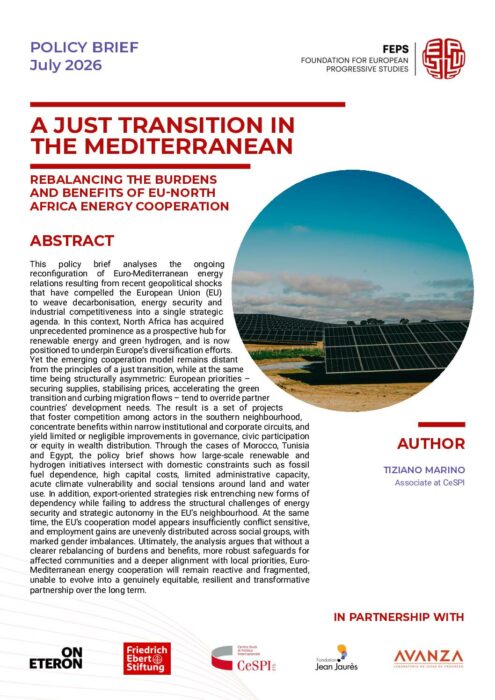
The Euro-Mediterranean dialogue: prospects for an area of prosperity and security

The official starting point of the EU-Mediterranean relations – after the less known Global Mediterranean […]

Book

09/10/2014

The official starting point of the EU-Mediterranean relations – after the less known Global Mediterranean Policy (GMP) launched in the 1970s – was the ambitious initiative of the Euro-Mediterranean Partnership (EMP, or Barcelona Process), established by the Euro-Mediterranean Conference of Ministers of Foreign Affairs, held on 27 and 28 November 1995 in Barcelona. The aim of the Partnership was to strengthen relations with the Southern Mediterranean Partners through three main objectives and to lay down a broad framework of political, economic, financial, social and cultural relations with these countries. This process has been going on for 13 years now, but its efficiency and success are doubted for several reasons.

The breakdown of the Middle East Peace Process has a huge effect on the progress of the EMP, mainly on the political and security chapter. Due to this factor, the political and cultural dimension, which is considered to be more successful, is also hindered and, according to analysts, the results certainly leave room for improvement. The predominance of the European Union in this process is also a target of criticism, because it gives the impression of inequality among the members of the Barcelona Process. The proposal put forward by Nicolas Sarkozy during his electoral campaign to establish a “Mediterranean Union” cannot only be seen as an alternative to Turkish membership in the EU, but also as a sign of dissatisfaction with the existing EMP. According to the original plan, which created serious tension between France and Germany, the Mediterranean Union would have ten member states, five from the northern shore and five from the southern shore; it would have been entirely independent and would not have been a part of the Barcelona Process. In her speech, Angela Merkel warned Sarkozy that if the Mediterranean countries wanted to establish a union completely apart from the other European countries, such a union would be a crucial test for Europe, with the result that Germany would turn more towards Eastern European countries, while France would turn more towards southern countries. In the end, the proposal was integrated in the Barcelona Process under the name “Union for the Mediterranean” (UfM) and it certainly gave a boost to relations between the northern and southern coasts of the Mediterranean Sea. On the occasion of the Conference of Foreign Ministers in Marseille, held on 3 and 4 November 2008, the project was given a concrete form by the designation of Barcelona as the headquarters of the UfM and by the determination of a new institutional architecture. But the question is: will this new structure ensure a closer and more efficient process? This project was so dear to the French presidency of the EU, but what will happen next?

Convinced that there is a need for a Mediterranean policy based on solidarity, dialogue, cooperation and exchange, the Foundation for European Progressive Studies (FEPS) – which aims at being a leading and unifying force on the intellectual social-democratic European scene – and Fondazione Italianieuropei – an Italian think tank designed to promote a Europe-minded political culture – decided to publish a report on EU-Mediterranean relations. The objective would be to analyze the state of play of the EU initiatives towards that region. In order to give a balanced image of the EMP and to enable the reader to have an overview of different opinions, the report consists of articles written by a number of authors from both the northern and southern shore of the Mediterranean region. The report is divided into three main parts, each of them focusing on different topics. The first part offers a historical overview of the past European projects in the Mediterranean. The second part gives an analysis of the economic relations between the two shores of the Mediterranean Sea. The third part is a collection of articles giving an assessment of the political dialogue between the EU and its Mediterranean partners. The report concludes with a critical work on the future prospects of the Barcelona Process and the UfM.

This publication, edited and introduced by two independent think tanks, will be helpful in our task of supporting a consolidation of the Euro-Mediterranean area, which has to be based on democratic principles, respect for the rule of law and human rights, the strengthening of regional cooperation and of social and environmental integration.

Network
Fondazione Italianieuropei
Find all related publications
Publications
28/11/2025

Smarter spending today, safer societies tomorrow

Digitally-enabled capabilities for European defence
28/11/2025

More money, more dependence?

Financing European Union defence for autonomy and cooperation
28/11/2025

ReArm Europe

The impact and role of EU arms export controls
14/11/2025

Beyond Rhetoric: Crafting a Win-Win EU-Africa Partnership

Strategic Recommendations from the EU-Africa Progressive Network
Find all related Progressive Post
Progressive Post
21/11/2025

Palestine: in pursuit of a just and inclusive peace

The twenty-point plan, initially proposed by the Trump administration in September and subsequently endorsed at […]
12/11/2025

How Progressives win when democracy is on the line

Across democracies, the threat to liberal institutions no longer comes from the margins. It sits […]
31/10/2025

The Global Gateway in context

Europe's dual ambitions to align geostrategy and development
Find all related events
Events
Past
15/11/2025
Amsterdam, Netherlands

Africa Day 2025

FEPS fringe sessions
08/11/2025
Santa Marta, Colombia

EU-LAC dialogue on Just Transition and trade

Despite the EU’s growing emphasis on sustainability, its trade and investment policies remain largely disconnected […]
04 - 06/11/2025
Doha, Qatar

Rethinking pre-distribution and fiscal policies to advance social justice

Solutions session during the Second World Summit for Social Development (WSSD)
Load more...
Find all related Audiovisual
Audiovisual
15/11/2025

‘Africa Day 2025’ Flickr album

Photo album of the ‘Africa Day 2025‘ event in Amsterdam, Netherlands. Africa Day has been […]
17/10/2025

‘S&D Latin America Days FEPS fringe session’ Flickr album

The S&D Latin America Days aim to foster cooperation between progressive forces in Latin America and […]
16/09/2025

The Long Roads to PEACE: Europe, Ukraine, and Global Diplomacy — with Stephen Bronner

📺🔊 Available on YouTube, Spotify & Apple Podcast Prof. Stephen Bronner has been leading an […]
16/09/2025

The long roads to PEACE: Europe, Ukraine, and global diplomacy – with Stephen Bronner

Prof. Stephen Bronner has been leading an international network of scholars and experts to study […]
Find all related news
News
27/11/2025

FEPS President Maria João Rodrigues at the T20 South Africa Summit in Johannesburg

Organised by the South African Institute of International Affairs (SAIIA), the Institute for Global Dialogue […]
21/10/2025

Maria João Rodrigues at PES Congress 2025

🇳🇱 🌹 FEPS attended the Party of European Socialists (PES) Congress in Amsterdam, which included […]
18/10/2025

FEPS at PES Congress 2025

🇳🇱 🌹Within PES Congress, there were full rooms on insightful discussion on a range of […]
13/03/2025

Europe’s defence strategy must be peace-oriented

FEPS Position Paper on European defence
Find all related in the media
In the media

‘Bruselas, ¿te Quiero?’ Tras un verano cruel, Von der Leyen pide a Europa que “luche”

by Euronews 16/09/2025
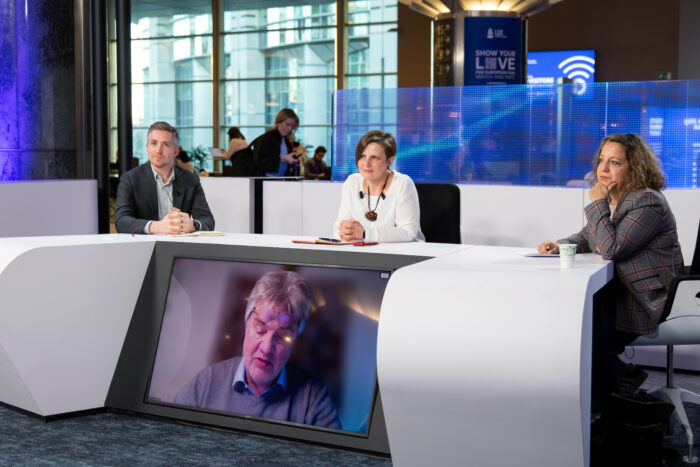
After a harsh summer, Von der Leyen calls on Europe to ‘fight’” Episode of Euronews’ Brussels, my Love? featuring Beatriz Abellán, FEPS Policy Analyst on International Relations, discussing Von der Leyen’s State of the Union speech, the EU’s trade deal with the United States, and the future of multilateralism. She also stresses that the EU’s credibility is at stake due to its delayed response to the genocide in Palestine.

Tévedés azt hinni, hogy Trump után visszatérhetünk a régi kerékvágásba

by telex 24/04/2025
“It’s a mistake to think we can go back to the old normal after Trump”. Interview with FEPS Secretary General László Andor in Telex (HU), where he discusses the global trade tensions triggered by Trump-era tariffs, the shifting US-China dynamic, and the need for the EU to develop a new strategic approach in a permanently changed world order.

СТРАТЕГИЯТА ЗА ОТБРАНА НА ЕВРОПА ТРЯБВА ДА БЪДЕ ОРИЕНТИРАНА КЪМ МИРА

by Novi Vremena 27/03/2025
In the article "Europe’s defence strategy must be peace-oriented", the Bulgarian media Novi Vremena highlights FEPS position on European defence strategy presented by László Andor, David Rinaldi and Beatriz Abellán.

FEPS President on Euronews talk-show ‘Brussels, my love?’

by Euronews 16/03/2024
FEPS President Maria João Rodrigues discusses NATO expansions and elections in Russia and Portugal on Euronews talk-show ‘Brussels, my love?‘