Roundtable Discussion: “Global New Deal” – Reform of the International System

FEPS organised a high-level round table meeting and brainstorming session with international experts on 13th […]

13/03/2009

FEPS organised a high-level round table meeting and brainstorming session with international experts on 13th March 2009 in order to add more input to the Global Vision Paper, a document aiming at finding systematic and global solutions to the current global crisis.

In his introduction speech, Ernst Stetter, Secretary General of FEPS, emphasised the importance of the creation of a truly global and fair New Deal, which is only possible if experts from all around the world contribute to the drafting of the vision paper. Josep Borrel, Director of the Global Progressive Forum, stated that the GPF project aims to show that a socialist alternative exists and he thanked FEPS for taking the lead on this.

Poul Nyrup Rasmussen, President of PES, presented the Global Progressive Forum’s mission and background. The GPF was created in 2004, predicated on the idea that a stronger structure was needed for cooperation between progressives. It involves cooperation between NGOs, politicians and academics with the objective of producing something relevant to governments and international institutions. The ambition of GPF is to take a first step towards a fairer globalisation, towards a Global New Deal. The event in April comes at a very relevant moment, so close to the G20 in London and other significant international events in Europe. According to him, the vision paper is of double importance, as it is relevant to the current context and comes as part of a broader reform approach. Maria João Rodrigues continued by presenting the draft global vision paper. First and foremost, she expressed her thanks for contributions from the Geneva Group, from other leading academics and politicians and from the experts of Columbia University. Then she raised a number of crucial points concerning amongst others the nature of the current crisis, the components of the global new deal and the reform of the multilateral system. This served as a starting point for the brainstorming session.

Karl Auguste Offmann, former President of the Republic of Mauritius, stressed that complete change is needed instead of only correcting and “engaging in patchwork”. According to some of the participants, the paper has still a too strong Euro-centric approach, therefore special attention will be given to better identify the problems outside Europe and to include them for a broader extent. Furthermore, it was urged to focus more on the following topics: taxes, income distribution, finance as a global public good and new multilateral system aiming at the highest expectations and not on the lowest compromise. According to José Antonio Ocampo, Co-President of the IPD at the Columbia University, the vision paper is development-friendly, but it should have a proposal for a truly global fund financed by truly global taxation. Mamadou Faye shared his thoughts about two aspects of the new multilateral system, namely institutional and management reform and he underlined the importance of reforming FAO and the agricultural subvention system. Regarding climate change, Shrawan Nigam, senior consultant at ICRIER, pointed out that one must take account of the socio-economic implications for emerging economies of large scale cuts in carbon emissions. The lively debate and the exchange of different ideas brought a valuable input for the improvement of the vision paper.

The ten major points of the vision paper will be introduced at the Global Progressive Forum, which will be held on 2-3 April 2009 in Brussels. The outcome of the conference will be used for the further development of this paper. The final version of the Global Vision Paper will be presented later this year, soon after the Global Progressive Forum.

List of the participants of this high-level round table meeting:

• Josep BORRELL, President, Global Progressive Forum
• David CAPEZZUTO, Policy Advisor, Global Progressive Forum
• Mamadou FAYE, Former Minister of the Senegal Republic
• James HOWARD, Director, Economic & Social Policy, ITUC
• Shrawan NIGAM, Senior consultant ICRIER
• Matthieu MÉAULLE, Economic Advisor, FEPS
• José Antonio OCAMPO, Co-president, IPD, Columbia University
• Karl Auguste OFFMANN, Former President of the Republic of Mauritius
• Yonnec POLET, Foreign Policy Coordinator, PES
• Poul Nyrup RASMUSSEN, President of PES
• Maria João RODRIGUES, Special Advisor on European Affairs FEPS/PES
• Guy RYDER, Secretary General, ITUC
• Ernst STETTER, Secretary General, FEPS
• Mario TELO, President, IEE, Université Libre de Bruxelles
• John TESHA, Secretary General, African Forum

Network
Global Progressive Forum
Find all related publications
Publications
06/10/2026

Taking the temperature of the EU’s clean industry strategy

Competitiveness and resilience of heat pumps
01/10/2026

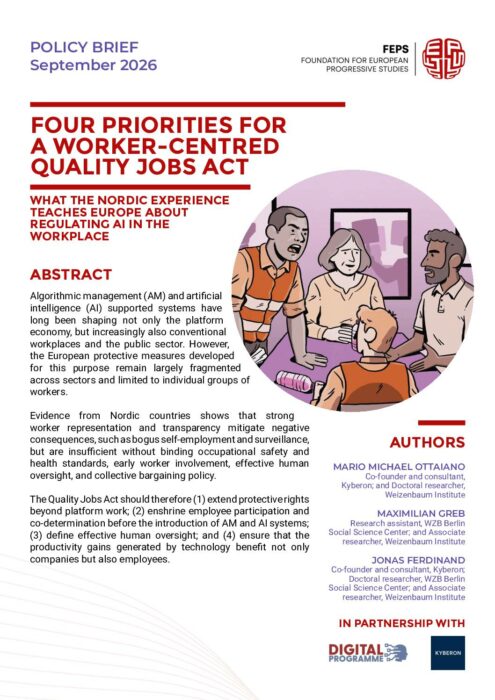
Four priorities for a worker-centred Quality Jobs Act

What the Nordic experience teaches Europe about regulating AI in the workplace
28/08/2026

How can Europe’s missing middle be financed

Translating Chinese lessons for scaling industrial innovation
14/08/2026

A just transition in the Mediterranean

Rebalancing the burdens and benefits of EU-North Africa energy cooperation
Find all related Progressive Post
Progressive Post
08/10/2026

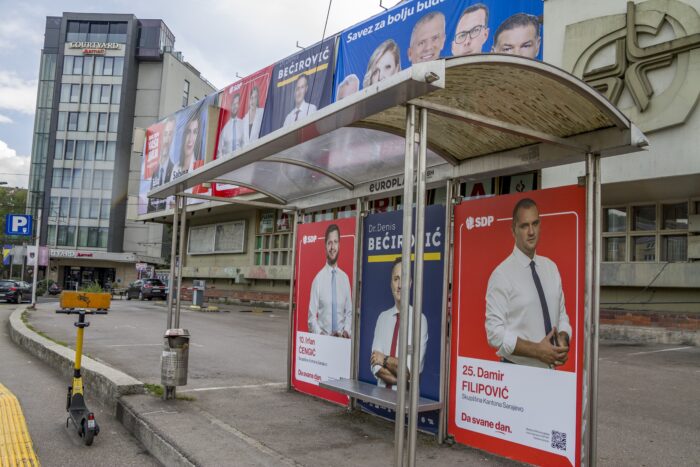
The vote is harder to steal, but politics remains hard to change

Bosnia and Herzegovina's 2026 elections
08/10/2026

The missing engine of Europe’s renewal

Extending democracy to the workplace
Find all related news
News
16/09/2026

FEPS Reacts: State of the European Union 2026

The 2026 State of the Union felt more like ‘von der Leyen I’ than ‘von […]
23/07/2026

FEPS Reacts: European Commission communication on the Action Plan on the European Pillar of Social Rights

By Laszlo Andor, FEPS Secretary-General & François Balate, Policy Analyst on Social The communication on the […]
08/07/2026

Letter to Manfred Weber, Chair of the EPP Group, by FEPS President Nicolas Schmit 

Dear Mr Weber, You are European, but also German. One should be entitled to expect […]
23/06/2026

FEPS Reacts: 10 years after Brexit

Written by FEPS Secretary-General László Andor 🔸 Brexit has been a case study in national self-harm. The […]
Find all related in the media
In the media

La Regina, il problema dei divari territoriali è una questione europea

by Regione Basilicata 22/09/2026
“La Regina: territorial disparities are a European issue” News article published by ANSA (IT), featuring Raffaele La Regina, participant in the FEPS Young Academics Network, discussing territorial and social inequalities across Europe, the need to reconcile competitiveness and cohesion, and the role of European cohesion policy, industrial policy and investment in ensuring that no region is left behind.

Канадскиот гамбит на Фон дер Лајен

by Racin.mk 21/09/2026
“Von der Leyen’s Canadian gambit” Opinion article by László Andor, FEPS Secretary General, published in Racin.mk (MK), analysing the EU’s growing rapprochement with Canada, the shift from geopolitics towards geoeconomics, and the need for Europe to reduce its dependence on the US while strengthening multilateralism. Andor also examines the Commission’s economic and social priorities, highlighting the need for stronger attention to living costs, labour and social policy.

Biztonságpolitika? Az a NATO dolga – EU-s biztosok értékelték Ursula von der Leyen beszédét

by Telex 21/09/2026
“Security policy? That’s NATO’s job – former EU Commissioners assess Ursula von der Leyen’s speech”. Article published in Telex (HU), featuring László Andor, FEPS Secretary General, analysing Ursula von der Leyen’s State of the Union address and discussing Europe’s economic competitiveness, investment gap, strategic vulnerabilities, AI, migration and the EU’s changing geopolitical position.

EU’s new cross‑border work rules favour recruitment, not workers, say critics

by EUObserver 16/09/2026
FEPS Policy Analyst on Social François Balate discusses the latest EU Labour Mobility Package under Commissioner Roxana Mînzatu zatu for the EUObserver.