Migration – FEPS Post Summit Briefing: European Council, 28 June 2018

As it has often been the case in the last few years, the issue of […]

04/07/2018

As it has often been the case in the last few years, the issue of migration dominated the debate in the days preceding the summit – to the point that a pre summit was convened on Sunday 17 June with the aim of brokering some kind of agreement among the willing Member States – as well as the discussion within the European Council itself, that lasted throughout the night and until the early hours on Friday morning.

Indeed, more than ever, it appeared that it was not just the definition of some form of understanding on how to deal with migration at European level that was at stake but also in the attempt to reconcile South European countries’ quest for some form of responsibility sharing with East European countries’ refusal to accept even a single refugee the existence of the European project itself, or at least of the Schengen system. The search for a compromise was frantic, but disentangling the European Council’s debate on migration from national political tensions – in a time in which, to be honest, the pressure of migrant flows on European borders has dramatically decreased compared to previous years – was impossible.

The ominous shadows of the new Italian Minister of Interior, Matteo Salvini, with his “holy war” against migration and migrants (which is indeed greatly contributing to the constant gain of consensus he has enjoyed since the new government was appointed at the beginning of last month), and even more of his German counterpart, Horst Seehofer, with his personal fight against Angela Merkel and his threat to blow up the 70-year long coalition between CDU and CSU, loomed over the European Council summit and greatly affected its extremely poor outcome.

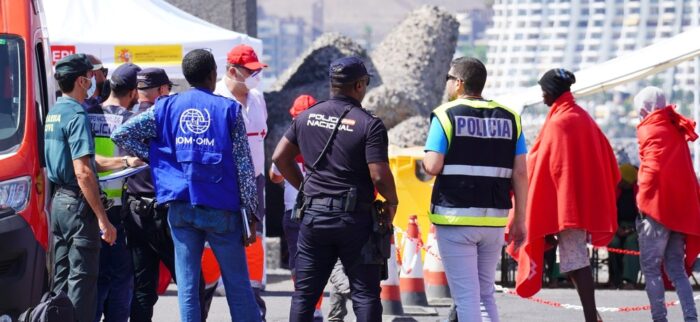
The conclusion, in fact, reiterates once more the EU’s propensity for externalising the management of migrant flows, by – among other actions – “fully implementing” the EU-Turkey Statement, supporting the Libyan coastguard, the call to “swiftly explore the concept of a regional disembarkation platform, in close cooperation with relevant third countries as well as UNHCR and IOM”. Apart from the very loose commitment (“swiftly explore”), it is far from being clear where such platforms should be established (Libya has recently declared that it will not accept the establishment of hotspots within its borders). By contrast, it is clear that only on a voluntary basis will the Member States share the responsibility for “taking charge of” (…) “those who are saved”. But, and this is crucial, “without prejudice to the Dublin reform”, an agreement on which, it is written in the European Council conclusion, needs to be found, possibly in October. The details on what kind of consensus are still very unclear.

Another contentious issue concerned the so-called secondary movements of asylum seekers (that is, the irregular movement of migrants from the country of first arrival to another Member State), which saw Germany and Italy on opposite fronts, with the former – pressed by the hardliner Minister of Interior – asking for blocking them once and for all, and the latter that wished to postpone any discussion on this topic in the hope to find first agreements on other more urgent matters. According to the conclusion reached last week, “Member States should take all necessary internal legislative and administrative measures to counter such movements”, but what this would imply in practical terms is not clear. What is more interesting, perhaps, are the repercussions in the two Member States. While Merkel has eventually managed to avoid the collapse of her government (also by means of further concessions to her Minister of Interior on the prevention of irregular migration between Germany and Austria, which might trigger further security border measures by the Vienna government and therefore endanger rather than protect Schengen), the Italian Prime Minister Giuseppe Conte has clearly stated that Italy has made no precise commitment on secondary movements.

In the document great emphasis is also given to the control of borders, the role of FRONTEX, the prevention of irregular entries and the priority of returning irregular migrants, confirming once more the security approach of the European Union to the management of migration, and to cooperation with African countries, aimed at the “socio-economic transformation” of the continent. Regrettably it is the human dimension that instead seems to be lacking in the European Council document, as if in drafting it the fact that it is of men, women and children that they are talking was forgotten.

Last but not least, the reference to “all vessels operating in the Mediterranean” that “shall respect the applicable law and not obstruct operations of the Libyan Coastguard” seems to foresee a change of attitude, for the worst, towards NGOs committed to search and rescue operations in the Mediterranean, therefore to the mission of saving human lives.

Read the full briefing

Find all related publications
Publications
15/12/2025

The Great Unravelling

“The great unravelling” examines the challenges that the new era of globalisation poses for progressive […]
09/12/2025

Tackling the housing crisis in Europe

Progressive ideas for affordable and sustainable housing policies
28/11/2025

Smarter spending today, safer societies tomorrow

Digitally-enabled capabilities for European defence
28/11/2025

More money, more dependence?

Financing European Union defence for autonomy and cooperation
Find all related news
News
12/12/2025

FEPS elects Nicolas Schmit as new President

After eight years in the role, outgoing President Maria João Rodrigues requested to be replaced, considering her mission accomplished. 
08/12/2025

Friends of the Western Balkans’ joint statement

Belgrade, 21 November 2025 We, the Friends of the Western Balkans (FoWB) – representatives of […]
04/12/2025

It is high time that the goal is set on “Quality”

FEPS commentary on the Quality Jobs Roadmap
27/11/2025

Is a bad COP outcome better than no outcome at all?

FEPS Commentary on COP30
Find all related in the media
In the media

Liberal democracy’s social, societal fabric under threat – Live from the EPC Annual Conference 2025

by EPC 08/12/2025
In a podcast by the European Policy Centre (EPC), FEPS Secretary General, László Andor, discusses how liberal democracy in Europe is being challenged not only at the institutional level but also through the erosion of social rights and what Europe must do to defend its social foundations.

« La souveraineté numérique européenne est un défi d’ordre civilisationnel »

by Le Monde 15/11/2025
"European digital sovereignty is a challenge for civilisation as a whole". In an opinion piece in the newspaper Le Monde, FEPS President Maria João Rodrigues shares her concerns about European digital dependence on American and Asian giants

When Algorithms Undermine Democracy: Europe’s Wake-Up Call

by Social Europe 11/11/2025
Maja Fjaestad and Simon Vinge, co-editors of FEPS book "Algorithmic rule", wrote this op-ed on the power of algorithms and how they threaten the foundations of democratic oversight

Los mapas de las fronteras internas que alimentan el voto ultra en Europa

by El Confidencial 13/10/2025
"The internal border maps that fuel the far-right vote in Europe" - FEPS Secretary-General László Andor discusses the impact of cohesion policies on social inequalities and the rise of the far-right across Europe in this El Confidencial article.