The EU’s New Resilience Agenda in the MENA Region

The Middle East and North Africa (MENA) is in turmoil. Hard and human security challenges […]
Speakers

03/11 - 04/10/2017
00:00:00 - 00:00:00
Holy Spirit University of Kaslik Lebanon Holy Spirit University of Kaslik Lebanon
The EU’s New Resilience Agenda in the MENA Region
56308
394-the-eu-s-new-resilience-agenda-in-the-mena-region
0

In order to give you access to our events, FEPS processes your personal data together with any other organiser of this event mentioned in the description of the event and in accordance with 'FEPS’ data protection policy.

The Middle East and North Africa (MENA) is in turmoil. Hard and human security challenges ranging from on-going inter-state conflicts and civil wars to radicalization and terrorism have been proliferating against the backdrop of unstable political circumstances, demographic and socio-economic challenges, migration and climate change.

The new EU Global Strategy (EUGS) released in late June 2016 represents a point of departure to re-calibrate the EU’s external and security policy towards the MENA, placing ‘resilience’ as the main pillar or leitmotif of the new comprehensive vision for the EU’s foreign and security policy. In the EUGS document, resilience is understood as the opposite to fragility, namely “the ability of states and societies to reform, thus withstanding and recovering from internal and external crises”. It is further defined as a precondition for sustainable growth and vibrant societies as well as for the ultimate attainment of democracy.  

The culmination of a year-long research project focusing on the EU’s New Resilience Agenda in the Middle East and North Africa Region, jointly undertaken by FEPS and Istituto Affari International (IAI), a conference is organised in Beirut, Lebanon aimed at presenting and discussing the project’s important findings to a select number of stakeholders in the MENA region. The conference will take place on 3 November 2017 at Holy Spirit University of Kaslik, in Lebanon. It will feature a keynote speech by Ms. Nathalie Tocci, Director of IAI, and the participation of important researchers focusing on the project’s six case-studies, Lebanon, Qatar, Egypt, Tunisia, Turkey, and Iraq, all aimed at unpacking the concept of resilience in concrete and substantive terms, as the implementation of the EUGS goes forward.  

Read the programme

Find all related publications
Publications
21/11/2026

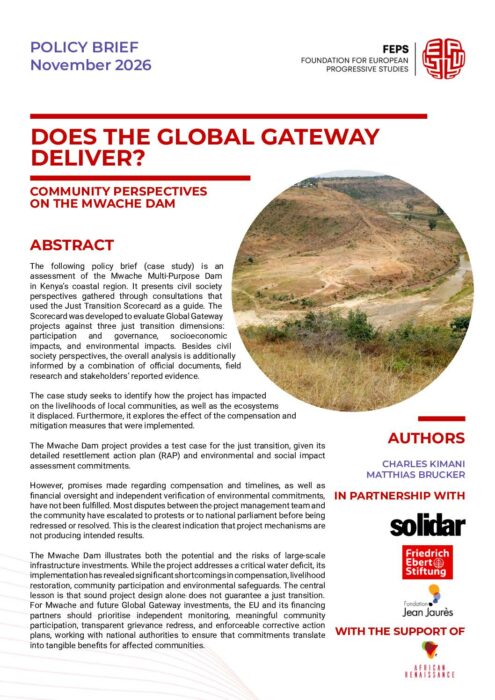
Does the Global Gateway deliver?

Community perspectives on the Mwache Dam in Kenya
21/11/2026

For a strategic EU-Global South Alliance

Global Gateway & beyond
16/11/2026

Designing a just and resilient Europe

Proposals for the EU Framework for Climate Resilience
09/11/2026

The far right, reactionary platformisation and progressive responses

The far right is thriving on social media, and this is no accident. This policy […]
Find all related Progressive Post
Progressive Post
19/11/2026

Translating Europe’s commitment to multilateralism into action in the Mediterranean

The case for doubling down on the Union for the Mediterranean
10/11/2026

A blue wave that might crush soon

Americans have elected a new Congress: going into 2027, both chambers will be under Democratic […]
05/11/2026

If you want peace, prepare for equality

I have always been struck by how little attention we pay to patriarchal culture when […]
Find all related Audiovisual
Audiovisual
06/11/2026

🇪🇺 How Europe survives? with Catherine De Vries and Alexandros Kentikelenis

Half of 🇪🇺 Europe is in upheaval today. Professors Catherine De Vries and Alexandros Kentikelenis […]
06/11/2026

🇪🇺 How Europe survives? with Catherine De Vries and Alexandros Kentikelenis

Half of 🇪🇺 Europe is in upheaval today. Professors Catherine De Vries and Alexandros Kentikelenis […]
05/11/2026

‘Education in times of AI and Big EdTech’ Flickr album

Photo album of the Education in times of AI and Big EdTech event at the […]
21/09/2026

“Security policy? That’s NATO’s job – former EU Commissioners assess Ursula von der Leyen’s speech”

Biztonságpolitika? Az a NATO dolga – EU-s biztosok értékelték Ursula von der Leyen beszédét Article […]
Find all related news
News
20/11/2026

FEPS React: EU member states’ negotiations with Rwanda on the ‘return hub’

The announcement by five European Union member states of the official start of negotiations with […]
30/10/2026

FEPS Reacts: The new EU Framework for Climate Resilience

Necessary foundations but little action
23/10/2026

Notice of vacancy – Policy Analyst on Gender Equality

Apply before 23 November 2026
16/09/2026

FEPS Reacts: State of the European Union 2026

The 2026 State of the Union felt more like ‘von der Leyen I’ than ‘von […]
Find all related in the media
In the media

Direct democracy MP Laouris clarifies participation at event with far-right party

by en.Philenews 18/11/2026
FEPS policy brief "Countering the far right in the European Parliament" was cited by en.Philenews in its latest coverage of the far-right Europe of Sovereign Nations (ESN) group in Cyprus.

Le Conseil d’analyse économique organise le webinaire “Inégalités face au changement climatique : qui paie la fracture ?”

by Bulletin Quotidien 18/11/2026
"The Council of Economic Analysis is organizing the webinar "Inequalities in the face of climate change: who is paying the price?" Read the article by Bulletin Quotidien about our upcoming event on 26 November: "What kind of European Union in the face of empires?".

Bharat Summit: Accountability key to restoring public trust in democracy

by UNI India 14/11/2026
Read UNI India’s article on the Bharat Summit, where Christian Salm, FEPS Head of Democracy and Participation Programmes, joined a political panel on democratic accountability and political reform.

Perustuslaki halutaan avata, jotta tekoälyä voidaan käyttää vielä enemmän – Ei, sanoo vasemmiston Honkasalo

by Helsingin Sanomat 06/11/2026
“The Constitution could be reopened to allow greater use of AI – No, says Left Alliance MP Honkasalo” News article by Veera Paananen published in Helsingin Sanomat (FI), referring to the FEPS and Demos Helsinki policy study on AI, automation and public authority in Nordic welfare states. The article draws on the study's findings to highlight the risks of delegating decision-making to AI in public services, including the loss of human judgement and accountability, and features Finnish MP Veronika Honkasalo's opposition to expanding AI-driven decision-making in the public sector.