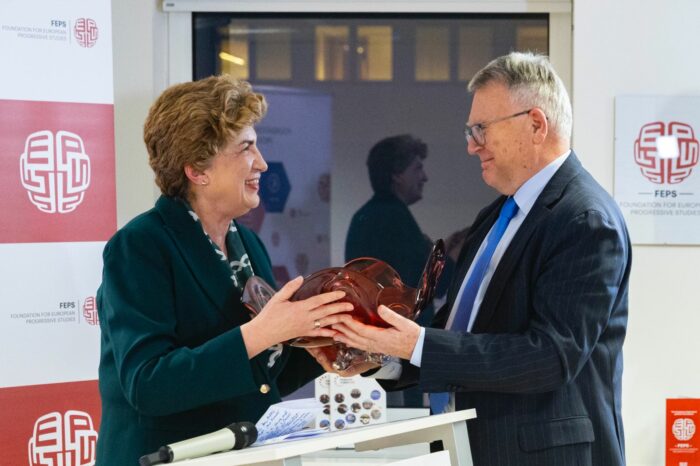
Shifting Europe from Austerity to Growth: A Proposed Investment Programme for 2012-2015

The meeting discussed concrete proposals (with appropriate figures and estimates) to significantly increase lending by […]

18/06/2012

The meeting discussed concrete proposals (with appropriate figures and estimates) to significantly increase lending by the European Investment Bank as well as other measures (notably the use of structural funds and project bonds), so as to meaningfully advance the European Union growth agenda. Indeed, modelling work included in the paper shows that highly needed jobs, especially for the youth, could be created in the European Union with the proposed measures.

Discussions started from a presentation of the paper made by Prof. Stephany Griffith-Jones, Columbia University (New York) and FEPS consultant, Dr Matthias Kollatz-Ahnen, former Senior Vice-President of the European Investment Bank and Lars Andersen, Director of the European Council of the Labour Movement (Denmark).

The meeting took place ahead of the next European Summit taking place at the end of June 2012, and given the need to counter austerity measures and to provide the European Union with sound and sustainable policy proposals for growth.

Taking place in the FEPS’office, the event was co-organised the Foundation for European Progressive Studies , together with the Initiative for Policy Dialogue at Columbia University (New York) and the European Council of the Labour Movement (Denmark,).

Read the paper

Find all related publications
Publications
19/12/2025

Moving beyond neoliberalism in EU trade policy

European Union trade policy finds itself at a crossroads. After three decades of neoliberal dominance in the […]
15/12/2025

The great unravelling

“The great unravelling” examines the challenges that the new era of globalisation poses for progressive […]
09/12/2025

Tackling the housing crisis in Europe

Progressive ideas for affordable and sustainable housing policies
28/11/2025

Smarter spending today, safer societies tomorrow

Digitally-enabled capabilities for European defence
Find all related news
News
06/01/2026

Venezuela is not about drugs: Trump’s Regional Expansionism and Europe’s Test

FEPS Commentary on US military intervention in Venezuela
16/12/2025

FEPS commentary on the EU Affordable Housing Plan

The announcement of the EU Affordable Housing Plan by Commissioner Dan Jørgensen is a historic milestone […]
15/12/2025

FEPS President Maria João Rodrigues at Digital UNGA in New York

From 15 to 17 December, the Digital UNGA took place in New York, bringing together […]
12/12/2025

FEPS elects Nicolas Schmit as new President

After eight years in the role, outgoing President Maria João Rodrigues requested to be replaced, considering her mission accomplished. 
Find all related in the media
In the media

“Talking with the enemy” – POLITICO Brussels Playbook, January 13

by POLITICO 13/01/2026
Read Nicolas Schmit, FEPS President-elect, in the 'POLITICO Brussels Playbook'. He calls for stronger European solidarity and a more assertive EU stance to defend its digital rules - particularly in the face of US sanctions.

Liberal democracy’s social, societal fabric under threat – Live from the EPC Annual Conference 2025

by EPC 08/12/2025
In a podcast by the European Policy Centre (EPC), FEPS Secretary General, László Andor, discusses how liberal democracy in Europe is being challenged not only at the institutional level but also through the erosion of social rights and what Europe must do to defend its social foundations.

« La souveraineté numérique européenne est un défi d’ordre civilisationnel »

by Le Monde 15/11/2025
"European digital sovereignty is a challenge for civilisation as a whole". In an opinion piece in the newspaper Le Monde, FEPS President Maria João Rodrigues shares her concerns about European digital dependence on American and Asian giants

When Algorithms Undermine Democracy: Europe’s Wake-Up Call

by Social Europe 11/11/2025
Maja Fjaestad and Simon Vinge, co-editors of FEPS book "Algorithmic rule", wrote this op-ed on the power of algorithms and how they threaten the foundations of democratic oversight