Call for tenders: Polling firm to conduct diaspora polling

The Foundation for European Progressive Studies (FEPS) is the only progressive think tank at the […]

27/06/2019

The Foundation for European Progressive Studies (FEPS) is the only progressive think tank at the European level. As such, FEPS establishes an intellectual crossroad between social democracy and the European project, putting fresh thinking at the core of its action. As a platform for ideas and dialogue, FEPS works in close collaboration with social democratic organisations, national foundations, and think tanks across Europe to tackle the challenges that Europe faces today. FEPS embodies a new way of thinking on the social democratic, socialist, and labour scene in Europe. Our main purpose is to nourish a fresh progressive dialogue through research.

Objective

FEPS is looking for a polling firm experienced in polling minorities to conduct polling of the Turkish diaspora in four European countries (Germany, France, the Netherlands, and Austria).

The minimum necessary polling requirements and associated services are as follows:

·Proven track-record identifying and polling target populations of Turkish migrants and Europeans of Turkish background, aged 18 years and older. Please provide examples of previous work, credentials of survey designers, specify in detail how survey will be conducted.

·Desired polling sample size: Germany (min. 1,000), Austria (min. 400), Netherlands (min. 400), France (min. 400); for a minimum of 2,200 interviews. Exact sample sizes and margins of error to be discussed with FEPS and partner organization during questionnaire design.

·Representative sample (balanced by age, gender, income, education, socio-economic status, geography). Please provide details on selection and sampling, adjustments or modeling to be conducted.

·Questionnaire: please specify the price for different numbers of questions (including demographic/sample determination questions); final questionnaire to be determined in consultation with FEPS and partner organization, with active advice of survey company.

·Preference given to proposals which offer (limited) access to any applicable previously gathered data (please specify in proposal) to inform analysis of changes and trends.

·Translation of questionnaire (from English to German, Turkish, French, Dutch).

·Phone polling with CATI System or comparable, with landline and mobile numbers used.

·Communications expenses included.

·Data Analysis: validation/revision of database as needed.

·Results presented in SPSS, Excel database.

·Re-translation of answers to open-ended questions into English.

·Cross-tabulation of data/responses.

·Short analysis of polling data, not exhaustive and not for publication.

Punctual support to:

·Design and implement public opinion research.

·Respond to queries relating to translation, sampling, data analysis.

Requirements:

·Agency based in the European Union.

·Established record polling minority populations and sub-groups.

·Native English. German, French, Dutch, Turkish speakers will be required for implementation of the poll, translation of the data.

·Ability to implement survey in calendar year 2019.


We would like to receive comprehensive proposals by Friday, July 26th 2019, 12.00pm Brussels time. If you are interested, please contact both Vassilis Ntousas, FEPS Senior International Relations Policy Advisor, at Vassilis.ntousas@feps-europe.eu, and Hedwig Giusto, FEPS Senior Policy Advisor at Hedwig.Giusto@feps-europe.eu. The final decision will be made by Friday, September 13th.

Find all related publications
Publications
05/03/2026

Digital sovereignty and a new multilateralism for the AI era

Artificial intelligence (AI) is transforming not only economies but the very nature of global power, […]
03/03/2026

Progressive pathways for a resilient (re)construction of Ukraine: Towards a new social contract

This policy study places labour at the centre of reconstruction planning for Ukraine as the […]
03/03/2026

European sovereignty and the social dimension

Reasserting Europe’s social-democratic model in turbulent times
29/01/2026

Progressive Yearbook 2026

In an eerie manner, 2025 resembled the ‘time of monsters’, which, according to the great […]
Find all related news
News
05/03/2026

FFPPVC commentary on the new EU Gender Equality Strategy 2026-2030

Commentary by the Feminist Foreign Policy Progressive Voices Collective (FFPPVC)
03/03/2026

Wag the dog?

FEPS commentary on the US-Israel attack on Iran
03/03/2026

Closing ceremony of the Progressive Ukraine programme

The graduation ceremony completed the programme which was part of the Open Progressive University (OPU).
29/01/2026

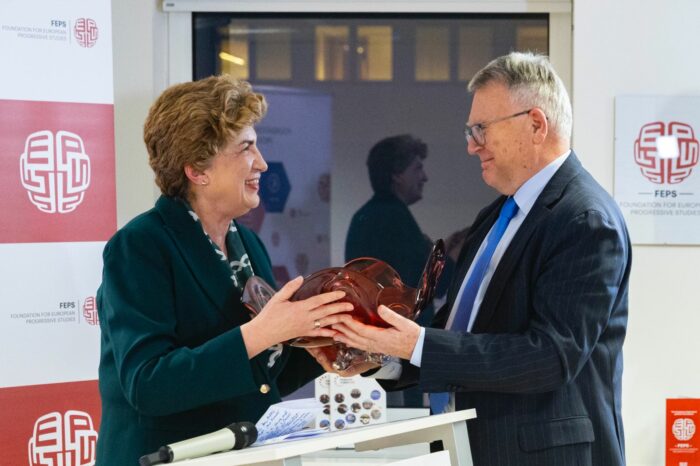
Maria João Rodrigues departs from FEPS Presidency, transitions to Nicolas Schmit

After completing eight years in the role, Maria Joâo Rodrigues has departed the role of […]
Find all related in the media
In the media

Africa and Europe Must Rethink Clean Energy Partnership After COP30 Setback

by News Ghana 27/02/2026
Read this article from News Ghana on the highlights of FEPS' event "Governing the global just transition", where diverse stakeholders discussed the EU's role in supporting a just transition from fossil fuels to clean energy in Africa

EUfória podcast Andor Lászlóval: Mire képes az EU saját erejéből és mennyire van kiszolgáltatva a világnak?

by EUrologus 26/02/2026
Listen to the EUfória podcast with László Andor, Secretary General of FEPS, on what the EU can achieve on its own, how to tackle its competitiveness challenge and how the Hungarian government’s stance shapes the EU’s image.

Can the EU ever become a superpower?

by Euronews 20/02/2026
In this episode of the podcast Brussels, My Love, FEPS President Nicolas Schmit discusses the informal meeting of the Antwerp European Industrial Summit and the Munich Security Council.

España los forma, Europa los contrata: así es el mapa de la nueva fuga de cerebros

by El Confidencial 10/02/2026
Spain trains them, Europe hires them: the map of the new brain drain: László Andor, FEPS Secretary-General, discusses the 'brain drain' as a result of the EU’s single market and highlights the need for a fairer mobility and retention strategy across the EU.