Activity Report: Energy Efficiency: Key to Social and Economic Security

The main messages from the forum were based on how energy efficiency is key to […]

16/02/2015

The main messages from the forum were based on how energy efficiency is key to solving many social and economic problems and what measures can be taken to use efficiency to its full potential.

  • There are some big gains to be made in Latvia, especially in the housing sector, however there is a huge problem of trust in efficiency measures, often due to negative publicity. More local awareness schemes and better incentives and opportunities for consumers and the private sector could help improve this. Trust can be generated also through using well-known household brands and use of quality marks to launch new products.
  • Cooperative schemes and association schemes are seen as positive, although there is also a need to attract private investors too in order for the schemes to be successful, this is done through state guarantees.
  • Apartment owners are wary of carrying out renovation and decisions often have to be taken by the whole building which slows things down. Therefore issues of the surrounding framework need to be addresses such as ownership structures, building codes, property law and planning requirements.
  • Sharing ideas and experiences at European level as well as establishing incentives can push forward energy efficiency measures and this together then with social measures.
  • More efficiency measures that are taken, the more and better technology will be deployed and bring down prices and save energy.
  • Addressing energy efficiency can clearly help fuel poverty.
  • In Latvia the 2012 EU energy efficiency directive needs to be implemented.

The forum gathered a mixture of Latvian experts, from NGOs, businesses and politicians alongside experts from the region and from European level. The discussions were based on looking at the current situation of energy efficiency in Europe and why energy can help social and economic problems, measures and tools for improving efficiency and future steps to be taken. 

In conclusion, it was noted that it requires a long-term policy and strategy from the State in this area. This would give confidence also to private financial institutions that this is an industry where it is safe to invest resources. Whereas, larger apartment buildings’ renovation in Latvia would attract investments from manufacturers of building materials, which would create new jobs and reduce the costs for energy efficiency activities in Latvia.


The Conference was streamed online to one of the biggest Latvian news portal Tvnet.lv and was viewed by 489 people. Video of the conference can be found at the foundation’s BSF home page

Based on this and previous conferences on energy efficiency, BSF created proposals for the Latvian Parliament to change legislation and policies in order to ensure better energy efficiency measures.

Also an e- book was created collecting practices and examples of energy policy on this issue in Finland, Estonia, and Latvia (available also in English) 

Twitter accounts:

@FEPS_Europe

@BSF_Latvija

Full summary of the discussions 

Link to the video streaming of the meeting 

The Latvian version of the discussion summaries and programme and other related documents and photos on our partner’s website, the Freedom and Solidarity Foundation.

Erica Hope’s Presentation from the European Climate Foundation 

Check out also www.ekubirojs.lv for more details of the presentation of the research presentation of Marta Bergmane and Mara Laizane about Resident’s understanding and perception of the impact of renovation of multifamily dwellings.

Find all related publications
Publications
19/03/2026

There must be an alternative

Against mainstream defeatism and towards the rejuvenation of the democratic public space
19/03/2026

Countering the far right in the European Parliament

Exploring progressive strategies in the age of far-right normalisation
18/03/2026

New own resources for the EU budget

As part of its proposals for the Multiannual Financial Framework (MFF) for 2028 to 2034 […]
05/03/2026

Digital sovereignty and a new multilateralism for the AI era

Artificial intelligence (AI) is transforming not only economies but the very nature of global power, […]
Find all related news
News
05/03/2026

FFPPVC commentary on the new EU Gender Equality Strategy 2026-2030

Commentary by the Feminist Foreign Policy Progressive Voices Collective (FFPPVC)
03/03/2026

Wag the dog?

FEPS commentary on the US-Israel attack on Iran
03/03/2026

Closing ceremony of the Progressive Ukraine programme

The graduation ceremony completed the programme which was part of the Open Progressive University (OPU).
29/01/2026

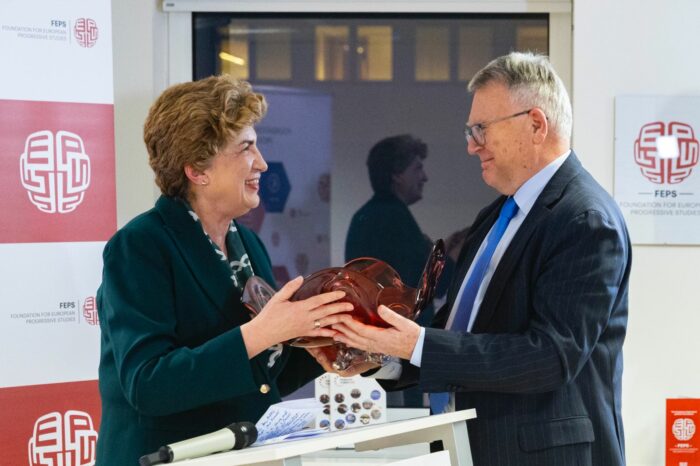
Maria João Rodrigues departs from FEPS Presidency, transitions to Nicolas Schmit

After completing eight years in the role, Maria Joâo Rodrigues has departed the role of […]
Find all related in the media
In the media

Világháború, vagy amit akartok

by Mérce 18/03/2026
"World War, or what you will". FEPS Secretary-General László Andor escalating conflict between the USA, Israel, and Iran and the lack of 'brakes' to prevent escalation from Donald Trump and Benjamin Netanyahu.

Africa and Europe Must Rethink Clean Energy Partnership After COP30 Setback

by News Ghana 27/02/2026
Read this article from News Ghana on the highlights of FEPS' event "Governing the global just transition", where diverse stakeholders discussed the EU's role in supporting a just transition from fossil fuels to clean energy in Africa

EUfória podcast Andor Lászlóval: Mire képes az EU saját erejéből és mennyire van kiszolgáltatva a világnak?

by EUrologus 26/02/2026
Listen to the EUfória podcast with László Andor, Secretary General of FEPS, on what the EU can achieve on its own, how to tackle its competitiveness challenge and how the Hungarian government’s stance shapes the EU’s image.

Can the EU ever become a superpower?

by Euronews 20/02/2026
In this episode of the podcast Brussels, My Love, FEPS President Nicolas Schmit discusses the informal meeting of the Antwerp European Industrial Summit and the Munich Security Council.