Democracy in the face of terrorism

France and Europe are faced with terrorist attacks of unprecedented violence and magnitude, and citizens […]

09/09/2016

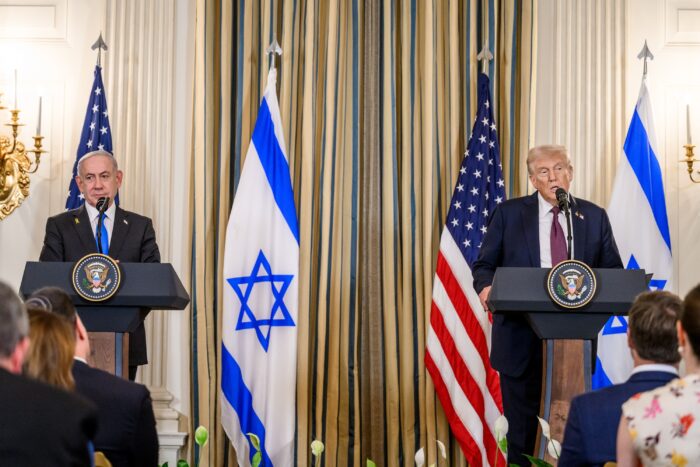
France and Europe are faced with terrorist attacks of unprecedented violence and magnitude, and citizens are starting to raise questions. Democracy is the goal, democracy is what must provide a solution. This was the message delivered at a symposium hosted on 8 September 2016 by the FEPS, Terra Nova and Jean Jaurès in the presence of the President of the French Republic.

Launching the debate in the name of the FEPS, its Secretary general, Ernst Stetter indicated that “ensuring the maximum safety of citizens while also fully respecting their personal freedom has evoked, in some ways, a paradoxical injunction”. A close observer of grassroots reactions arising from the refugee crisis, he indicated that “on the issue of migration such as that pertaining to terrorism, we must make a commitment towards rejecting simplistic responses. Any simplification will lead us to uneducated, totalitarian, unacceptable solutions”. Read the speech or watch it.

Referring to the Pericles period, Thierry Pech, Director of Terra Nova indicated a desire for us to decide on “who we are and what virtues we recognise in ourselves. What we are able to concede without losing our identity. On what we are able to compromise, without losing our way. And what, on the other hand, we need to hold on to. Support without compromise. Support without weakening”. Read the speech and/or watch it.

Continuing the introductions, Gilles Finchelstein, Managing Director of the Fondation Jean Jaurès, stated that “the crux of the matter is a democratic culture, with all of its underlying rules, values and spirit. Furthermore, is the certain notion of France and its model of society which today is called into question, turning towards the President to shed light on the upcoming debates, set some context and direction, to ensure that France remains loyal to herself”. Read the speech and/or watch it.

Islamic terrorism is under the illusion that democracy is weak, whereas we are well aware of the laws of History: democracies always win wars”, stated François Hollande, President of the French Republic. “Democracy will inevitably emerge victorious as it has a force that gathers momentum, becoming irresistible, it is freedom”. Certain about victory, the French President has based this victory on cohesion. Considering secularism as a fundamental challenge, he expressed confidence that Islam, French Muslims and the Republic are capable of drawing on rules, even those drafted in 1905, that are still relevant. “In essence, it is not a religious issue, but rather a Republican struggle as the Republic is a single, indivisible whole. It doesn’t differentiate between its children”, he reiterated. Read or/and Watch his speech.

Conference organised in Paris with Terranova and 

Introductory speeches by 

Ernst Stetter, Secretary General of FEPS

Gilles Finchelstein, Director of Jean-Jaurès Foundation

Thierry Pech, Director of Terra Nova

Speech by the President of the French Republic, François Hollande.


La démocratie face au terrorisme

La France et l’Europe sont confrontées à des attentats terroristes d’une violence et d’une ampleur sans précédent et les citoyens s’interrogent. C’est la démocratie qui est visée ; c’est la démocratie qui doit répondre. C’était le message du colloque organisé le 8 septembre 2016 autour du président de la République française, par la Fondation européenne d’études progressistes (FEPS), le think tank Terra Nova et la Fondation Jean-Jaurès.

Ouvrant le débat au nom de la FEPS, son secrétaire général, Ernst Stetter, a relevé qu’ « assurer, en même temps, la sécurité maximale des citoyens et le respect maximal de leurs libertés individuelles relevait, par certains côtés, de l’injonction paradoxale. Observateur attentif des réactions populaires survenus dans le contexte de la crise des réfugiés, il a indiqué que « pour la question migratoire comme celle du terrorisme, nous devrons prendre l’engagement de refuser des réponses simples. Toute simplification nous emmènera vers des solutions populaires, totalitaires et inacceptables. ».  – Lire et/ou voir son intervention

Se référant à l’époque de Périclès, Thierry Pech, le Directeur de Terra Nova a souhaité que nous nous prononcions « sur qui nous sommes et quelles sont les vertus dans lesquelles nous nous reconnaissons. Sur quoi nous pouvons transiger sans nous perdre. Sur quoi nous pouvons faire des compromis sans nous égarer. Et sur quoi nous devons au contraire tenir. Tenir sans composer. Tenir sans faiblir. ».  –  Lire et/ou voir son intervention

Prolongeant les introductions, Gilles Finchelstein Directeur général de la Fondation Jean Jaurès, a indiqué que « ce qui est en jeu, fondamentalement, c’est la culture démocratique avec ses règles, ses valeurs et son esprit ». Plus encore, « c’est une certaine conception de la France et de son modèle de société qui est aujourd’hui interrogée », comptant sur le Président pour « éclairer les débats qui viennent ; pour fixer des repères et un cap ; pour que la France soit fidèle à elle-même. » Lire et/ou voir son intervention. 

« Le terrorisme islamiste a l’illusion de croire que la démocratie est faible alors que nous connaissons les lois de l’Histoire: les démocraties gagnent toujours les guerres », a déclaré François Hollande, le Président de la République française.  « La victoire de la démocratie est inéluctable car elle dispose d’une force qui rassemble les énergies et qui devient irrésistible, c’est la liberté. » Convaincu de gagner, le Président français a conditionné cette victoire à la cohésion. Considérant la laïcité comme un enjeu fondamental, il s’est montré confiant que l’Islam, les musulmans français et la République capables soient capables de s’accommoder de règles, certes écrites en 1905 mais toujours d’actualité. « La question, au fond, n’est pas religieuse, c’est un combat républicain car la République est une et indivisible. Elle ne distingue pas entre ses enfants », a-t-il rappelé. Lire  et/ou Voir son intervention

Find all related publications
Publications
29/01/2026

Progressive Yearbook 2026

In an eerie manner, 2025 resembled the ‘time of monsters’, which, according to the great […]
15/01/2026

Financing enlargement via the 2028-2034 MFF

This brief intends to explain how the European Commission’s proposal for the 2028-2034 Multiannual Financial […]
19/12/2025

Moving beyond neoliberalism in EU trade policy

European Union trade policy finds itself at a crossroads. After three decades of neoliberal dominance in the […]
15/12/2025

The great unravelling

“The great unravelling” examines the challenges that the new era of globalisation poses for progressive […]
Find all related news
News
29/01/2026

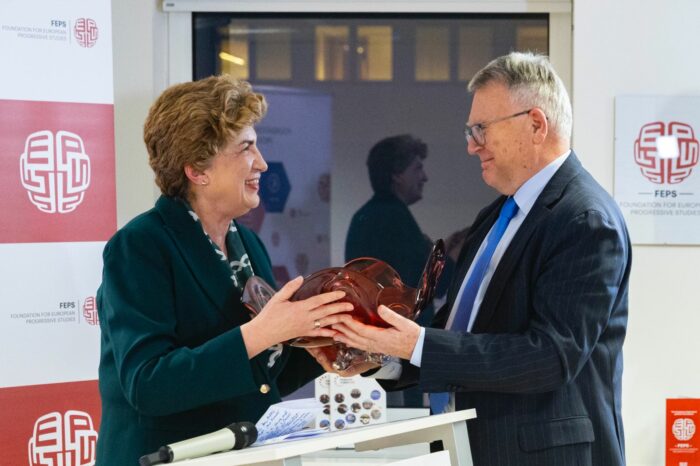
Maria João Rodrigues departs from FEPS Presidency, transitions to Nicolas Schmit

After completing eight years in the role, Maria Joâo Rodrigues has departed the role of […]
29/01/2026

Marianna Mazzucato awarded FEPS ‘Progressive Person of the Year’

FEPS Progressive Person of the Year 2025-2026
21/01/2026

Call for tender – HR consulting services

Applications to be submitted before 18 February
06/01/2026

Venezuela is not about drugs: Trump’s Regional Expansionism and Europe’s Test

FEPS Commentary on US military intervention in Venezuela
Find all related in the media
In the media

Can the EU ever become a superpower?

by Euronews 20/02/2026
In this episode of the podcast Brussels, My Love, FEPS President Nicolas Schmit discusses the informal meeting of the Antwerp European Industrial Summit and the Munich Security Council.

España los forma, Europa los contrata: así es el mapa de la nueva fuga de cerebros

by El Confidencial 10/02/2026
Spain trains them, Europe hires them: the map of the new brain drain: László Andor, FEPS Secretary-General, discusses the 'brain drain' as a result of the EU’s single market and highlights the need for a fairer mobility and retention strategy across the EU.

Von der Leyen’s management style ‘not good for Europe,’ says ex-commissioner

by POLITICO 02/02/2026
In this article published by POLITICO, FEPS New President Nicolas Schmit raises concerns about the Commission’s long-term vision and strategic planning, while noting its limited response to U.S. sanctions against Thierry Breton.

‘Regreso al futuro. El gran reseteo’ by Lina Gálvez

by Tinta Libre 02/02/2026
“Back to the Future: The Great Reset” Opinion article by FEPS Vice-President, Lina Gálvez reflecting on the current global crisis marked by rising authoritarianism, digital power and extreme inequality, and tracing its roots through a historical analysis of capitalism — from the post-1945 social and geopolitical settlement led by social democratic forces, through neoliberal financialisation, to what she describes as a new phase of fascist capitalism.