Democracy in the face of terrorism

France and Europe are faced with terrorist attacks of unprecedented violence and magnitude, and citizens […]

09/09/2016

France and Europe are faced with terrorist attacks of unprecedented violence and magnitude, and citizens are starting to raise questions. Democracy is the goal, democracy is what must provide a solution. This was the message delivered at a symposium hosted on 8 September 2016 by the FEPS, Terra Nova and Jean Jaurès in the presence of the President of the French Republic.

Launching the debate in the name of the FEPS, its Secretary general, Ernst Stetter indicated that “ensuring the maximum safety of citizens while also fully respecting their personal freedom has evoked, in some ways, a paradoxical injunction”. A close observer of grassroots reactions arising from the refugee crisis, he indicated that “on the issue of migration such as that pertaining to terrorism, we must make a commitment towards rejecting simplistic responses. Any simplification will lead us to uneducated, totalitarian, unacceptable solutions”. Read the speech or watch it.

Referring to the Pericles period, Thierry Pech, Director of Terra Nova indicated a desire for us to decide on “who we are and what virtues we recognise in ourselves. What we are able to concede without losing our identity. On what we are able to compromise, without losing our way. And what, on the other hand, we need to hold on to. Support without compromise. Support without weakening”. Read the speech and/or watch it.

Continuing the introductions, Gilles Finchelstein, Managing Director of the Fondation Jean Jaurès, stated that “the crux of the matter is a democratic culture, with all of its underlying rules, values and spirit. Furthermore, is the certain notion of France and its model of society which today is called into question, turning towards the President to shed light on the upcoming debates, set some context and direction, to ensure that France remains loyal to herself”. Read the speech and/or watch it.

“Islamic terrorism is under the illusion that democracy is weak, whereas we are well aware of the laws of History: democracies always win wars”, stated François Hollande, President of the French Republic. “Democracy will inevitably emerge victorious as it has a force that gathers momentum, becoming irresistible, it is freedom”. Certain about victory, the French President has based this victory on cohesion. Considering secularism as a fundamental challenge, he expressed confidence that Islam, French Muslims and the Republic are capable of drawing on rules, even those drafted in 1905, that are still relevant. “In essence, it is not a religious issue, but rather a Republican struggle as the Republic is a single, indivisible whole. It doesn’t differentiate between its children”, he reiterated. Read or/and Watch his speech.

Conference organised in Paris with Terranova and 

Introductory speeches by 

Ernst Stetter, Secretary General of FEPS

Gilles Finchelstein, Director of Jean-Jaurès Foundation

Thierry Pech, Director of Terra Nova

Speech by the President of the French Republic, François Hollande.


La démocratie face au terrorisme

La France et l’Europe sont confrontées à des attentats terroristes d’une violence et d’une ampleur sans précédent et les citoyens s’interrogent. C’est la démocratie qui est visée ; c’est la démocratie qui doit répondre. C’était le message du colloque organisé le 8 septembre 2016 autour du président de la République française, par la Fondation européenne d’études progressistes (FEPS), le think tank Terra Nova et la Fondation Jean-Jaurès.

Ouvrant le débat au nom de la FEPS, son secrétaire général, Ernst Stetter, a relevé qu’ « assurer, en même temps, la sécurité maximale des citoyens et le respect maximal de leurs libertés individuelles relevait, par certains côtés, de l’injonction paradoxale. Observateur attentif des réactions populaires survenus dans le contexte de la crise des réfugiés, il a indiqué que « pour la question migratoire comme celle du terrorisme, nous devrons prendre l’engagement de refuser des réponses simples. Toute simplification nous emmènera vers des solutions populaires, totalitaires et inacceptables. ».  – Lire et/ou voir son intervention

Se référant à l’époque de Périclès, Thierry Pech, le Directeur de Terra Nova a souhaité que nous nous prononcions « sur qui nous sommes et quelles sont les vertus dans lesquelles nous nous reconnaissons. Sur quoi nous pouvons transiger sans nous perdre. Sur quoi nous pouvons faire des compromis sans nous égarer. Et sur quoi nous devons au contraire tenir. Tenir sans composer. Tenir sans faiblir. ».  –  Lire et/ou voir son intervention

Prolongeant les introductions, Gilles Finchelstein Directeur général de la Fondation Jean Jaurès, a indiqué que « ce qui est en jeu, fondamentalement, c’est la culture démocratique avec ses règles, ses valeurs et son esprit ». Plus encore, « c’est une certaine conception de la France et de son modèle de société qui est aujourd’hui interrogée », comptant sur le Président pour « éclairer les débats qui viennent ; pour fixer des repères et un cap ; pour que la France soit fidèle à elle-même. » Lire et/ou voir son intervention. 

« Le terrorisme islamiste a l’illusion de croire que la démocratie est faible alors que nous connaissons les lois de l’Histoire: les démocraties gagnent toujours les guerres », a déclaré François Hollande, le Président de la République française.  « La victoire de la démocratie est inéluctable car elle dispose d’une force qui rassemble les énergies et qui devient irrésistible, c’est la liberté. » Convaincu de gagner, le Président français a conditionné cette victoire à la cohésion. Considérant la laïcité comme un enjeu fondamental, il s’est montré confiant que l’Islam, les musulmans français et la République capables soient capables de s’accommoder de règles, certes écrites en 1905 mais toujours d’actualité. « La question, au fond, n’est pas religieuse, c’est un combat républicain car la République est une et indivisible. Elle ne distingue pas entre ses enfants », a-t-il rappelé. Lire  et/ou Voir son intervention

Find all related publications
Publications
06/10/2026

Taking the temperature of the EU’s clean industry strategy

Competitiveness and resilience of heat pumps
01/10/2026

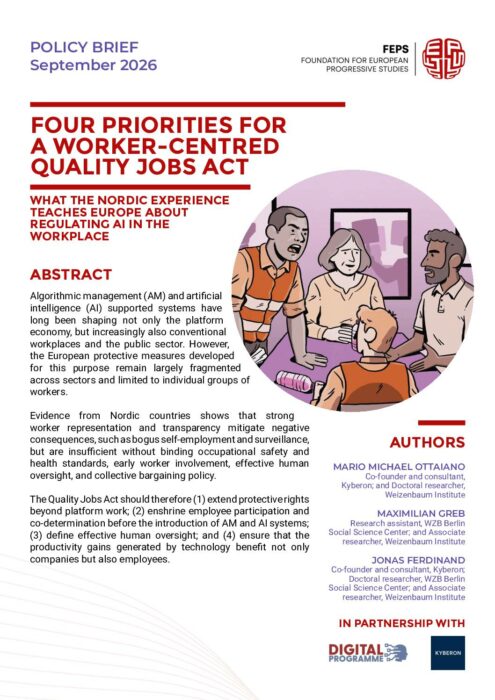
Four priorities for a worker-centred Quality Jobs Act

What the Nordic experience teaches Europe about regulating AI in the workplace
28/08/2026

How can Europe’s missing middle be financed

Translating Chinese lessons for scaling industrial innovation
14/08/2026

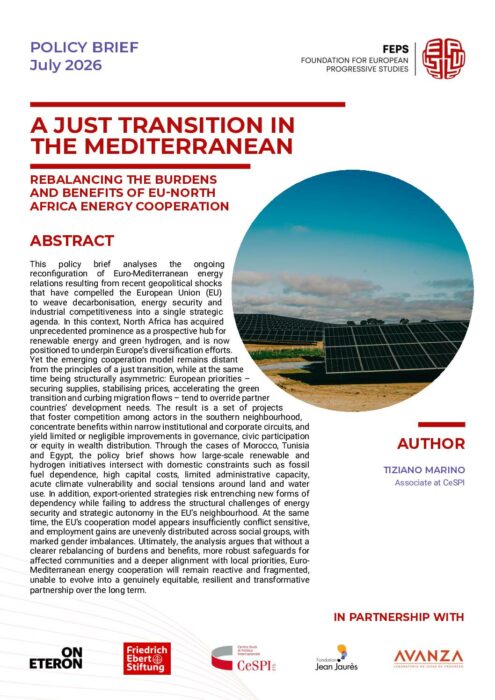
A just transition in the Mediterranean

Rebalancing the burdens and benefits of EU-North Africa energy cooperation
Find all related Progressive Post
Progressive Post
08/10/2026

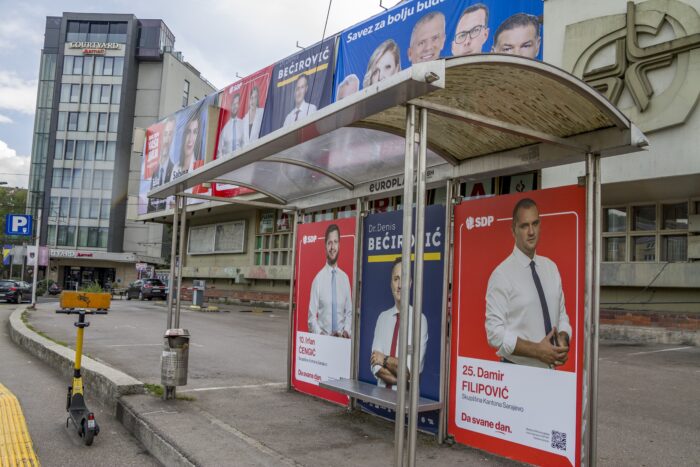
The vote is harder to steal, but politics remains hard to change

Bosnia and Herzegovina's 2026 elections
08/10/2026

The missing engine of Europe’s renewal

Extending democracy to the workplace
Find all related news
News
16/09/2026

FEPS Reacts: State of the European Union 2026

The 2026 State of the Union felt more like ‘von der Leyen I’ than ‘von […]
23/07/2026

FEPS Reacts: European Commission communication on the Action Plan on the European Pillar of Social Rights

By Laszlo Andor, FEPS Secretary-General & François Balate, Policy Analyst on Social The communication on the […]
08/07/2026

Letter to Manfred Weber, Chair of the EPP Group, by FEPS President Nicolas Schmit 

Dear Mr Weber, You are European, but also German. One should be entitled to expect […]
23/06/2026

FEPS Reacts: 10 years after Brexit

Written by FEPS Secretary-General László Andor 🔸 Brexit has been a case study in national self-harm. The […]
Find all related in the media
In the media

La Regina, il problema dei divari territoriali è una questione europea

by Regione Basilicata 22/09/2026
“La Regina: territorial disparities are a European issue” News article published by ANSA (IT), featuring Raffaele La Regina, participant in the FEPS Young Academics Network, discussing territorial and social inequalities across Europe, the need to reconcile competitiveness and cohesion, and the role of European cohesion policy, industrial policy and investment in ensuring that no region is left behind.

Канадскиот гамбит на Фон дер Лајен

by Racin.mk 21/09/2026
“Von der Leyen’s Canadian gambit” Opinion article by László Andor, FEPS Secretary General, published in Racin.mk (MK), analysing the EU’s growing rapprochement with Canada, the shift from geopolitics towards geoeconomics, and the need for Europe to reduce its dependence on the US while strengthening multilateralism. Andor also examines the Commission’s economic and social priorities, highlighting the need for stronger attention to living costs, labour and social policy.

Biztonságpolitika? Az a NATO dolga – EU-s biztosok értékelték Ursula von der Leyen beszédét

by Telex 21/09/2026
“Security policy? That’s NATO’s job – former EU Commissioners assess Ursula von der Leyen’s speech”. Article published in Telex (HU), featuring László Andor, FEPS Secretary General, analysing Ursula von der Leyen’s State of the Union address and discussing Europe’s economic competitiveness, investment gap, strategic vulnerabilities, AI, migration and the EU’s changing geopolitical position.

EU’s new cross‑border work rules favour recruitment, not workers, say critics

by EUObserver 16/09/2026
FEPS Policy Analyst on Social François Balate discusses the latest EU Labour Mobility Package under Commissioner Roxana Mînzatu zatu for the EUObserver.