Africa Day 2016

On November 5th 2016, the Foundation Max van der Stoel (FMS) and the Foundation for […]

11/01/2017

On November 5th 2016, the Foundation Max van der Stoel (FMS) and the Foundation for European Progressive Studies (FEPS) organised the yearly Africaday (Afrikadag in Dutch), that is, the biggest event in the Netherlands on Africa and international cooperation. This year, Africaday’s general theme was the relations between Europe and Africa, and the conference’s keynote speaker was Ashish J. Thakkar, founder and CEO of the Mara Group: a multi-sector investment group that is active across 25 African countries.

The primary objective of Africaday 2016 was to increase public support for international cooperation: without broad public support you cannot have political support, while this is needed to achieve real change with regard to international cooperation. Africaday always manages to reach a relatively young, large and diverse audience. This year we had over 1,000 visitors, 300 speakers and organisers and some 100 volunteers present at Africaday. The average age of the visitors was 41 years old. Due to extensive (social) media outreach, we were able to reach even more people than those 1,400. With Africaday, the FMS and FEPS tried to create a positive and realistic image of Dutch and European efforts in the field of international cooperation and Africa.

During the conference, we had a total of 40 workshops, debates, lectures, interviews etc. including an extensive cultural programme. What is more, an information market was also organised, with more than 25 organisations present.

Read the activity report

Find all related publications
Publications
29/01/2026

Progressive Yearbook 2026

In an eerie manner, 2025 resembled the ‘time of monsters’, which, according to the great […]
15/01/2026

Financing enlargement via the 2028-2034 MFF

This brief intends to explain how the European Commission’s proposal for the 2028-2034 Multiannual Financial […]
19/12/2025

Moving beyond neoliberalism in EU trade policy

European Union trade policy finds itself at a crossroads. After three decades of neoliberal dominance in the […]
15/12/2025

The great unravelling

“The great unravelling” examines the challenges that the new era of globalisation poses for progressive […]
Find all related news
News
29/01/2026

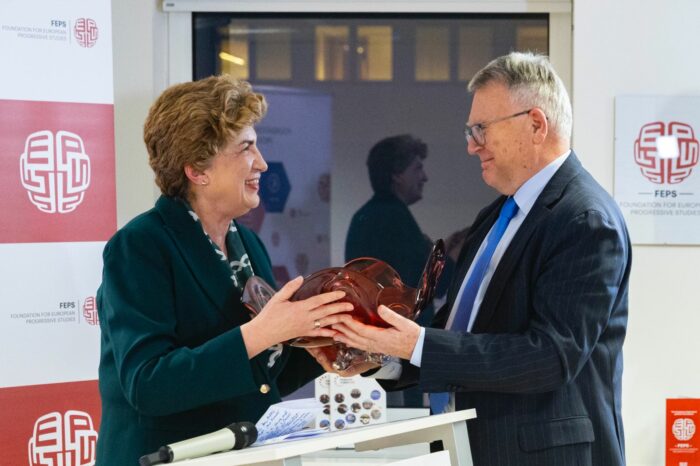
Maria João Rodrigues departs from FEPS Presidency, transitions to Nicolas Schmit

After completing eight years in the role, Maria Joâo Rodrigues has departed the role of […]
29/01/2026

Marianna Mazzucato awarded FEPS ‘Progressive Person of the Year’

FEPS Progressive Person of the Year 2025-2026
21/01/2026

Call for tender – HR consulting services

Applications to be submitted before 18 February
06/01/2026

Venezuela is not about drugs: Trump’s Regional Expansionism and Europe’s Test

FEPS Commentary on US military intervention in Venezuela
Find all related in the media
In the media

Can the EU ever become a superpower?

by Euronews 20/02/2026
In this episode of the podcast Brussels, My Love, FEPS President Nicolas Schmit discusses the informal meeting of the Antwerp European Industrial Summit and the Munich Security Council.

España los forma, Europa los contrata: así es el mapa de la nueva fuga de cerebros

by El Confidencial 10/02/2026
Spain trains them, Europe hires them: the map of the new brain drain: László Andor, FEPS Secretary-General, discusses the 'brain drain' as a result of the EU’s single market and highlights the need for a fairer mobility and retention strategy across the EU.

Von der Leyen’s management style ‘not good for Europe,’ says ex-commissioner

by POLITICO 02/02/2026
In this article published by POLITICO, FEPS New President Nicolas Schmit raises concerns about the Commission’s long-term vision and strategic planning, while noting its limited response to U.S. sanctions against Thierry Breton.

‘Regreso al futuro. El gran reseteo’ by Lina Gálvez

by Tinta Libre 02/02/2026
“Back to the Future: The Great Reset” Opinion article by FEPS Vice-President, Lina Gálvez reflecting on the current global crisis marked by rising authoritarianism, digital power and extreme inequality, and tracing its roots through a historical analysis of capitalism — from the post-1945 social and geopolitical settlement led by social democratic forces, through neoliberal financialisation, to what she describes as a new phase of fascist capitalism.