Resisting state propaganda in the new information environment: The case of the EU, Russia and the Eastern Partnership countries

The Foundation for European Progressive Studies (FEPS) in cooperation with our Latvian partner Brīvības un solidaritātes fonds (BSF) organised […]

01/02/2017

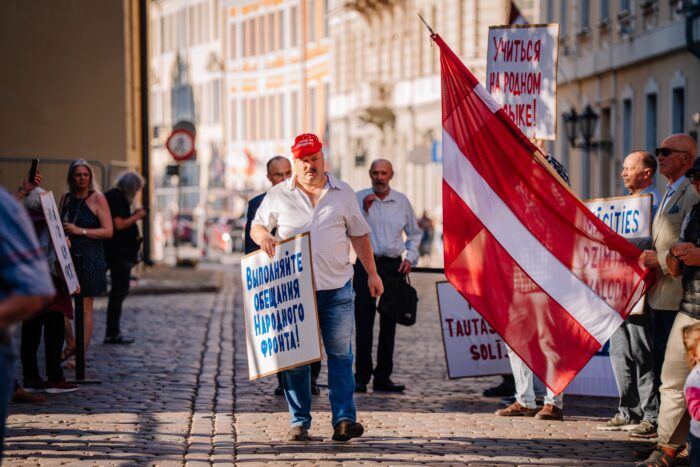
The Foundation for European Progressive Studies (FEPS) in cooperation with our Latvian partner Brīvības un solidaritātes fonds (BSF) organised a launch event of the book ‘Resisting state propaganda in the new information environment: The case of the EU, Russia and the Eastern Partnership countries’. 

The event took place at 10am on Friday, September 16th, at the Latvian University Library in Riga. It featured the participation of media industry experts and some of the publication’s co-authors, including Roberts Putnis, Head of Media Policy Division at the Latvian Ministry of Culture, Andris Mellakauls, Head of the Information Space Integration division at the Latvian Ministry of Culture and former chair of the Council of Europe Steering Committee on Media and Information Society, and Māris Cepurītis, Researcher at the Centre for East European Policy Studies. In a packed room, an interesting debate followed the presentations of the speakers, focusing on the various themes and strands of argumentation mentioned in the publication. 

Through a collection of important articles, this book unfolds an interesting analysis of some rapidly emerging themes in the problematique of modern propaganda. It does so by primarily looking at how the European Union (EU) and some of its member states have acted to resist foreign propaganda efforts, and in so doing, tried to protect their democratic ethos and values. To inform this discussion with additional specificity, a number of information initiatives undertaken by the Russian Federation towards the Baltic EU member states and some of the Eastern Neighbourhood states are used as an illustrative example.

By reviewing policy responses against these and similar propaganda efforts, both at EU level and within various national contexts, this book also provides an in-depth overview of the challenges and opportunities that exist in defending core democratic values from hostile propaganda campaigns in our digital age. It also touches upon the methodology and the impact that these campaigns have had, not only on promoting or demoting certain information, but also on reinforcing certain messages and imagery, and ultimately on undermining the democratic foundations and modus operandi of each the countries under examination.

Read the activity report

Network
Brivibas Freedom and Solidarity Foundation
Find all related publications
Publications
17/04/2026

The open future and its enemies

How we can protect free society from AI dictatorship
17/04/2026

EqualiZe

A new political gender divide is often said to be defining Gen Z in Europe: […]
27/03/2026

Laboratories of counter-hegemony

Orbán, Trump and the transatlantic far-right ecosystem
25/03/2026

The European Green Deal tracker

How well is your member state implementing key policies of the Green Deal? The European […]
Find all related news
News
13/04/2026

Hungary’s civic revolution

FEPS' commentary on the outcomes of the Hungarian election
05/03/2026

FFPPVC commentary on the new EU Gender Equality Strategy 2026-2030

Commentary by the Feminist Foreign Policy Progressive Voices Collective (FFPPVC)
03/03/2026

Wag the dog?

FEPS commentary on the US-Israel attack on Iran
03/03/2026

Closing ceremony of the Progressive Ukraine programme

The graduation ceremony completed the programme which was part of the Open Progressive University (OPU).
Find all related in the media
In the media

What next for Olivér Várhelyi, Orbán’s last man standing in Brussels?

by EURACTIV 14/04/2026
FEPS Secretary General László Andor discusses the potential impact of the HUngarian election result on EU Commissioner, Olivér Várhely

EU relieved to see back of Orbán but Magyar’s Hungary may still present problems

by The Guardian 14/04/2026
FEPS Secretary General László Andor comments on Hungary's future following the outcome of the 2026 general election

Bilancio UE: fondi sociali in bilico, l’Europarlamento chiede più risorse e meno flessibilità

by Il Sole 24 Ore 13/04/2026
"EU budget: social funds at risk, the European Parliament calls for more resources and less flexibility" In this article by Il Sole 24 ore, FEPS Secretary General László Andor highlights the risks that the current MFF proposal - set to be voted on by the European Parliament - could pose to the EU budget and outlines the consequences of reducing social funding.

Világháború, vagy amit akartok

by Mérce 18/03/2026
"World War, or what you will". FEPS Secretary-General László Andor escalating conflict between the USA, Israel, and Iran and the lack of 'brakes' to prevent escalation from Donald Trump and Benjamin Netanyahu.