Reforming the EU: From reflection to political action What is the Meseberg Agreement worth?

The Foundation for European Progressive Studies (FEPS) together with the Paris-based partner the Jean-Jaurès Foundation […]

21/09/2018

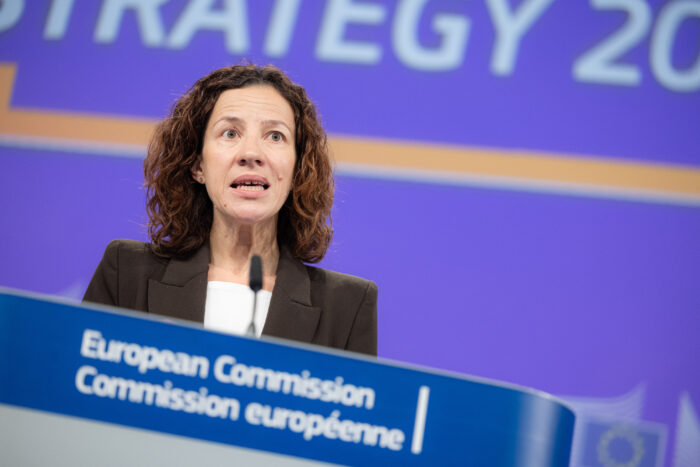
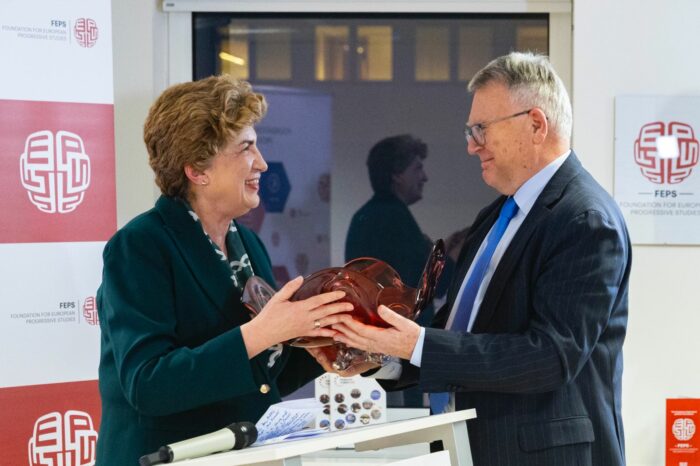
The Foundation for European Progressive Studies (FEPS) together with the Paris-based partner the Jean-Jaurès Foundation organised a lunch hour debate on the EU and Eurozone reform. The debate took place in the frame of Call to Europe, FEPS unique, interactive, signature initiative that enhances EU wide debates with its citizens. Call to Europe as a two-way dialogue between the institutions and the people looking at how we cane move to constructive political action.

This particular debate centred on the following questions: To what extent does the agreement show a preference for community over intergovernmental solutions? Is it sufficient to make progress on the Banking Union’s second pillar but not addressing the third? How to make the Euro area stable if risk-sharing is not seen as a method for risk-reduction? Does it make sense to work together for tax convergence and leave the common consolidated corporate tax base (CCCTB) out of the picture? Has the idea of a Minister for the Economy and Finance of the Euro area been abandoned? Would that be advisable to partly revise the Stability and Growth Pact?


Ernst Stetter, Secretary general of FEPS, was in charge of the opening of the conference. The keynote speech was delivered by Peter Bofinger, Chair for Monetary Policy and International Economics, University Wurzburg and member of the German Council of Economic Experts. It was followed by a debate with  Marco Buti, Director-General for Economic and Financial Affairs at the European Commission,  Michael Vincent, expert on financial regulation, who teaches at Sorbonne University and Gesine Schwan, President of the HUMBOLDT-VIADRINA Governance Platform, commented on EMU reform from a different angle.

Read the activity report

Network
Fondation Jean-Jaurès
Find all related publications
Publications
19/12/2025

Moving beyond neoliberalism in EU trade policy

European Union trade policy finds itself at a crossroads. After three decades of neoliberal dominance in the […]
15/12/2025

The great unravelling

“The great unravelling” examines the challenges that the new era of globalisation poses for progressive […]
09/12/2025

Tackling the housing crisis in Europe

Progressive ideas for affordable and sustainable housing policies
28/11/2025

Smarter spending today, safer societies tomorrow

Digitally-enabled capabilities for European defence
Find all related news
News
06/01/2026

Venezuela is not about drugs: Trump’s Regional Expansionism and Europe’s Test

FEPS Commentary on US military intervention in Venezuela
16/12/2025

FEPS commentary on the EU Affordable Housing Plan

The announcement of the EU Affordable Housing Plan by Commissioner Dan Jørgensen is a historic milestone […]
15/12/2025

FEPS President Maria João Rodrigues at Digital UNGA in New York

From 15 to 17 December, the Digital UNGA took place in New York, bringing together […]
12/12/2025

FEPS elects Nicolas Schmit as new President

After eight years in the role, outgoing President Maria João Rodrigues requested to be replaced, considering her mission accomplished. 
Find all related in the media
In the media

Liberal democracy’s social, societal fabric under threat – Live from the EPC Annual Conference 2025

by EPC 08/12/2025
In a podcast by the European Policy Centre (EPC), FEPS Secretary General, László Andor, discusses how liberal democracy in Europe is being challenged not only at the institutional level but also through the erosion of social rights and what Europe must do to defend its social foundations.

« La souveraineté numérique européenne est un défi d’ordre civilisationnel »

by Le Monde 15/11/2025
"European digital sovereignty is a challenge for civilisation as a whole". In an opinion piece in the newspaper Le Monde, FEPS President Maria João Rodrigues shares her concerns about European digital dependence on American and Asian giants

When Algorithms Undermine Democracy: Europe’s Wake-Up Call

by Social Europe 11/11/2025
Maja Fjaestad and Simon Vinge, co-editors of FEPS book "Algorithmic rule", wrote this op-ed on the power of algorithms and how they threaten the foundations of democratic oversight

Los mapas de las fronteras internas que alimentan el voto ultra en Europa

by El Confidencial 13/10/2025
"The internal border maps that fuel the far-right vote in Europe" - FEPS Secretary-General László Andor discusses the impact of cohesion policies on social inequalities and the rise of the far-right across Europe in this El Confidencial article.