FEPS Weekly Newsletter 23 Sept 2022

FEPS Weekly Newsletter Share Tweet Share Share Preview 📅 Recovery Watch, migration, energy, climate, gender, […]

23/09/2022
FEPS Weekly Newsletter
Preview
📅 Recovery Watch, migration, energy, climate, gender, future of Europe and more…
 ‌ ‌ ‌ ‌ ‌ ‌ ‌ ‌ ‌ ‌ ‌ ‌ ‌ ‌ ‌ ‌ ‌ ‌ ‌ ‌ ‌ ‌ ‌ ‌ ‌ ‌ ‌ ‌ ‌ ‌ ‌ ‌ ‌ ‌ ‌ ‌ ‌ ‌ ‌ ‌ ‌ ‌ ‌ ‌ ‌ ‌ ‌ ‌ ‌ ‌ ‌ ‌ ‌ ‌ ‌ ‌ ‌ ‌ ‌ ‌ ‌ ‌ ‌ ‌ ‌ ‌ ‌ ‌ ‌ ‌ ‌ ‌ ‌ ‌ ‌ ‌ ‌ ‌ ‌ ‌ ‌ ‌ ‌ ‌ ‌ ‌ ‌ ‌ ‌ ‌ ‌ ‌ ‌ ‌ ‌ ‌ ‌ ‌ ‌ ‌ ‌ ‌ ‌ ‌ ‌ ‌ ‌ ‌ ‌ ‌ ‌ ‌ ‌ ‌ ‌ ‌ ‌ ‌ ‌ ‌ ‌ ‌ ‌ ‌ ‌ ‌
Upcoming Events
Events
Recovery Watch
29 September, FEPS Headquarters, Brussels

Take part in the first Recovery Watch annual gathering!

What are the lessons to be learned from the national recovery plans? Will the NRRPs be able to drive us towards a more socially and environmentally sustainable society?

Among the speakers: Mariana Vieira da Silva, Portuguese Minister of the Presidency; Thomas Dermine, Belgian State Secretary for Economic Recovery and Strategic Investment; Mario Nava, Director-General at EC DG REFORM; Fabrizio Barca, Coordinator of the Forum Disuguaglianze e Diversità and former Italian Minister of Territorial Cohesion.

👁️About the Recovery Watch research project: FEPS, Friedrich Ebert Stiftung (FES) and the Institut Emile Vandervelde (IEV), in collaboration with several first-rate research organisations, have built a structured network of experts to monitor the implementation of NRRPs and assess their impact on key social outcomes.
Disinformation on migration after the invasion of Ukraine
28 September, EPC Headquarters, Brussels

In this hybrid event we will discuss the actions needed to build up societal resilience against disinformation and promote a more balanced and informed public discourse on migration.

Drawing on two studies by FEPS, the European Policy Center and the Friedrich-Ebert-Stiftung (
2020 study and 2021 study), it will also offer an opportunity to reflect on existing and future challenges, particularly in relation to the displacement of millions of Ukrainians in Europe.

Disinformation distorts perceptions and shapes political discourse. It taps into people’s worries, amplifying them. Manipulated statistics, out-of-context information, and false claims about migrants and refugees are particularly pervasive. Disinformation narratives frame them as a fundamental threat to Europeans’ health, wealth and identity. Join us to find out what we can do to fight disinformation.
Geopolitics of energy & the green transition
27 September, FEPS Headquarters, Brussels

The disruption of the flow of hydrocarbons from Russia has put Europe in a situation where the continent is faced with the double challenge of maintaining energy security while also living up to its commitments to address the climate crisis. The – sometimes novel and unorthodox – measures and policies that are being adopted in this context are likely to have long-term repercussions that are not limited to the energy field.

To better understand the connection between short-term crisis responses and long-term implications across various policy domains, this FEPS experts’ roundtable is adopting a foresight approach.
The path towards a socially just Fit for 55 package
27 September, FEPS Headquarters, Brussels

To map out how the inclusion of social issues into European climate policy has taken place in the European Parliament, this “Experts Meet Policymakers Exchange” aims to foster a dialogue between members of different political groups, researchers and policy experts.

MEPs will reflect on which social issues they regard as most important, and how they have translated their ideas into concrete policy proposals in the four legislative files that are addressed in the ongoing CISL-FEPS research project.
PAST EVENT

Participants addressed how the COVID-19 crisis has had a magnifying glass effect on gender imbalances in the labour market. They also discussed the favourable opportunities arising from recent policy developments offering progressive answers to old forms of inequalities (gender pay gaps, labour market gender segregation, career differences) as well as new ones (underemployment or part-time work).


This event was part of the FEPS Employment Breakfast Series:

Groceries at your doorstep in less than 20 minutes. That’s the promise of a relatively new segment of the platform economy. But little is known about the business models behind this promise, the working conditions and labour organising. In this session at the Hans-Boeckler-Stiftung‘s annual LABOR.A Conference, we shared and discussed early insights from the research being carried out by FEPS and UNI Europa.

During the UNGA 77 week in New York, FEPS is expanding its global partnership. Among others, FEPS President Maria João Rodrigues and Senior Fellow Jo Leinen met with Richard Ponzio, Director of Global Governance, Justice and Security Program at the Stimson Center, to discuss the global governance architecture.

In a UNGA side event organised by the Stimson Center and the Global People Assembly, FEPS President participated in the discussion to introduce the Global Future Forum as a key civil society event in 2023 and to launch a collective drafting process to strengthen global governance structures in order to deliver on the 2030 Agenda.

FEPS President also met Dr Michael Broening, Executive Director of FES New York, to discuss how to bring truly progressive perspectives into the discussions around the New Global Deal. FEPS Vice-President Uwe Optenhoegel joined the discussion online.

Following the EU care strategy presentation, FEPS, FES and CEPS co-hosted an experts meeting to discuss the ambition of the European Commission and critically assess this new initiative.

This week, FEPS hosted the participants of the Managing Global Governance Academy for an enriching discussion on the EU’s path to the digital decade and on the global governance for a digital future. The participants were professionals working in governmental organisations, policy-oriented think tanks, research institutions, civil society, and private sector organisations based in Brazil, China, Europe, India, Indonesia, Mexico, and South Africa.
Last week, in her yearly State of the Union address, Commission President Ursula von der Leyen appealed to the ‘spirit of Maastricht’ to overcome the challenges the European Union is currently facing.

30 years after the treaty that turned the Communities into a Union, however, the EU remains a largely incomplete project. And the rules that were forged 30 years ago have hindered the process of building the ‘ever closer union’ that the authors of those rules were dreaming of, rather than paving the way to it.
Read More
PROGRESSIVE PAGE
Warfare and the State of our Union
by Maria João Rodrigues

In her recent speech about the State of the Union, President Von der Leyen was right to focus on the challenges raised by the war in Ukraine, but she was short on a long-term vision, and on a plan to cope with its real nature. Read More
EUROPEAN PROGRESSIVE OBSERVATORY
The far-right Sweden
by Anders Lindberg

In the elections in Sweden, the coalition led by Magdalena Andersson and the Social Democrats lost two seats in parliament, from 175 to 173, and thereby lost the majority to a conservative coalition under Ulf Kristersson. It was no landslide, and the new government will, like the previous one, most likely be a complete parliamentary mess. But this is our new normal. Read More
#124 FEPS Talks Podcast
Reasons for hope: the plans and prospects for the Australian Labor Party

🎙️Professor Rob Manwaring, Flinders University in Adelaide, and Dr Ania Skrzypek, FEPS Director for Research and Training, connect to discuss the recent unprecedented victory of Anthony Albanese Australian Labor Party and the inspiration that it may provide for sister parties across the globe.

On 21 May 2022, Australian Labor Party, led by Anthony Albanese, noted an unprecedented victory, forming then a government and preventing the 4th term of the Liberal Party. What led to that success? What is on the agenda? Which challenges does ALP share with the other sister parties across the globe?

🎧 Listen to this podcast on Spotify | Apple Podcast | Website
Website
Facebook
Twitter
Youtube
Instagram


Copyright © 2022 FEPS Europe, All rights reserved.
You are receiving this email because you participated in one of FEPS’ events and/or have registered for FEPS’ newsletter.
If you wish not to receive FEPS’ communications anymore, please click here: unsubscribe now


Email Marketing by ActiveCampaign
Find all related Progressive Post
Progressive Post
10/11/2026

A blue wave that might crush soon

Americans have elected a new Congress: going into 2027, both chambers will be under Democratic […]
05/11/2026

If you want peace, prepare for equality

I have always been struck by how little attention we pay to patriarchal culture when […]
05/11/2026

The Women, Peace and Security agenda amid shifting geopolitics

While the current conflictual and geopolitical environment makes the Women, Peace and Security agenda ever […]
Find all related Magazine
Magazine
  • cover book

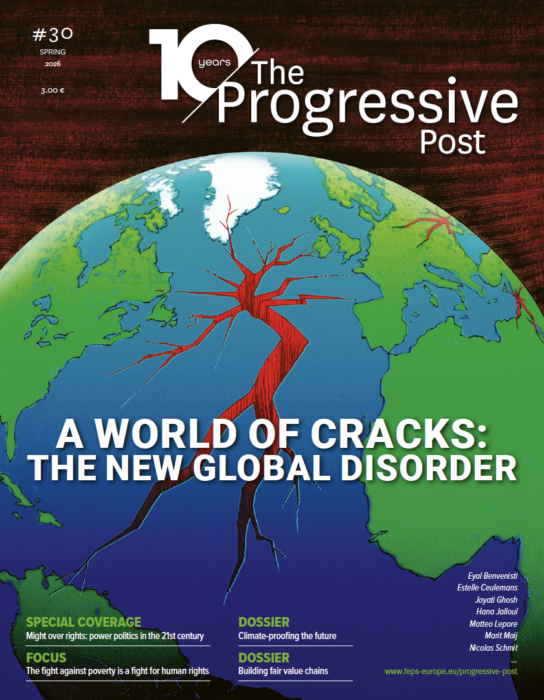
    Issue #30 Progressive Post

Issue #30

A world of cracks: the new global disorder
  • cover book

    Issue #29 Progressive Post

Issue #29

Does peace still have a chance?
Find all related publications
Publications
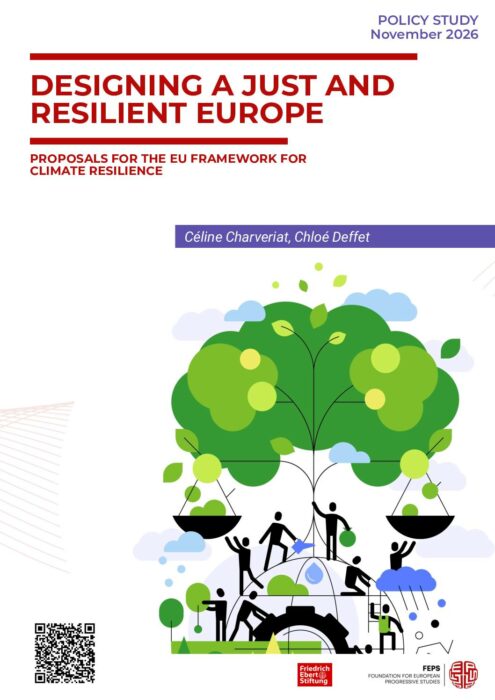
16/11/2026

Designing a just and resilient Europe

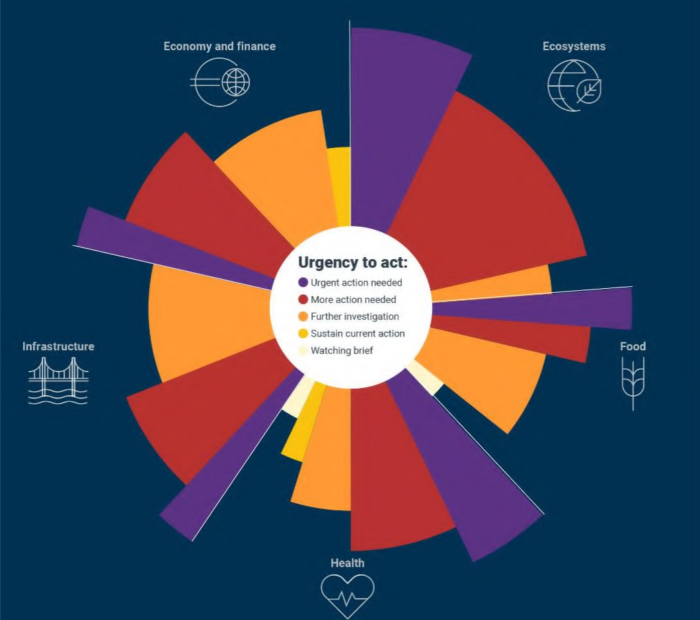
Proposals for the EU Framework for Climate Resilience
09/11/2026

The far right, reactionary platformisation and progressive responses

The far right is thriving on social media, and this is no accident. This policy […]
04/11/2026

Education in times of AI and Big EdTech

Why we need a public-led, democratic and community-centred EdTech stack
04/11/2026

AI, automation, and public authority

Beyond the hype of algorithmic decision-making in the Nordic Welfare State
Find all related news
News
30/10/2026

FEPS Reacts: The new EU Framework for Climate Resilience

Necessary foundations but little action
23/10/2026

Notice of vacancy – Policy Analyst on Gender Equality

Apply before 23 November 2026
16/09/2026

FEPS Reacts: State of the European Union 2026

The 2026 State of the Union felt more like ‘von der Leyen I’ than ‘von […]
23/07/2026

FEPS Reacts: European Commission communication on the Action Plan on the European Pillar of Social Rights

By Laszlo Andor, FEPS Secretary-General & François Balate, Policy Analyst on Social The communication on the […]
Find all related in the media
In the media

Bharat Summit: Accountability key to restoring public trust in democracy

by UNI India 14/11/2026
Read UNI India’s article on the Bharat Summit, where Christian Salm, FEPS Head of Democracy and Participation Programmes, joined a political panel on democratic accountability and political reform.

Perustuslaki halutaan avata, jotta tekoälyä voidaan käyttää vielä enemmän – Ei, sanoo vasemmiston Honkasalo

by Helsingin Sanomat 06/11/2026
“The Constitution could be reopened to allow greater use of AI – No, says Left Alliance MP Honkasalo” News article by Veera Paananen published in Helsingin Sanomat (FI), referring to the FEPS and Demos Helsinki policy study on AI, automation and public authority in Nordic welfare states. The article draws on the study's findings to highlight the risks of delegating decision-making to AI in public services, including the loss of human judgement and accountability, and features Finnish MP Veronika Honkasalo's opposition to expanding AI-driven decision-making in the public sector.

Tekoäly ei ole oikotie säästöihin – julkisella sektorilla vastuuta ei voi ulkoistaa

by Demokraatti 04/11/2026
AI is no shortcut to savings – responsibility cannot be outsourced in the public sector” News article published in Demokraatti (FI), highlighting the FEPS and Demos Helsinki policy study, as part of the FEPS–Nordic Digital Programme. The article draws on the study’s findings that AI and automation do not automatically generate savings or productivity gains in the public sector, emphasising the need for long-term investment, human oversight and accountability in public administration

Frågan om jämställdhet splittrar unga svenskar

by dagens arena 29/10/2026
"The issue of gender equality divides young Swedes" - FEPS Policy Analyst on Democracy Matteo Dressler discusses the findings of the EqualiZe policy study in the Swedish context.