Climate and gender policy

'Climate mainstreaming: breaking down the silos' series

Policy Brief

10/02/2023

Climate change is a systemic issue that cannot be addressed by siloed thinking and policymaking. The transition to a political, social and economic model needs a holistic understanding to address the planetary emergencies and to implement the commitments of the EU Climate Law. By holistic, we mean a theoretical ground aware of interdependencies between different policy fields.

Transforming societies and economies while respecting sustainability principles means mainstreaming environmental concerns whenever we design policies for all other areas. At the same time, like the effects of climate change, also environmental policies can affect different areas, such as gender and health.

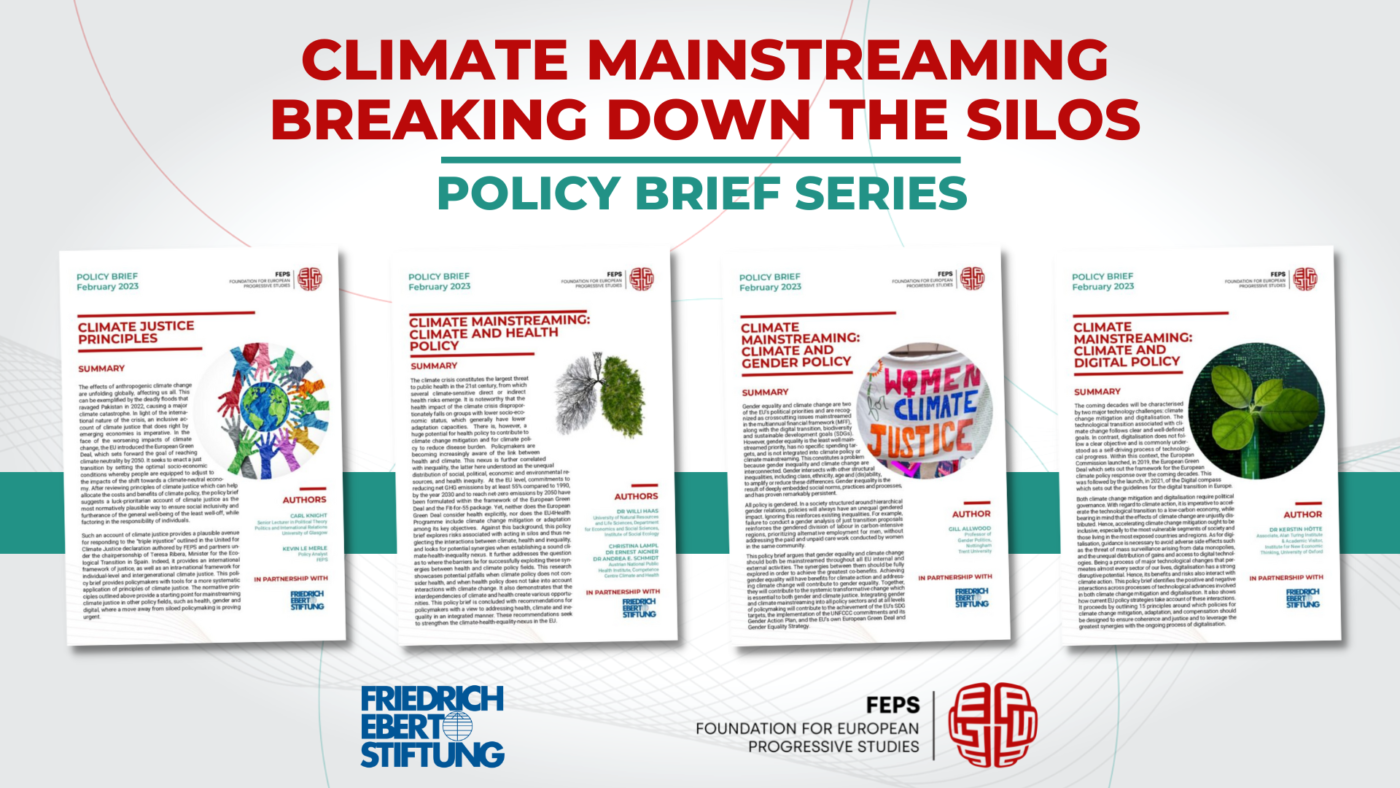
The ‘Climate mainstreaming: Breaking down the silos’ series comprises four policy briefs that foreground and disentangle these interlinkages by connecting climate matters with different disciplinary backgrounds (justice, gender, digital and health).

The objective is to influence and assist progressive policymakers and stakeholders who want to adopt holistic, comprehensive and environmentally sustainable policies that can remedy rather than exacerbate existing inequalities. 

Gender policy

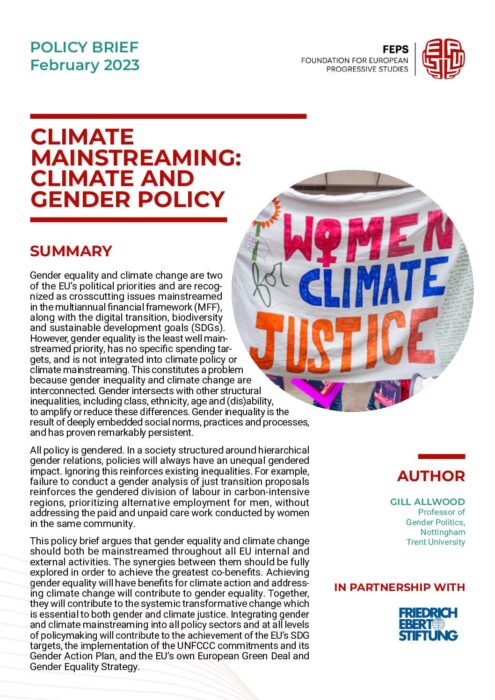
All policy is gendered, and gender inequality and climate change are interconnected. In a society structured around hierarchical gender relations, policies will always have an unequal gendered impact. Ignoring this reinforces existing inequalities.

For example, failure to conduct a gender analysis of just transition proposals reinforces the gendered division of labour in carbon-intensive regions, prioritizing alternative employment for men without addressing the paid and unpaid care work conducted by women in the same community.

This policy brief argues that gender equality and climate change should both be mainstreamed throughout all EU internal and external activities. The synergies between them should be fully explored in order to achieve the greatest co-benefits. Together, they will contribute to the systemic transformative change, which is essential to both gender and climate justice.

Integrating gender and climate mainstreaming into all policy sectors and at all levels of policymaking will contribute to the achievement of the EU’s SDG targets, the implementation of the UNFCCC commitments and its Gender Action Plan, and the EU’s own European Green Deal and Gender Equality Strategy.
Network
Friedrich-Ebert-Stiftung (FES)
Related publications
10/02/2023

Climate justice principles

'Climate mainstreaming: Breaking down the silos' series
10/02/2023

Climate and health policy

'Climate mainstreaming: Breaking down the silos’ series
09/02/2023

Climate and digital policy

'Climate mainstreaming: breaking down the silos' series
Find all related publications
Publications
21/10/2026

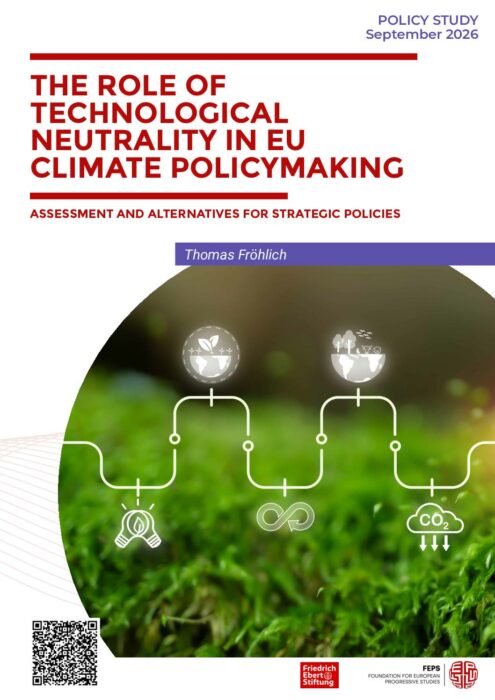
The role of technological neutrality in EU climate policymaking

Assessment and alternatives for strategic policies
06/10/2026

Taking the temperature of the EU’s clean industry strategy

Competitiveness and resilience of heat pumps
20/07/2026

A toolkit for countering climate misinformation

FEPS YAN papers 9th cycle
13/07/2026

European populism and anti-gender narratives

Links between the EU and North Macedonia
Find all related Progressive Post
Progressive Post
05/11/2026

If you want peace, prepare for equality

I have always been struck by how little attention we pay to patriarchal culture when […]
05/11/2026

The Women, Peace and Security agenda amid shifting geopolitics

While the current conflictual and geopolitical environment makes the Women, Peace and Security agenda ever […]
05/11/2026

The EU’s next WPS plan must act on tech, not just mention it

The EU is drafting its next action plan on Women, Peace and Security, and technology […]
Find all related events
Events
02 DEC 2026

Silver Rose Awards 2026

Brussels, Belgium
Find all related Audiovisual
Audiovisual
23/04/2026

‘Accelerating industrial decarbonisation’ Flickr album

Discussions on technological neutrality and on the IAA
23/04/2026

‘An enlargement for a new generation ’ better natures; is it feasible?’ Flickr album

Photo album of the ‘An enlargement for a new generation‘ event in Brussels, Belgium. The […]
17/04/2026

‘FEPS at Global Progressive Mobilisation’ Flickr album

Photo album of the ‘FEPS at Global Progressive Mobilisation‘ event in in Barcelona, Spain. The […]
25/03/2026

‘The European Green Deal tracker’ Flickr album

Photo album of ‘The European Green Deal Tracker” event at FEPS HQ. In this event, […]
Find all related news
News
30/10/2026

FEPS Reacts: The new EU Framework for Climate Resilience

Necessary foundations but little action
23/10/2026

Notice of vacancy – Policy Analyst on Gender Equality

Apply before 23 November 2026
16/09/2026

FEPS Reacts: State of the European Union 2026

The 2026 State of the Union felt more like ‘von der Leyen I’ than ‘von […]
05/03/2026

The new EU Gender Equality Strategy 2026-2030

Commentary by the Feminist Foreign Policy Progressive Voices Collective (FFPPVC)
Find all related in the media
In the media

Frågan om jämställdhet splittrar unga svenskar

by dagens arena 29/10/2026
"The issue of gender equality divides young Swedes" - FEPS Policy Analyst on Democracy Matteo Dressler discusses the findings of the EqualiZe policy study in the Swedish context.

Nedostatak brižnosti

by Vox Feminae 31/01/2025
"Lack of care" The Croatian feminist magazine Vox Feminae highlights the chapter by Annica Kronsell in FEPS book "A new Gender Equality Contract for Europe", which is dedicated to imagining a new gender contract for the climate

COP climate talks not fit for purpose and need reform, say climate leaders

by Reuters 15/11/2024
Read this Reuters article about the open letter calling for a comprehensive reform of the climate conferences, with Maria João Rodrigues, FEPS President, among the signatories