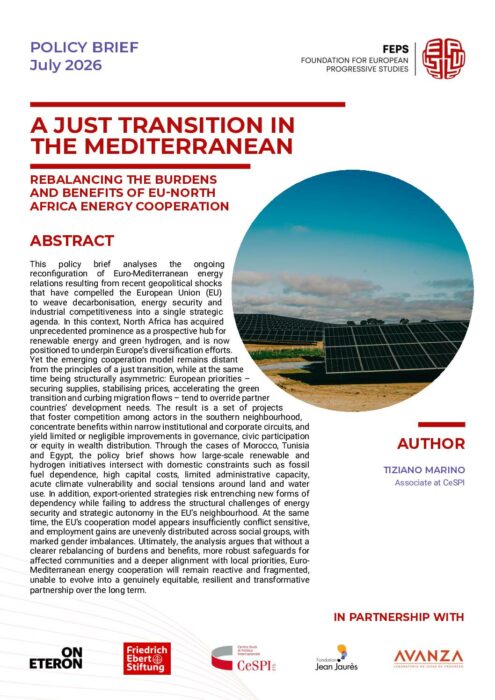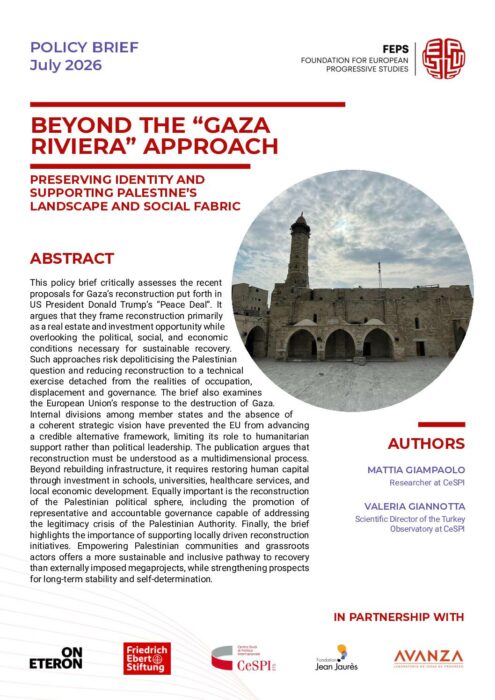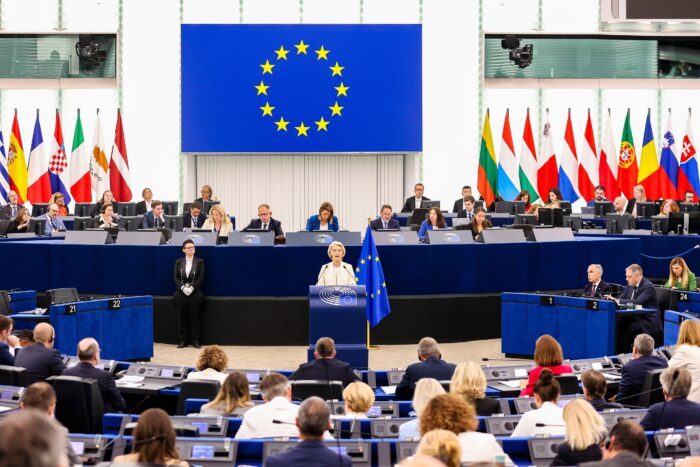
COP23 Side-events focusing on just transition

Following the important work that the Foundation for European Progressive Studies (FEPS) has conducted on the issue […]

15/12/2017

Following the important work that the Foundation for European Progressive Studies (FEPS) has conducted on the issue of a just transition, and within the framework of our partnership with Fondation Jean Jaurès and the the Transnational Law Institute, within the Dickson Poon School of Law, King’s College London, FEPS organized two side events during the COP23 Summit in Bonn, Germany. 

A concept of Climate Justice frames global climate change as a political and ethical issue, not strictly an environmental one. It recognizes that the poorest, most vulnerable people regularly suffer the greatest impacts of climate change even though they produce the least emissions that drive it. This concept could be applied within the EU to meet the Paris Agreement, by means of a just transition to a low-carbon economy.

These two side-events focused on different aspects of this important concept. 

The first side-Event, which took place on November 8th, presented practical options to address climate justice in a socially equitable manner. It highlighted EU success stories and opportunities for collaboration and the sharing of good practices with other UNFCCC parties.

This second side-event, held on November 15th, examined opportunities for progress and synergy on the response measures work programme items of just transition and economic diversification, both through the improved forum on response measures and through complementary regional and national processes. 

Read the activity report

Network
Fondation Jean-Jaurès
Find all related publications
Publications
29/01/2026

Progressive Yearbook 2026

In an eerie manner, 2025 resembled the ‘time of monsters’, which, according to the great […]
15/01/2026

Financing enlargement via the 2028-2034 MFF

This brief intends to explain how the European Commission’s proposal for the 2028-2034 Multiannual Financial […]
19/12/2025

Moving beyond neoliberalism in EU trade policy

European Union trade policy finds itself at a crossroads. After three decades of neoliberal dominance in the […]
15/12/2025

The great unravelling

“The great unravelling” examines the challenges that the new era of globalisation poses for progressive […]
Find all related news
News
29/01/2026

Maria João Rodrigues departs from FEPS Presidency, transitions to Nicolas Schmit

After completing eight years in the role, Maria Joâo Rodrigues has departed the role of […]
29/01/2026

Marianna Mazzucato awarded FEPS ‘Progressive Person of the Year’

FEPS Progressive Person of the Year 2025-2026
21/01/2026

Call for tender – HR consulting services

Applications to be submitted before 18 February
06/01/2026

Venezuela is not about drugs: Trump’s Regional Expansionism and Europe’s Test

FEPS Commentary on US military intervention in Venezuela
Find all related in the media
In the media

Can the EU ever become a superpower?

by Euronews 20/02/2026
In this episode of the podcast Brussels, My Love, FEPS President Nicolas Schmit discusses the informal meeting of the Antwerp European Industrial Summit and the Munich Security Council.

España los forma, Europa los contrata: así es el mapa de la nueva fuga de cerebros

by El Confidencial 10/02/2026
Spain trains them, Europe hires them: the map of the new brain drain: László Andor, FEPS Secretary-General, discusses the 'brain drain' as a result of the EU’s single market and highlights the need for a fairer mobility and retention strategy across the EU.

Von der Leyen’s management style ‘not good for Europe,’ says ex-commissioner

by POLITICO 02/02/2026
In this article published by POLITICO, FEPS New President Nicolas Schmit raises concerns about the Commission’s long-term vision and strategic planning, while noting its limited response to U.S. sanctions against Thierry Breton.

‘Regreso al futuro. El gran reseteo’ by Lina Gálvez

by Tinta Libre 02/02/2026
“Back to the Future: The Great Reset” Opinion article by FEPS Vice-President, Lina Gálvez reflecting on the current global crisis marked by rising authoritarianism, digital power and extreme inequality, and tracing its roots through a historical analysis of capitalism — from the post-1945 social and geopolitical settlement led by social democratic forces, through neoliberal financialisation, to what she describes as a new phase of fascist capitalism.