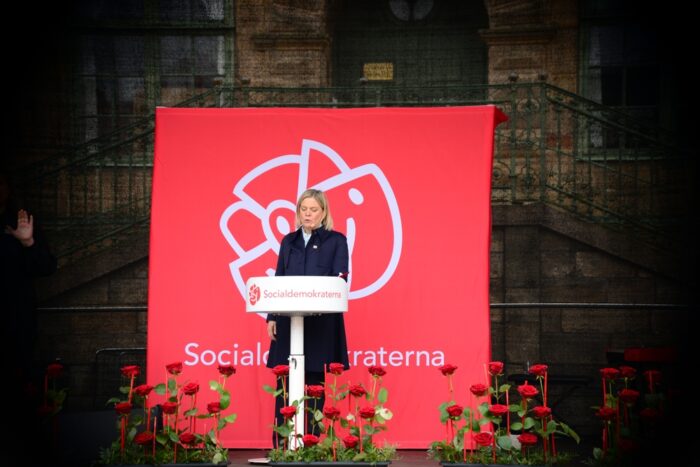
Mind the gap: bringing progressive movements and parties together

Social democratic political parties in Europe are increasingly challenged in their role as actors and […]
Speakers

01 - 02/11/2017
00:00 - 00:00
Pavilhão Carlos Lopes Parque Eduardo VII 1070-051 Lisboa, Portugal Pavilhão Carlos Lopes Parque Eduardo VII 1070-051 Lisboa, Portugal
Mind the gap: bringing progressive movements and parties together
56317
403-mind-the-gap-bringing-progressive-movements-and-parties-together
0

In order to give you access to our events, FEPS processes your personal data together with any other organiser of this event mentioned in the description of the event and in accordance with 'FEPS’ data protection policy.

Social democratic political parties in Europe are increasingly challenged in their role as actors and engines of economic and societal change. Globalisation, the rise of populism and nationalism, the increasing influence of multinationals and financial markets on the decision-making process and political fragmentation have all contributed to an image of mainstream political parties as rigid, old and unable to effectively relate to or represent the voices and interests of citizens. Moreover, the question has been put forward if politics in general still has control over increasingly intertwined global economic processes.

Social movements – often with a core of disillusioned young people – have been addressing these questions in many countries. Against this background the Foundation for European Progressive Studies and the Foundation Max van der Stoel have published the manual that will be presented in Lisbon, within the framework of the PES Council.

The manual offers social democratic parties and party members tools to discuss different challenges within their parties and to (re)connect with social movements. The overall objective is to bridge the gap between citizens and political parties, so that social democratic parties can work with citizens to improve the world we live in. We used the examples and input that was given by more than 300 participants from 14 countries in the series of seminars and trainings in 2016-2017.

The manual can be used by trainers, by boards or personnel of political parties or by individual politicians looking for methods and exercises to learn more about social movements in their region or country.

Read the manual

Check the programme of the workshop

Network
Foundation Max van der Stoel (FMS)
Find all related publications
Publications
11/05/2026

Place-based industrial policy

Places, people and power in European industrial policy
17/04/2026

The open future and its enemies

How we can protect free society from AI dictatorship
17/04/2026

EqualiZe

Gender differences in political opinion and voting among Generation Z
27/03/2026

Laboratories of counter-hegemony

Orbán, Trump and the transatlantic far-right ecosystem
Find all related Progressive Post
Progressive Post
21/05/2026

All far from quiet on the Eastern front

The sense of Eastern discomfort that the European progressive family noted after the last European […]
13/05/2026

The race for the most impossible job in the world

Antonio Guterres’ term as UN Secretary-General (UNSG) ends on 31 December 2026. The final decision for […]
12/05/2026

The inconvenience is not ours

When the United States and Israel launched strikes on Iran on 28 February, killing the […]
Find all related Audiovisual
Audiovisual
24/04/2026

The language of EUROPEAN SOVEREIGNTY with Josep Borrell

📺🔊 Available on YouTube, Spotify & Apple Podcast In this episode of FEPS Talks, Josep […]
24/04/2026

The language of EUROPEAN SOVEREIGNTY with Josep Borrell

📺🔊 Available on YouTube, Spotify & Apple Podcast In this episode of FEPS Talks, Josep […]
23/04/2026

‘Accelerating industrial decarbonisation’ Flickr album

Discussions on technological neutrality and on the IAA
23/04/2026

‘An enlargement for a new generation ’ better natures; is it feasible?’ Flickr album

Photo album of the ‘An enlargement for a new generation‘ event in Brussels, Belgium. The […]
Find all related news
News
13/04/2026

Hungary’s civic revolution

FEPS' commentary on the outcomes of the Hungarian election
05/03/2026

The new EU Gender Equality Strategy 2026-2030

Commentary by the Feminist Foreign Policy Progressive Voices Collective (FFPPVC)
03/03/2026

Wag the dog?

FEPS commentary on the US-Israel attack on Iran
03/03/2026

Closing ceremony of the Progressive Ukraine programme

The graduation ceremony completed the programme which was part of the Open Progressive University (OPU).
Find all related in the media
In the media

Јавање на огнениот коњ

by Racin 19/05/2026
"Riding the Fiery Horse" Read the analysis by László Andor, FEPS Secretary General, on the implications of Donald Trump’s visit to China.

Ue, la competitività non è nulla senza i diritti sociali

by La Repubblica 06/05/2026
"In the EU, competitiveness is nothing without social rights" In this article published in La Repubblica, former European Commissioners Nicolas Schmit (FEPS President), László Andor (FEPS SecGen) and Anna Diamantopoúlou (part of FEPS' Bureau) remind European leaders that deregulation will only make Europe poorer and that only social sovereignty will make it stronger.

A competitividade não é nada sem direitos sociais

by Publico 06/05/2026
"Competitiveness is nothing without social rights." Writing for Público, former European Commissioners Nicolas Schmit (FEPS President), László Andor (FEPS SecGen), and Anna Diamantopoúlou (FEPS Bureau) argue that competitiveness is hollow without social rights. They caution European leaders that a path of deregulation will only lead to widespread poverty, asserting instead that "social sovereignty" is the true key to a stronger Europe.

Andor László: Átváltozó Európa

by Portfolio 06/05/2026
"László Andor: Europe in Transformation" In this article published in Portfolio, former European Commissioners Nicolas Schmit (FEPS President), László Andor (FEPS SecGen) and Anna Diamantopoúlou (part of FEPS' Bureau) remind European leaders that deregulation will only make Europe poorer. They argue that as the continent faces a "stalled" German economy and shifting global dynamics, only social sovereignty and a renewed social contract can truly make the Union stronger.