Climate and Clash in the UN General Assembly

By Maria Joao Rodrigues, FEPS President A clash of visions took place in the last […]

03/10/2019

By Maria Joao Rodrigues, FEPS President

A clash of visions took place in the last General Assembly of the United Nations in New York. Not a clash between patriots and globalists, as Trump declared during his 35-minute speech in front of a tense and silent audience of world leaders. But a clash between nationalists and those who push for more international cooperation to tackle so many global challenges: peace, democracy, poverty, migration, trade, digital revolution, sustainable development and climate change.

The impacts of the neo-liberal agenda of unfettered capitalism are of course still in full operation, but there are two different ways to respond to this destructive agenda. One way is selfish, self-centred and illusionary. The other is progressive, updating regulation, cooperation and the distribution of resources to build a fairer global order.

The nationalist club was well represented at this Summit by Trump, Bolsonaro and Johnson. Trump was also extremely clear in his purpose to challenge the European Union by actively supporting Brexit. The irony is that all these leaders are now under heavy charges of not respecting their own people: Trump being threatened with impeachment by the American Congress, Bolsonaro under heavy charges for burning the Amazon rainforest, and Johnson for confronting the British Parliament.

On the other side, in support of the efforts of UN Secretary-General Antonio Guterres, there were progressive leaders such as Pedro Sanchez, Stefan Loven and Mette Frederiksen. This was particularly clear in the Climate Summit of 23 September, opened by a dramatic criticism presented by Greta Thunberg speaking on behalf of the hundreds of thousands who had taken to the streets all over the world three days earlier.

This was the day FEPS held a preparatory conference in New York to launch the recommendations of the recently created Steering Committee for Climate Justice. The event included the participation of inspiring speakers from the world of politics, academia and civil society, such as former Irish President Mary Robinson and the Ministers for Climate from Spain, Denmark, Finland and Kenya.

Teresa Ribera, Spanish Minister for Ecological Transition and chair of FEPS Steering Committee on Climate Justice, presented key guiding proposals for a progressive agenda to tackle the climate crisis, and brought them to the UN Summit. These proposals can be summarised in the following building blocks:

A just transition: the Green New Deal is not only a matter of addressing the ecological transformation, it is about reaching a Global Social-Ecological Contract providing plans for a just transition across the globe in the framework of SDGs.

Environmental rights: the intrinsic value of nature must be respected, and environmental rights included in available charters of human rights.

Climate-proof global investment, finance and trade: climate justice cannot be achieved without shifting the entire financial and tax system towards the promotion of sustainable development.

Inclusive governance: to attain these objectives, we must strive for inclusive governance giving voice to those who might pay the highest price, starting with the youngest.

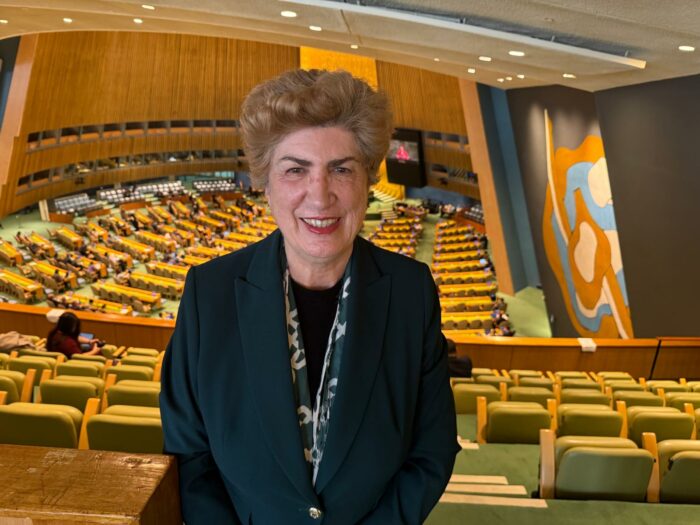
These were the concerns I also brought to the UN Climate Summit on behalf of FEPS, which now counts on UN Economic and Social Council (ECOSOC) observer status. Despite the global attention given to climate issues, and despite the noise made by the vocal youth movement, one point that was very evident from this Summit was that there is still a long way to go to convince those who are still in denial, those who just do the bare minimum to be kept in the picture, and those who speak about climate action but overlook its social implications.

The dozen of coalitions launched by UN Secretary General Antonio Guterres are a good initiative to win over inertia and complacency. Nevertheless, a stronger force is needed to strike the Global Social-Ecological Contract. We need to respond to climate change with a big economic and social transformation inspired by a new concept of progress for all. This should be a role for Progressives today.

A first big test will start in Europe with the new elected European Commission delivering on its proposal of a Green New Deal. A key role will belong Frans Timmeremans as 1st Vice-President.


Maria Joao Rodrigues


Background note:

In the framework of the UN Climate Action Summit and the UN General Assembly, which took place in New York, FEPS organised an outstanding side event on Climate Justice. After months of work, Teresa Ribera, Spanish Minister for Ecological Transition and chair of the FEPS Steering Committee on Climate Justice, presented this committee’s conclusions and brought them to the UN Summit. For the first time, FEPS – recently granted the consultative status of the UN Economic and Social Council (ECOSOC) – also took part in the UN Summit, with a powerful message. Not only must we address the climate crisis, but we must do it with social justice. Not only do we need a Green New Deal, we need a New Social-Ecological Contract

More on the FEPS United for Climate Justice proposals can be found here.


Find all related publications
Publications
03/11/2025

Towards a global Pact for the Future with a stronger Social Pillar

Reflections on a bolder role of the EU ahead of the Second World Summit for Social Development
06/10/2025

Governing the global just transition from fossil fuels to clean energy

Litmus tests and proposals for COP30
26/06/2025

Strengthening and mainstreaming Just Transition goals in the EU Budget

The EU’s legally binding commitment to achieve climate neutrality by 2050 demands a far-reaching socio-economic […]
23/06/2025

Europe’s strategic role in global development

A call for ambition and reform
Find all related events
Events
Past
03/12/2025
Brussels, Belgium

Silver Rose Awards 2025

Advancing a socially just transition in the face of political challenges
08/11/2025
Santa Marta, Colombia

EU-LAC dialogue on Just Transition and trade

Despite the EU’s growing emphasis on sustainability, its trade and investment policies remain largely disconnected […]
04 - 06/11/2025
Doha, Qatar

Rethinking pre-distribution and fiscal policies to advance social justice

Solutions session during the Second World Summit for Social Development (WSSD)
Load more...
Find all related news
News
27/11/2025

Is a bad COP outcome better than no outcome at all?

FEPS Commentary on COP30
10/09/2025

Von der Leyen – walking the walk at last?

FEPS reaction to The State of the European Union 2025
26/02/2025

FEPS reaction to the European Commission’s Clean Industrial Deal

What Teresa Ribera presented today is an ambitious plan that makes the case for Europe […]
15/11/2024

Ahead of G20, FEPS president at the T20 and C20 Summit 2024

FEPS President Maria João Rodrigues actively participated in the T20 and C20 Summits 2024, held […]
Find all related in the media
In the media

COP climate talks not fit for purpose and need reform, say climate leaders

by Reuters 15/11/2024
Read this Reuters article about the open letter calling for a comprehensive reform of the climate conferences, with Maria João Rodrigues, FEPS President, among the signatories

Las COP ya “no sirven” y deben ser reformadas, claman expertos en política climática

by La Vanguardia 15/11/2024
"COPs are “no longer useful” and in need of reform, say climate policy experts" Read this article of La Vanguardia about an open letter sent to Simon Stiell, Executive Secretary of the UN Framework Convention on Climate Change, calling for a comprehensive reform of the climate conferences. Maria João Rodrigues, FEPS President, is among the signatories.

Ласло Андор: Европа трябва да създаде нов модел за икономически растеж

by dir.bg 14/03/2024
'Europe must create a new model for economic growth'. Interview by Laszlo Andor, FEPS Secretary General

Цената на прехода – зелен, дигитален и демографски

by BNT 13/03/2024
'The cost of transition - green, digital and demographic' BNT Interview with László Andor about the three major transformations the world is facing.